Transcription of 1. - indiabudget.gov.in
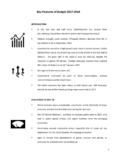
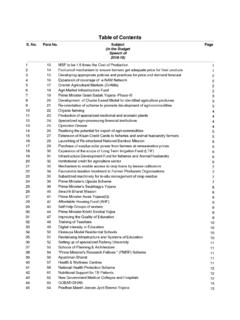
1 KEY TO BUDGET DOCUMENTSBUDGET list of Budget documents presented to the Parliament, besides the finance Minister's BudgetSpeech, is given Financial Statement (AFS) for Grants (DG) mandated under FRBM Framework Policy Strategy Term Fiscal Policy Explaining the Provisions in the finance at a BudgetThe documents shown at Serial A, B, and C are mandated by Art. 112,113, and 110(a) of the Constitutionof India respectively, while the documents at Serial No. D (i) (ii) and (iii) are presented as per the provisions ofthe Fiscal Responsibility and Budget Management Act, 2003. Other documents are in the nature of explanatorystatements supporting the mandated documents with narrative in a user-friendly format suited for quick orcontextual references.
2 Hindi version of all these documents is also presented to the Parliament. A web versionis hosted at http:// , with hyperlinks, intended to make more efficient and user-friendly accessto all In addition to the above, the Department of Expenditure in the Ministry of finance in collaboration withNITI Aayog from the financial year 2017-18, is preparing the consolidated Outcome Budget for all Ministriesand Departments. Further individual Departments/Ministries also prepare and present to the Parliament theirDetailed Demands for Grants and their Annual Reports. The Economic Survey which highlights the economictrends in the country and facilitates a better appreciation of the mobilization of resources and their allocationin the Budget is brought out by the Economic Division of the Department of Economic Affairs, Ministry ofFinance.
3 The Economic Survey is presented to the Parliament ahead of the Union Budget. The web versionsof these documents are normally posted by the respective Ministries/Departments on their web A brief description of the Budget documents listed in para 1 is given Annual Financial Statement (AFS)The Annual Financial Statement (AFS), the document as provided under Article 112, shows the estimatedreceipts and expenditure of the Government of India for 2018-19 in relation to estimates for 2017-18 as alsoactual expenditure for the year 2016-17. The receipts and disbursements are shown under three parts in910which Government Accounts are kept viz.
4 ,(i) The Consolidated Fund of India, (ii) The Contingency Fund ofIndia and (iii) The Public Account of India. The Annual Financial Statement distinguishes the expenditure onrevenue account from the expenditure on other accounts, as is mandated in the Constitution of India. TheRevenue and the Capital sections together, therefore make the Union Budget. The estimates of receipts andexpenditure included in the Annual Financial Statement are for expenditure net of refunds and recoveries. TheUnion Government finance Accounts also reflect expenditure in a similar significance of the Consolidated Fund, the Contingency Fund and the Public Account as well as thedistinguishing features of the Revenue and the Capital portions are given below briefly:(i)The Consolidated Fund of India (CFI) draws its existence from Article 266 of the Constitution.
5 Allrevenues received by the Government, loans raised by it, and also receipts from recoveries of loansgranted by it, together form the Consolidated Fund of India. All expenditure of the Government isincurred from the Consolidated Fund of India and no amount can be drawn from the ConsolidatedFund without due authorization from the Parliament.(ii)Article 267 of the Constitution authorises the existence of a Contingency Fund of India which is animprest placed at the disposal of the President of India to facilitate meeting of urgent unforeseenexpenditure by the Government pending authorization from the Parliament. Parliamentary approvalfor such unforeseen expenditure is obtained, ex- post-facto, and an equivalent amount is drawn fromthe Consolidated Fund to recoup the Contingency Fund after such ex-post-facto approval.
6 The corpusof the Contingency Fund as authorized by Parliament presently stands at ` 500 crore.(iii)Moneys held by Government in trust are kept in the Public Account. Provident Funds, Small Savingscollections, income of Government set apart for expenditure on specific objects such as roaddevelopment, primary education, other Reserve/Special Funds etc., are examples of moneys kept inthe Public Account. Public Account funds that do not belong to the Government and have to be finallypaid back to the persons and authorities who deposited them, do not require Parliamentary authorisationfor withdrawals. The approval of the parliament is obtained when amounts are withdrawn from theConsolidated Fund and kept in the Public Account for expenditure on specific objects.
7 The actualexpenditure on the specific object is again submitted for vote of the Parliament for withdrawal fromthe Public Account for incurring expenditure on the specific Union Budget can be demarcated into the part pertaining to revenue which is for ease ofreference termed as Revenue Budget in (iv) below and the part pertaining to Capital which is for easeof reference termed as Capital Budget in (v) below.(iv)The Revenue Budget consists of the revenue receipts of the Government (Tax revenues and otherNon Tax revenues) and the expenditure met from these revenues. Tax revenues comprise proceedsof taxes and other duties levied by the Union.
8 The estimates of revenue receipts shown in the AnnualFinancial Statement take into account the effect of various taxation proposals made in the FinanceBill. Other non-tax receipts of the Government mainly consist of interest and dividend on investmentsmade by the Government, fees and other receipts for services rendered by the Government. Revenueexpenditure is for the normal running of Government departments and for rendering of various services,making interest payments on debt, meeting subsidies, grants in aid, , the expenditure which does not result in creation of assets for the Government ofIndia, is treated as revenue expenditure.
9 All grants given to the State Governments/Union Territoriesand other parties are also treated as revenue expenditure even though some of the grants may beused for creation of capital assets. Revenue expenditure which results in the creation of capitalassets is reduced from revenue deficit to arrive at the Effective Revenue Deficit (ERD).Effective Revenue Deficit (ERD) = Revenue Deficit - Grants for Creation of Capital Assets11(v)Capital receipts and capital payments together constitute the Capital Budget. The capital receipts areloans raised by the Government from the public (these are termed as market loans), borrowings bythe Government from the Reserve Bank of India and other parties through the sale of Treasury Bills,the loans received from foreign Governments and bodies, disinvestment receipts and recoveries ofloans from State and Union Territory Governments and other parties.
10 Capital payments consist ofcapital expenditure on acquisition of assets like land, buildings, machinery, equipment, as alsoinvestments in shares, etc., and loans and advances granted by the Central Government to the Stateand the Union Territory Governments, Government companies, Corporations and other parties.(vi)Accounting Classification The estimates of receipts and disbursements in the Annual Financial Statement and of expenditurein the Demands for Grants are shown according to the accounting classification referred to underArticle 150 of the Constitution. The Annual Financial Statement shows, certain disbursements distinctly, which are charged onthe Consolidated Fund of India.