Transcription of 12-Step Worksheet with Questions
1 Updated 12/22/20 12-Step Worksheet with Questions A Guide to Working the 12 steps To a newcomer, a 12-Step program can be overwhelming. You may look at dramatic concepts such as making amends or reaching a spiritual awakening and wonder what that means in practical terms. Your first source for the substantive content of each step should be your sponsor. Do not work the steps without input from them and possibly from the rest of your group as well. The literature specific to your group is also valuable resources in this process. The process is called working the steps for a reason. Each step requires exhaustive mental work alongside practical steps. The 12-steps are designed to help us better understand where our addiction stems from and what we can do about it. This requires a great deal of introspection and soul searching. It is for this reason that focused Questions are a crucial element in the equation.
2 If you work the steps, listen to your sponsor, and take your recovery seriously, your life will improve immeasurably. Answering these Questions as you reach the appropriate step , will help you along that process. This is not meant as a comprehensive source of Questions relevant to your work on the 12 steps . Instead, we advise that you show the Questions to your sponsor and decide together if they are appropriate for you. Answering these Questions does not replace the work you do with your sponsor, attending meetings, using official literature, and daily prayer and meditation. Instead, it is meant to complement the traditional elements and assist you as you improve your life by working the steps. step 1 Focus of step 1: step one is built around the realization that our addiction has defeated us. That our attempts to function have failed and that addiction is the cause of this outcome.
3 Therefore, our Questions at this stage will focus on how we were defeated, by what our lives look like as a result. These Questions will seem dour, and they are. But keep in mind that we are not surveying the wreckage in our lives to feel self-pity. We are preparing to rebuild. step 1 Questions How did you discover your addiction? Why did you enjoy it initially? How did you feel when you had not engaged in an addictive behavior for a while? List all the types of behavior of which your addiction consisted. Which did you do most often and why? Did your addiction damage your most important personal relations? How did it do so? Does your addiction isolate you from other people? Is it an internal feeling of isolation, or have the people in your life noticed it too? Were there any feelings that you to bouts of engagement in addictive behavior?
4 Were you trying to mask them? How did your behavior alter or influence those feelings? What is the most regrettable outcome of your addiction? How did your addiction affect your finances? How did you rationalize your spending? Did you have to hide the damage from other people? How did you try to hide your addictive behavior from other people? Did it work? Did you suffer any illnesses or maladies, either physical or mental, because of your addiction? What were they? How did you deal with them? Did you ever do something you truly did not want to do (without being forced), knowing that you did not want it? Was it related to your addiction? How did it feel? Did you ever put yourself in danger because of your addiction? How did you manage the situation? Did you put yourself in danger again or did you learn from the first time? What is the most embarrassing situation that emerged in your life as a result of your addiction?
5 Did you ever manipulate other people to satisfy your addiction? How did you rationalize it? In what period in your life did you feel you had the least control? Was it related to your addiction? What did it feel like? How much time did you spend on your addiction, both when things were at their worst and normally? How did this influence the rest of your life? Did you ever truly betray another person because of your addiction? How did you rationalize it? Did your addiction affect your career? What lengths did you go to hide your behavior at work? Did it work? When did you realize you were an addict? Did you feel like your life was unmanageable at that moment? In what way? How step 1 helps us recover: Answering these Questions will allow us to take stock of how our lives have become unmanageable and the damage we have done to ourselves and others.
6 It shows how previous efforts to manage our addiction have failed. Admitting this failure allows us to prepare for a better path. Read more about step 1 & admitting powerlessness. step 2 Focus of step 2: This step focuses on the restoration of hope. Though we previously acknowledged that we cannot manage our own lives, that does not mean that control cannot be regained. It means that we must trust that a greater power can lead us to recovery. To do so, we will ask Questions probing into our spirituality and our willingness to let go and stop trying to control our own lives. step 2 Questions Do you believe that there is an order to the universe or are events random? What was the attitude towards spirituality in your childhood home? How do you feel about the spiritual tradition you grew up in? Did it contribute to your addiction or provide you any aid or comfort?
7 Do you ever attend religious services or rites of any kind? Why or why not? What role does spirituality currently play in your life? Do you wish spirituality played a larger role in your life? If so, why doesn t it? Do you ever feel anger at a Higher Power? Why do you feel it? Is it justified? Have you ever prayed to a Higher Power in moments of distress? Why? How did it make you feel? Have you ever made a deal or bargain with a Higher Power? Did you keep to it? Why? Does your Higher Power have characteristics? If so, what are they? Did you ever feel like someone in your family had authority over you and abused it? How does that make you feel about the concept of a Higher Power? How step 2 helps us recover: These Questions will help you focus on your current vision of a Higher Power. They should also help you gain an idea of why you view a Higher Power as you do.
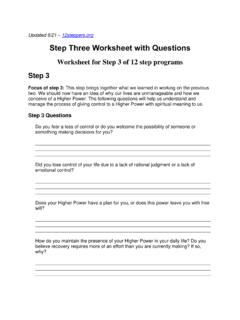
8 You may also be thinking of what role your Higher Power will play in your future and how it will be different. Read more about step 2 & a power greater than ourselves. step 3 Focus of step 3: This step brings together what we learned in working on the previous two. We should now have an idea of why our lives are unmanageable and how we conceive of a Higher Power. The following Questions will help us understand and manage the process of giving control to a Higher Power with spiritual meaning to us. step 3 Questions Do you fear a loss of control or do you welcome the possibility of someone or something making decisions for you? Did you lose control of your life due to a lack of rational judgment or a lack of emotional control? Does your Higher Power have a plan for you, or does this power leave you with free will? How do you maintain the presence of your Higher Power in your daily life?
9 Do you believe recovery requires more of an effort than you are currently making? If so, why? Do you ever pray? How does prayer make you feel? Does it matter why you pray? Have you ever truly trusted anyone? Was this trust betrayed? How easy is it for you to trust now? Do you feel like your life has meaning? Has anything you have done in the past made you feel like your life was meaningful? Why? Are there things that are easy for me to surrender? Are other things very difficult to surrender? Why and what is the difference? What is the most problematic habit or part of me which I have not yet fully surrendered? How step 3 helps us recover: These Questions were designed to provide insight into the process of surrender. At the same time, they help us begin to try to understand what role our Higher Power will play in our new path. Read more about step 3 and the third step prayer.
10 step 4 Focus of step 4: These Questions are designed to help us take stock of who we are. Since addiction has taken such a toll on our lives, we will focus on the deficiencies which got us here. However, we should never lose sight of the positive elements in our personalities and lives. The important part is to assess our lives fairly, so we are not captured by the twin dangers of self-aggrandizement and self-righteousness at one extreme or guilt and self-loathing on the other. To this end, answer these Questions honestly and in a measured fashion. step 4 Questions Has anyone hurt you deeply by judging our outing your addictive behavior? Do you feel anger at this person? When you think of the person you hurt most through your addiction, how do you feel about yourself? Do you ever get mad at random? At what? Why? Have you ever tried to get revenge on a person?