Transcription of 1316 NURSING CARE PLAN Urinary Elimination …
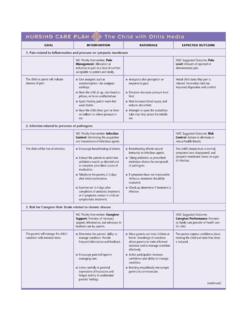
1 1316 UNIT X / Promoting Physiologic HealthNURSING CARE PLANU rinary EliminationASSESSMENT DATANURSING DIAGNOSISDESIRED OUTCOMES* NURSING AssessmentMr. John Baker is a 68-year-old shopkeeper who was admitted tothe hospital with Urinary retention, hematuria, and fever. The ad-mitting nurse gathers the following information when taking anursing history. Mr. Baker states he has noticed Urinary frequencyduring the day for the past 2 weeks, and that he doesn t feel hehas emptied his bladder after urinating. He also has to get up twoor three times during the night to urinate. During the past fewdays, he has had difficulty starting urination and dribbles after-ward.
2 He verbalizes the embarrassment his Urinary problemscause in his dealings with the public. Mr. Baker is concernedabout the cause of this Urinary problem. He is diagnosed with be-nign prostatic hypertrophy (BPH) and referred to a urologist whosuggests a transurethral resection of the prostate (TURP) in sev-eral months. He is placed on antibiotic Urinary Elimination (retention and overflow inconti-nence) related to bladder neckobstruction by enlargedprostate gland (as evidencedby dysuria, frequency, nocturia,dribbling, hesitancy, and blad-der distention) Urinary Continence [0502] asevidenced by: Able to start and stopstream Empties bladder completelyKnowledge: Treatment Regi-men [1813] as evidenced bysubstantial.
3 Description of self-care re-sponsibilities for ongoingcare Description of self-monitoringtechniquesNURSING INTERVENTIONS*/SELECTED ACTIVITIESRATIONALEU rinary Incontinence Care [0610]Monitor Urinary Elimination , including consistency, odor, volume,and the client select appropriate incontinence garment or pad for short-term management while more definitive treatment is Mr. Baker to limit fluids for 2 to 3 hours before him to drink a minimum of 1,500 mL (six 8-ounceglasses) fluids per ingestion of bladder irritants ( , colas, coffee, tea, andchocolate).These parameters help determine adequacy of Urinary undergarments can help diminish the embarrassingaspects of Urinary fluid intake several hours before bedtime will de-crease the incidence of Urinary retention and overflow inconti-nence, and promote fluids during the day will increase Urinary output anddiscourage bacterial , coffee, and tea have a natural diuretic effect and arebladder ExaminationHeight: cm (6 2 )Weight: kg (189 lb)Temperature: C ( F)Pulse: 88 BPMR espirations: 20/minuteBlood pressure.
4 146/86 mm HgCatheterization for Urinary re-tention yielded 300 mL amberurine, Foley left in place for 2 daysDiagnostic DataCBC normal; urinalysis: amber,clear, pH , specific , negative for glucose,protein, ketone, RBCs, and bac-teria; IVP: evidence of enlargedprostate glandUrinary Retention Care [0620]Instruct Mr. Baker or a family member to record Urinary for residual urine, as intermittent catheterization, as as an indicator of Urinary tract and renal function and offluid enlarged prostate compresses the urethra so that urine is re-tained. Checking for residual urine provides information aboutbladder maintain tonicity of the bladder muscle by preventingoverdistention and providing for complete 11/8/06 5:59 PM Page 1316 CHAPTER 48 / Urinary Elimination 1317 Outcomes partially met.
5 Following removal of the Foley catheter, Mr. Baker reported continued difficulty initiating a Urinary stream but ex-perienced less dribbling and nocturia. He and his wife selected an undergarment that was acceptable to Mr. Baker and he reports that hefeels more confident. Intermittent catheterization not indicated. Intake is approximately 200 mL in excess of output. He is able to discussthe correlation between his enlarged prostate and Urinary difficulties. A transurethral resection of the prostate is scheduled in 2 weeks.*The NOC # for desired outcomes and the NIC # for NURSING interventions are listed in brackets following the appropriate outcome or , interventions, and activities selected are only a sample of those suggested by NOC and NIC and should be further individualized for CARE PLAN Urinary EliminationcontinuedNURSING INTERVENTIONS*/SELECTED ACTIVITIESRATIONALE Provide enough time for bladder emptying (10 minutes).
6 Instruct the client in ways to avoid constipation or stool addition to the effect of an enlarged prostate on the bladder,stress or anxiety can inhibit relaxation of the Urinary time should be allowed for stool may place pressure on the bladder outlet, caus-ing Urinary : Disease Process [5602]Appraise Mr. Baker s current level of knowledge about benign pro-static the pathophysiology of the disease and how it relates tourinary anatomy and the rationale behind management, therapy, and treat-ment Mr. Baker on which signs and symptoms to report to the health care provider ( , burning on urination, hematuria,oliguria).
7 Assessing the client s knowledge will provide a foundation forbuilding a teaching plan based on his present understanding ofhis this case, Urinary retention and overflow incontinence are causedby obstruction of the bladder neck by an enlarged prostate information about treatment options is important to di-minish anxiety, promote compliance, and enhance decision the individual with prostatic hypertrophy, Urinary retention andan overdistended bladder reduce blood flow to the bladder wall,making it more susceptible to infection from bacterial for these manifestations of Urinary tract infection isessential to prevent CRITICAL THINKING1.
8 Considering Mr. Baker s history and assessment data, whatother physical conditions could explain his symptoms?2. The primary care provider has recommended surgery. Whatassumptions will the nurse need to validate in helping prepareMr. and Mrs. Baker for this surgery?3. It does not appear that other alternatives have been consid-ered. Why might this be so?4. Incontinence can lead to client decisions to limit social interac-tions. What would be an appropriate response if Mr. Bakerstates that he will just stay home until he has his surgery?See Critical Thinking Possibilities in Appendix A.
9 11/8/06 5:59 PM Page 1317