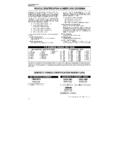
Transcription of 1953-1974 VW Engine Type and Number
1 To determine what type of Engine you have, fi rst determine whether it is the Engine single-port or twin-port (the term dual-port or DP is used in the US). The single-port intake manifold consists of a single tube running from head to head across under the carbu-retor. There are smaller diameter heat riser pipes from the muffl er on either side, attached underneath the intake manifold in the center. The two sides of the intake mani-fold combine in the center with a tube extending upwards to a fl ange upon which the carburettor rests. The intake manifold on twin-port engines is similar, except that the tubes split in two at each end as they turn downwards to the cylinder heads. Also, the twin-port intake manifold is in three pieces - the center section with a tube attached on either side; these run to the cylinder Engine fi rst came out in 1971, but the earli-er cases can be converted to twin-port, so it s not always easy to tell exactly what you have unless you know the Engine s Engine Number is stamped just under the alternator/oil fi ller stand (under the zunfolge 1432, which means fi ring order 1432 in German).
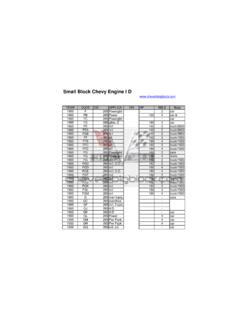
2 The fi rst two letters (or single letter on earlier engines) will tell you what the Engine started out as, but of course it could be different now and sometimes the only way of checking is to remove a cylinder head and measure the bore and stroke. But at least the Engine letters will give you a following table from the Haynes Manual gives a summary of Engine types, numbers and horsepower over the years. 1953-1974 VW Engine Type and Number *Dual-port version- Table courtesy of Haynes Automotive Repair Manual, VW Beetle & Karmann Ghia, 1954 thru 1979 Models, with additions from Rob single port engines make a little less power and can only use the smaller 30 series carburetors or the mod-ern replacement H30/31, but are considered a little more torquey, and are popular with off roaders. The twin port engines can make a little more peak hp as they use the larger 34 PICT/3 stock Engine rebuilds these days use 1600cc pistons and cylinders (P&C)s, as these are readily available and will also fit straight into the 1300cc and 1500cc cases, without any need to change anything but the heads (even these can be left original if you can live with the higher than normal compression ratio).
3 Smaller P&Cs are very dif-ficult to find these days. SO most VW rebuilt engines now are at least 1600cc. Then there are the oversized P&Cs and stroked crankshafts which will give a range of new capac-ities -- 1641cc, 1776cc, 1835cc, 1916cc and so on up to about 2235cc. Anything bigger than 1776 will probably have a larger (non-standard) carburetor or twin carbu-retors, as the Engine won t breath well on large capacity with the smaller Solex carburetors.~~~Specific Information Regarding Engine NumberFrom Questions Posed to Rob(Good information about Engine type here as well.)~~~AB SerieS Engine numBerSSomeone wrote asking for help with determining the date when his Engine was made. His Engine Number is AB responded -- Your Engine is probably late 71 rather than early 72 - just going on the total engines built vs the total chassis built in each year. VW always built more engines than chassis (for replacements), but assuming the missing Engine numbers were 71 rather than 72 makes for a more even spread of engines vs s interesting to see that Canada got the 1300cc en-gines - the US was almost entirely to 1600cc engines from 67 onwards.
4 The rest of the world still had 1300cc en-gines up to and including 86. I don t know if Canada fol-lowed the same pattern as Australia, but from 71 onwards in Australia, 1300cc engines were used in standard Bugs and 1600 engines in Superbugs. It s easy to pick one from the other from the back of the car (without seeing the bulbous front) - just look for the eyebrow vents to make it 71+ and then at the Engine lid badge - VW 1300 makes it a standard Bug, and Volkwagen L or Volkswa-gen S makes it a was the pattern for the USA to get only the biggest Engine for each year, and the US models stayed with drum brakes. The rest of the world got at least 2 and some-times 3 choices of Engine size , and from 68 onwards the 1500/1600 cars got front disc brakes as standard. In the Production DateDisplacementenginenumberHorsepowerDe c. 1953 through July 19601200cc1, 2, 336 August 1960 through July 19651200cc5, 6, 7, 8, 940 August 1965 through July 19861200ccD (not to US)40 August 1965 through July 19661300ccFO50 August 1965 through July 19701300ccE low comp37 August 1966 through July 19671500ccHO53 August 1967 through July 19691500ccH5 low comp50 August 1967 through July 19701500ccL (smog)50 August 1969 through July 19701500ccH1 (outside USA)53 August 1969 through July 19701600ccB57 August 1970 through July 19731300ccAB (not to US)48 August 1970 through July 19731300ccAC (not to US)44 August 1970 through Sept.
5 19711600cc*AE60 August 1970 through July 19731600cc*AF (low comp)58 August 1971 through July 19731600cc*AD (not to US)65 From August 1971 (Calif. only)1600cc*AH60 FromOct. 19721600cc*AK46 August 1973 through July 19751300ccAR (not to US)48 August 1973 through Dec 19801600cc*AS (not to USA?)60 From Dec. 1974 (fuel-injected)1600cc*AJ60 USA only the Karmann Ghias from 68 onwards got the (identical) disc brake SerieS Engine numBerSSomeone wrote asking about the year for an Engine with the Number responded - Our Engine Number list shows the AH series as a low compression version of the 1600cc Engine , used in the US in 71 and 72. The top Number in our list is 114,000 which is less than your Number so it s possible it was sold in some parts of the world but not others, into 1973 it s got it s original cylinders and pistons (which is doubtful) then they would be dished pistons to reduce the compression ratio so it can run on low octane fuel. If it now has flat topped (normal compression) pistons it needs 87 AKI octane fuel (in the USA).
6 How can you tell? - the only sure way is to remove a cylin-der head and look at the piston tops, but you might get some idea from the compression - a normal-compression 1600cc Engine will give over 130psi, a low compression version will probably be a little less than that, but since ALL engines lose compression as they age it s not a definitive 1969 VW had either the H series 1500cc, a few L se-ries 1500cc (smog - probably sold in Cal), and in other parts of the world, the E and F series 1300s and D series your Engine have the doghouse oil cooler (a box on the FRONT side of the fan shroud to the left of center)? If it does, it s quite possible the Engine will run a little hotter than it needs, as this version of the cooling system has a larger fan and needs a slotted Engine lid to get enough inlet to prevent it running short of cooling air at higher 2-slot 70- 71 model Engine lid, or the 4-slot 72+ lids are interchangable with the 68 and 69 solid SerieS Engine numBerSSomeone wrote asking about his Engine with the Number AUxxxxxxx.
7 He could not find an Engine num-ber begining AU. He also wanted to know about Engine Number series for Volkswagens made in responded -I haven t seen or heard of any engines starting with AU - very wonder if it s a rebuilder s ID - added when the Engine was rebuilt - although then I suppose it should be some-thing like AUDxxxxxxx or AUFxxxxxxxx, (before the normal D or F etc) so I don t really possibility is that it s a case originally used on a VW industrial Engine - I don t have the Number series for those (VW built millions of 1200 and 1600 industrial engines).I don t have the Number series for Brazillian or Mexican made engines either - I d love to know SerieS Engine numBerSIn response to a question regarding F series engines, Rob wrote -The F series engines were originally 66-70 1300cc sin-gle port engines. But that case can have 1500cc or more likely 1600cc P&Cs plugged straight in (1500cc P&Cs are almost impossible to get now). You can actually still use the 1300cc heads but they must be fly cut for the larger cylinder tops (the cylinder bottoms are all the same for those three sizes, but the 1300cc cylinder tops are smaller on the outside at the top).
8 You d have high compression - about :1 but it will work (with higher octane fuel). Or you get a set of 1600cc single-port heads and then you an Engine similar to the 1970 B series 1600cc Engine numBerSAnother question from a guy building a Spyder repli-ca. His Engine (1600cc or 1300cc - he wasn t sure). The Engine Number is SFD022728, which does not fit into any of the standard numbers on the net. He wanted to know whether SFD is an authentic Number and how to deter-mine the size of his responded -- I haven t heard of SFD numbers. Is it possible an Engine builder has added his own stamp to the Engine Number ? I ve seen an X or other letter added after the Number by some rebuilders so they will know which Engine rebuilds are only sure way to check the capacity is to remove the head on one side and take some measurements. 64mm stroke and 77mm bore is 1200cc, 69mm stroke and 77mm bore is 1300, 69mm stroke and 83mm bore is 1500, 69mm stroke and bore is heads can be either single port or twin port - the twin port heads came in 1971 - and are in only two sizes of TPs - 1300 and 1600 (1300 TPs were not sent to the US).
9 It s very easy to mix-n-match parts on VWs so you could have an early Engine , or a later Engine retro fitted with SP heads and a single-port Engine is a torquey Engine - for the same capacity they pull better at lower rpms than the twin-port engines, but the twin-port engines make more total horsepower (at slightly higher rpms).For information, if you have a single-port Engine , you can not use the larger 34 PICT/3 carburettor. The single-port manifold has a smaller flange and accepts the 30 series carburettors or the modern replacement H30 H30/31 (with the right jetting) will work well with any Engine from 1200cc to 1600cc. So will the 30 PICT/2. SOme of the early 30 PICT/1 will work OK with the 1500cc and 1600cc capacities, and some won t. The first 30 PICT/1s do not have a power jet, which is OK for a 1300 but it will run a 1500 or 1600 lean (hot) at high rpms/highpower. The later 30 PICT/1s do have a power jet and can be used with a 1500/1600sp SerieS Engine numBerSSomeone wrote about his Engine having the Number of U0091519, wanting to know details about the responded -The U series Engine numbers were used on the Type 3 cars - Notchback, Squareback and Fastback.
10 The U series were 1600cc twin port. Those Engine numbers are not included in our Web site, as our site is directed to the Type 1 Engine could be still in it s original Type 3 format (pancake - lowered cooling shroud with the fan on the crankshaft), or converted to the upright-cooling Bug are almost identical to the Bug case, and make fine cases for rebuilding engines in either main difference is that the original case had no oil dipstick near the Engine pulley, so when converting it to the Bug format, usually one needs to be manufactured using a black plastic adaptor (which can be bought from some Bug places) bolted to the back of the Engine to the right of the Engine oil cooler was laid flat on top of the case in the Type 3, so the Bug style oil cooler adaptor must be used when it s rebuilt into a Bug s upright cooling shroud. They also had the original cool tins - close fitting tinware under the cylinders to help with the more convoluted cooling-air path.