Transcription of 2010: FLEXIBLE-GRAPHITE-BASED POROUS …
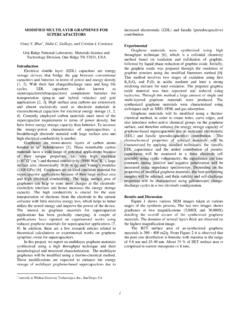
1 FLEXIBLE-GRAPHITE-BASED POROUS composite This paper alleviates the problems mentioned above by electrochemical electrode exhibiting eliminating the need for a binder, while maintaining low cost, high electrical CONDUCTIVITY process simplicity and versatility. This is achieved by exploiting the mechanical binding that is inherent in the formation of flexible graphite from exfoliated graphite. This Shoukai Wang and Chung paper uses no conductive filler, but it uses a graphite matrix. The graphite is in the form of flexible graphite. The composite Materials Research Laboratory electrochemically active component is present as a particulate University at Buffalo filler in the FLEXIBLE-GRAPHITE-BASED composite . Due to the State University of New York porosity of flexible graphite, the electrolyte permeability is Buffalo, NY 14260-4400, high . Due to the flexibility of flexible graphite, the electrode is flexible, in contrast to the brittleness of the ceramic-based Introduction electrodes of the prior art.
2 Due to the strong electrical Electrodes are needed for batteries, fuel cells, connectivity in the flexible graphite, the electrical resistivity is supercapacitors, electrochemical sensors and other low. Furthermore, flexible graphite is attractive for its electrochemical devices. An electrode involving an chemical resistance, thermal stability, thermal conductivity, electrochemically active species that is poor in electrical low thermal expansion coefficient, low density, shapability conductivity requires the presence of an electrically (through cutting or molding) and low manufacturing cost. conductive species in the electrode for rendering conductivity Although this study uses MnO2 as the electroactive to the electrode . Manganese dioxide (MnO2) [1] and lithium component, the technology described here may be applied to cobalt oxide (LiCoO2) [2] are examples of such particles other than manganese dioxide.
3 Electrochemically active species. Electrically conductive species used in such an electrode Experimental methods is commonly in the form of discontinuous carbon fillers, such The manganese dioxide powder contains 82-85% MnO2. as carbon black [1,2], graphite particles [3-5] and carbon The as-received particles of particle size of 50-70 m are nanofiber [1,2,6]. The filler is commonly mixed with the reduced in average size to 4 m by ball milling. electrochemically active particles in the presence of a binder, The exfoliated graphite was obtained by rapid furnace which is typically nonconductive. Examples of binders are heating of acid-intercalated natural graphite flake of typical PTFE and PVDF. The binder is commonly introduced in the mean size mm. The worms are of length 2-4 mm. form of particles. Upon heating, the binder flows and Composites are prepared by compression of a mixture of provides the binding ability.
4 The binder serves to bind the exfoliated graphite and MnO2 particles, the weights of which ingredients together to form a bulk form, such as a sheet. are controlled, such that the resulting composite contains 53. Instead of using a binder to join the conductive species to MnO2. The mixing is conducted for 24 h using a ball the electrochemical species in the electrode , it is possible to mill without grinding medium. The compression of the deposit the electrochemical species on a conductive substrate, mixture is conducted in a cylindrical mold of length 45 cm and such as carbon black. Although the absence of a binder is inner diameter mm by applying a uniaxial pressure of attractive from the electrical conduction point of view, the MPa via a matching piston. Each resulting specimen is a deposition methods are more expensive, more complicated disc of diameter mm and thickness around mm. and less versatile (in terms of the choice of electrochemical Each disc obtained by compression is cut by using a knife species) than methods involving a binder.
5 Into a number of specimens, which are used for electrical A problem with the abovementioned electrode resistivity measurement in the in-plane direction (2 specimens technologies that involve binders relates to the high electrical per disc), electrical resistivity measurement in the out-of-plane resistivity, which stems from (i) the contact resistance at the direction (2 specimens per disc) and for water absorptivity interface between adjacent units of the conductive filler, and measurement (2 specimens per disc). Each specimen obtained (ii) the high contact resistance at the interface between the by cutting has all of its edges lightly sanded in order to conductive substrate and the electrochemically active species remove the sheared carbon layers that may be present. due to the intervening binder. The resistivity of a MnO2 The electrical resistivity is measured by using the four- electrode with discontinuous graphitized carbon nanofiber as probe method, with silver paint in conjunction with copper the conductive additive is.
6 Cm [1]; the resistivity of an wire serving as electrical contacts. LiCoO2 electrode with discontinuous carbon nanofiber as the The absorptivity test is conducted by immersing each conductive additive is .cm [6]. Another problem relates specimen in deionized water for controlled amounts of time to the detrimental effect of the binder on the electrolyte (1-36 h) and determining the water uptake by weighing. permeability of the electrode , and the consequent reduced degree of utilization of the electrochemically active Results and discussion component. Yet another problem relates to the limited The composite contains 15 MnO2, 29 solid chemical resistance of the binder. graphite (nonporous) and 56 air. The air volume fraction is much higher than that expected if the composite consisted of two phases, , MnO2 and similarly prepared measured on the same disc. A higher in-plane or out-of-plane flexible graphite (without MnO2).
7 Without MnO2, the material resistivity correlates with a higher absorptivity. contains 60 solid graphite and 40% air. Thus, the porosity is increased by the addition of MnO2. Both the in-plane and out-of-plane resistivity values are Out-of-plane Resistivity ( .cm). increased by the presence of MnO2. The in-plane resistivity is increased by 10%, while the out-of-plane resistivity is increased by 40%. The calculated resistivity for the composite , as obtained by the Rule of Mixtures ( , the conductivity of the composite is equal to the conductivity of flexible graphite In-plane multiplied by the volume fraction of flexible graphite, with the conductivity of MnO2 taken as zero), is higher than the 0. corresponding measured value for both in-plane and out-of- 20 40 60. plane directions. This means that the graphite maintains Absorptivity (%). connectivity of its conduction path in the presence of MnO2 Fig.
8 1 Correlation of the resistivity and the absorptivity. particles for both in-plane and out-of-plane directions. The MnO2 slightly disrupts the out-of-plane conduction, but does Conclusions not disrupt the in-plane conduction. A flexible POROUS MnO2 electrode of exceptionally low The electrical anisotropy, as expressed as the ratio of the electrical resistivity ( .cm in the out-of-plane direction out-of-plane resistivity to the in-plane resistivity is increased and .cm in the in-plane direction) and high water slightly by the presence of MnO2. The anisotropy is 24 (electrolyte) absorptivity is obtained using flexible graphite as without MnO2 and is 31 with MnO2. This effect of MnO2 is the matrix and MnO2 particles as the filler. In contrast, the consistent with the notion that MnO2 disrupts the out-of-plane resistivity is 1 .cm or above for MnO2 electrodes made using conduction more than the in-plane conduction.
9 The conventional method that involves a conductive additive Both the in-plane and out-of-plane resistivity values of the and a binder [1,6]. The MnO2 causes the fraction of pores that FLEXIBLE-GRAPHITE-BASED MnO2 composite are much lower than are accessible by water to increase from 31% to 100%. The the resistivity of 1 .cm or above for the composite in the composite is obtained by compressing a mixture of exfoliated form of a mixture of MnO2 particles and carbon particles or graphite and MnO2 particles in the absence of a binder. It fibers (including graphitized carbon nanofiber) held by a contains 15 MnO2, 30 solid graphite (nonporous). polymeric binder [1]. The low resistivity of the composite of and 55 air. The MnO2 particles are of size 6-9 m. this work is attributed to the high degree of electrical Relative to the unmodified flexible graphite, the composite connectivity of the flexible graphite matrix of the composite .
10 Exhibits higher resistivity (10% higher in-plane and 40%. On the other hand, the MnO2 volume fraction is lower in this higher out-of-plane), 125% higher absorptivity and higher work than that in prior work [1]. porosity. The MnO2 slightly disrupts the out-of-plane The water absorptivity, as indicated by the fractional mass conduction, but does not disrupt the in-plane conduction. The gain for a selected time of water immersion, is considerably resistivity and absorptivity are correlated. increased by the presence of MnO2. For a given specimen, References the water absorption increase is most significant during the [1] Lu W, Chung DDL. A comparative study of carbons for use as an first 12 h of water immersion; afterward, the water absorption electrically conducting additive in the manganese dioxide cathode is incremental. The absorptivity at 12 h is increased by 125% of an electrochemical cell.