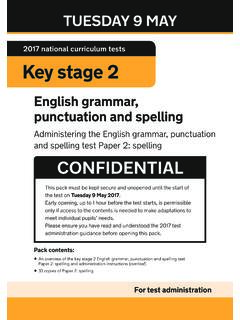
Transcription of 2017 key stage 2 mathematics administering the …
1 For test administrationMathematicsAdministering the mathematics test Paper 2: reasoningPack contents: An overview of the key stage 2 mathematics test Paper 2: reasoning (overleaf) 10 copies of Paper 2: reasoningThis pack must be kept secure and unopened until the start of the test on Wednesday 10 May 2017. Early opening, up to 1 hour before the test starts, is permissible only if access to the contents is needed to make adaptations to meet individual pupils needs. Please ensure you have read and understood the 2017 test administration guidance before opening this national curriculum testsKey stage 2 WEDNESDAY 10 MAYWEDNESDAY 10 MAYWEDNESDAY 10 MAY2017 key stage 2 mathematics test The key stage 2 mathematics test consists of 3 papers.
2 The papers must be administered in order. Pupils can have a break between the papers. However, test packs for each test must not be opened until the pupils are in the test room ready to complete the test. The scheduled day for the administration of Papers 1 and 2 is Wednesday 10 May. The scheduled day for the administration of Paper 3 is Thursday 11 2: reasoningThe following information explains how to administer the key stage 2 mathematics test Paper 2: reasoning. If you have any questions, you should check with your headteacher or key stage 2 test co-ordinator before you administer the test.
3 Please make sure you follow these instructions correctly to ensure that the test is properly administered. Failure to administer the test correctly could result in a maladministration investigation at the This component of the test consists of a single test paper. Pupils will have 40 minutes to complete the test, answering the questions in the test will need the equipment specified below: a blue / black pen or a dark pencil a sharp, dark pencil for mathematical drawing ruler (showing centimetres and millimetres) angle measurer or protractor (papers 2 and 3 only) mirror (papers 2 and 3 only) rubber (optional).
4 However, please encourage pupils to cross out any answers they may wish to change, instead of rubbing them may use the following equipment, if this is normal classroom practice, provided they only give word-for-word translations: bilingual dictionaries or electronic translators bilingual word lists monolingual English electronic spell checkers. Pupils are not allowed: calculators squared paper tracing paper. Assistance Teachers may use photocopying to enlarge pages from the test papers as part of the access arrangements for specific pupils. Please note that the diagram in the following question should not be enlarged: Question 21 You must ensure that nothing you say or do during a test could be interpreted as giving pupils an advantage, indicating that an answer is correct or incorrect, or suggesting the pupil looks at an answer again.
5 If a pupil requests it, a question may be read to the pupil on a one-to-one basis. If reading to a pupil, you can read words and numbers but not mathematical symbols. This is to ensure that pupils are not given an unfair advantage by having the function inadvertently explained by reading its name. For pupils with hearing impairment, be careful when signing numbers, mathematical signs and words. In particular, be careful when signing the following: Q12: vertices Q17: vertices Guidance for administering the test to pupils with a visual impairment is contained in the modified test packs.
6 At a pupil s request, you may point to parts of the test paper such as charts, diagrams, statements and equations, but you must not explain the information or help the pupil by interpreting it. The following examples illustrate how to deal with some common (continued)Q. What does quadrilateral or > or < mean? A. I can t tell you, but think hard and try to remember. We can talk about it after the test. Q. What is ? A. That s nought point six. If any everyday context or words related to a question are unfamiliar to a pupil, you may show them related objects or pictures, or describe the related the test begins Review the list of pupils with any particular individual needs, pupils who are allowed additional time or who may need a transcript made at the end of the test.
7 Ensure that you know how to administer any access arrangements correctly. Please refer to the 2017 key stage 2 access arrangements guidance. It is important that the pupils names on their tests match the names on the test attendance register. Check with your test co-ordinator whether any pupil in your group is known by a different name in school, or has changed their name since pupil registration. This is so you can ensure the pupil writes the correct name on their test paper. Check that there are enough administrators to maintain adequate supervision for the test. You should consider the possibility of at least one test administrator needing to leave the room with a pupil.
8 Ensure that you understand how to deal with issues during the tests . Write the school s name and DfE number on a board that is visible to all pupils. Leave space on the board to write the start and finish times of the test. How to deal with issues during the testIt is impossible to plan for every scenario. Whatever action you take, pupil safety must always be your first consideration. In the following circumstances, you will need to stop the test either for an individual pupil or for the whole cohort: test papers are incorrectly collated or the print is illegible an incorrect test has been administered a fire alarm goes off a pupil is unwell a pupil needs to leave the test room during the tests a pupil is caught cheating.
9 If you need to stop the test: make a note of the time make sure pupils are kept under test conditions and that they are supervised if pupils have to leave the room, ensure they don t talk about the test speak to your test co-ordinator or a senior member of staff for advice on what to do next consider contacting the national curriculum assessments helpline on 0300 303 3013 for further should brief your headteacher on how the incident was dealt with, once the test is over. What to do at the start of the test Check that seating is appropriately spaced and that no pupil can see another pupil s test paper.
10 Check that pupils don t have any materials or equipment that may give them extra help. Check that pupils don t have mobile phones or other disruptive items. Ensure that each pupil has a copy of mathematics Paper 2: reasoning. Write the start and finish times on the board so that all the pupils can see them. What to say at the start of the testIt is important to brief pupils fully at the start of each test. You should use this script to introduce mathematics Paper 2: reasoning. This is the key stage 2 mathematics Paper 2: reasoning. You will need a blue / black pen, a dark sharp pencil, a ruler, a protractor and a mirror.