Transcription of 3.3 The logarithm as an inverse function
1 The logarithm as an inverse functionIn this section we concentrate onunderstandingthe logarithm function . If the logarithm is understoodas the inverse of the exponential function , then the variety of properties of logarithms will be seen asnaturally flowing out of our rules for The meaning of the logarithmThe logarithmic functiong(x) = logb(x) is the inverse of an exponential functionf(x) = so themeaningofy= logb(x) isby= expressionby=xis said to be the exponential form for thelogarithmy= logb(x). The positive constantbis called thebase(of the logarithm .)Some worked each of the following logarithms in exponential form and then use that exponential form tosolve log2(8) = exponential form is 2x= 23= 8 the answer isx= log2(247) = exponential form is 2x= log2(12) = exponential form is 2x= 2 1=12the answer isx= log2(18) = exponential form is 2x= 2 3=18the answer isx= log2(3 2) = exponential form is 2x= 21 1 The graph of a logarithm functionThe graph ofy= 2xwas drawn in an earlier lecture (see figure 1.)
2 Figure graph ofy= 2x120 The graph of the inverse functiony= log2xis obtained by reflecting the graph ofy= 2xacross theliney= graph ofy= log2xIf we draw them together, we have the picture below, in figure 3:Figure graphs ofy= 2xandy= log2x(in blue) with the line of reflection,y=x(in green)We agreed earlier that the exponential functionf(x) =bxhas domain ( , ) and range (0, ).Sinceg(x) = logbxis the inverse function off(x) thedomainof the log function will be therangeof the exponential function , and vice versa. So the domain ofg(x) = logbxis (0, ) and the range is( , ).The most useful base for logarithms ise. We will abbreviate loge(x) by ln(x) and speak of the naturallogarithm.
3 Sometimes, for historical reasons, we may use base 10. It is customary to speak then of the commonlogarithm and abbreviate log10(x) by log(x),dropping the subscript. However (warning!), in highermathematics and engineering applications, log(x) means baseeand is equivalent to ln(x).In these notes we will use log(x) to mean log10(x).121 One more abbreviation often in computer science, because computers store data in binary (in bitsof zeroes and ones), one uses base 2. There is now an attempt to write log2(x) as lb(x) and speak of the binary summary, here are our abbreviations:1. lnxmeans the logarithm basee,2. logxmeans the logarithm base 10 and3.
4 Lbxmeans the logarithm base few more worked each of the following logarithms in exponential form and then use that exponential form tosolve log(1000) = exponential form is 10x= 103= 1000 the answer isx= ln(1e3) = exponential form isex=e 3so the answer is lb(1 2) = exponential form is 2x=1 21/2= 2 then 2 1/2=1 2and so the answerisx= 1 properties of exponential functions in terms of logarithmsThe logarithm function plucks the exponent from an expression. For this reason, the properties ofexponents translate into properties of example, we know that when we multiply two terms with a common base, we add the exponents:(bx)(by) =bx+y(8)Suppose we call the first termM:=bxand the second termN:=by.
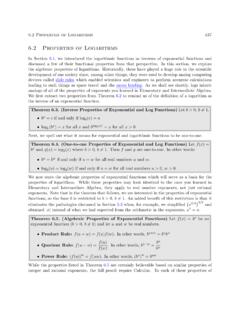
5 Then one may ask the question, What is the exponent onbin the productMN?The answer is We add the exponents appearing inMandN. In other words (if we learn to translate logb as the exponent ), we can restate this exponent property as when we multiplynumbers we add their exponents . This is theproduct propertyfor logarithms:logb(MN) = logbM+ logbN(9)What happens when we divide two terms with a common base?bxby=bx y(10)When we do division, we subtract exponents. So, in the language of logarithms, we have thequotientproperty, the exponent in a quotient is the difference of the two exponents :logb(MN) = logbM logbN(11)122A third important property of exponents: when we raise a term likebxto a power, we multiply exponents.
6 (bx)c=bxc(12)In our logarithm language (thinking ofMasbx) we have theexponent propertylogb(Mc) =clogbM(13)Each of these three properties is merely a restatement, in the language of logarithms, of a property Changing the baseSuppose we want to change the base of our logarithm . This often occurs when we want to use a good base likeeon a problem which began with a different we want to work with basecbut our problem began with baseb:y= this in exponential form:by= take the log of both sides of the equation. If we want to work in basecthen let us apply logc() toboth sides of our (by) = logc(x).Now we use the exponet property (equation 13, pulling the exponentyoutside the logarithm :ylogc(b) = logc(x).)
7 Solve fory:y= we have discovered is thatyhas been rewritten. Soy, which was originally equal to logbxis nowlogbx=logcxlogcb(14)Let s call this the change of base we want to compute log2(17) but our calculator only allows us to use the naturallogarithmln. Then, by the change of base equation (equation 14), we can writelog2(17) =ln 17ln 2 More on the logarithm as an inverse functionWe began this lecture by definingg(x) = logb(x) as the inverse function off(x) =bx. Since thesefunctions are inverses, we know then that(f g)(x) = (g f)(x) =x.(15)Let us examine this in more that (g f)(x) =g(f(x)) =g(bx) = logb(bx).
8 So, since the log function and the exponentialfunction are inverse functions, this must be equal to justxand so we havelogb(bx) =x.(16)This equation is really fairly easy to understand. If we translate logb(x) as the exponent onbthatgivex then we should translate logb(bx) as the exponent onbwhich givesbx. Obviously this shouldbexsincexis the exponent one places onbto getbx.(If that doesn t make sense, read through it onemore time )Since (f g)(x) =xwe also havex= (f g)(x) =f(g(x)) =f(logbx) = (17)This isalmostas easy to understand as equation 16. It says that if we place onb the exponent you putonbto getx (logbx) then we should just getx!
9 We will explore these properties more in the next we understand the logarithm as the inverse of the exponential function , we are prepared to findthe inverse of many functions involving the logarithm . Here are some worked examples on inverse functions Find the inverse function off(x). (x) = (x) =ex2 (x) = 5 + (x) = log2(x+ 2) + To find the inverse off(x) =ex2sety=ex2and then swap inputs and outputs so thatx= the natural logarithm of both sideslnx=y2and solve foryby taking square roots of both sides lnx= one inverse function isf 1(x) = To find the inverse ofy=ex2 5we swap letters so thatx=ey2=5, take natural logs of both sideslnx=y2 5,add 5 and take square roots so thatf 1(x) = lnx+ To find the inverse ofy= 5 +exwe swap variables, subtract 5 from both sides and then take thenatural log to get ln(x 5) = 1(x) = ln(x 5).
10 4. To find the inverse off(x) = log2(x+ 2) + 2 we writey= log2(x+ 2) + 2,change variables (to indicate that we are swapping inputs and outputs)x= log2(y+ 2) + 2,and subtract 2 from both sidesx 2 = log2(y+ 2).At this point it is best to write this logarithmic equation in exponential 2=y+ 2 from both sides2x 2 2 =yand then write out our answer using inverse function 1(x) = 2x 2 Other resources for logarithmic functionsIn the free textbook,Precalculus, by Stitz and Zeager (version 3, July 2011, available at )this material is covered in sections and the free textbook,Precalculus, An Investigation of Functions, by Lippman and Rassmussen ( , available at ) the logarithms are covered in section the textbook by Ratti & McWaters,Precalculus, A Unit Circle Approach, 2nd ed.