Transcription of 3. PHYTOHORMONES AND THEIR …
1 3. PHYTOHORMONES AND THEIR physiological EFFECTS Three terms used routinely to describe various aspects of the changes that a plant undergoes during its life cycle are growth , differentiation, and development. Development, growth and differentiation Development Development is an umbrella term, referring to the sum of all of the changes that an organism goes through in its life cycle from germination of the seed through growth , maturation, flowering, and senescence. Development is most readily manifest in changes in from of the organism or organ, such as the transition from the vegetative to flowering condition or from leaf primordium to fully expanded leaf. Development may also be manifest at the subcellular and biochemical levels, such as when chloroplasts appear in leaf cell brought into to the light and the enzymes of photosynthesis become active.
2 Development is the sum of growth and differentiation. growth growth is the quantitative term, related to changes in size and mass. It can be assessed by a variety of quantitative measures. growth of cells in culture is sometimes measured as in increase in cell number or the fresh weight of packed cells. For higher plants , however fresh weight is not always a reliable measure. Although most plant tissues are approximately 80% water, water content is highly variable and fresh weight will fluctuate widely with changes in the water status of the plant. Dry weight, a measure of the amount of protoplasm or dry matter, is used more often than fresh weight, but even dry weight can be misleading as a measure of growth . Differentiation Differentiation is a qualitative term, referring to the differences other than size that arise among cells, tissues and organs.
3 Differentiation occurs when a dividing cell gives rise to two daughter cells destined to assume different anatomical characteristics and functions. In the earliest stage of development, for example, division of the zygote gives rise to cells that will become the root or shoot of the plant. Unspecialized parenchyma cells differentiate into xylem vessels or phloem sieve tubes, each with a distinct of morphology and specialized function. Differentiation does not lend itself easily to quantitative interpretation but must normally be described as a series of qualitative changes. Finally, although growth and differentiation are normally concurrent events, examples abound of growth without differentiation and differentiation without growth .
4 Differentiation is a two-way street. Even though plant cells may appear to be highly differentiated or specialized, they may often be stimulated to revert to a more embryonic form; that is cells dedifferentiate. It is a though the cells have been genetically reprogrammed, allowing them to reverse the process and them to differentiate along new and different paths. The ability of differentiated cells to regenerate new plants demonstrates that all living plants cells retain complete a genetic program, even though not all of the information is actively used by the cell at any given time. This concept is known as totipotency. All that is required to change the pattern of differentiation is the right input to select the appropriate genetic information at the right time.
5 Control of growth and development The orderly growth and development of complex multicellular organisms require coordination and are subject to controls at three distinct levels. Intrinsic controls operate at both the intracellular level and the intercellular level. Typically, intracellular controls involve changes in gene expression that influence cellular activities through altering the kinds of proteins in the cell. Intercellular controls focus on hormones and THEIR roles in coordinating the activities of group of cells. Extracellular controls are extrinsic; that is, they originate outside the organism and convey information about environment. Genetic control of development Totipotency of plant cells indicates that all of the information required for the development of a complete plant is contained within the genetic complement of each cell, even highly differentiated cells.
6 In other words, cells do not lose genes although many genes are not expressed or may be turned off as differentiation and development progress. The orderly development of a plant requires a programmed sequence of gene activations in order to produce the required gene products, that is, proteins, at the appropriate time. The cells must also have to capacity to respond to those products. Genes consist of specific sequences of nucleotides in the deoxyribonucleic acid (DNA) molecule. A sequence of three nucleotides (a codon) codes for each amino acid. The nucleotide sequences in the gene thus determine the primary structure or sequence of amino acids of proteins, principally enzymes that determine the course of cellular metabolism. Gene expression refers to the synthesis of specific proteins encoded by specific genes.
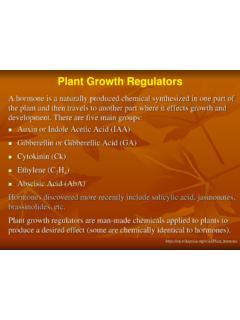
7 Not all genes are active all the time, but may be turned on or off depending on the requirements of the developmental program or in response to changing environmental conditions. Differential gene expression is thus the principal means for altering the complement of enzymes in the cell and, consequently, the course of metabolism and differentiation of the cell. Hormonal regulation of development Interaction between cells is an exceedingly complex affair. Much of this kind of behavior can be interpreted in terms of hormones, chemical messengers that carry information between cells. Several classes of hormones are known, which promote or inhibit various developmental responses, either singly or in combination. The details of hormones and THEIR actions in regulating plant development will be discussed in the following chapters.
8 Environmental regulation of development A variety of external or environmental stimuli can at various times be involved in regulating plant development. Most environmental stimuli are physical parameters. Light, temperature, and gravity have the most obvious and dramatic impact. Other parameters such is magnetic field, sound, and wind (a mechanical stimulus) may have more subtle effects, but these have been difficult to establish experimentally. Other environmental factors such as soil moisture, humidity, and nutrition may also influence development in some cases. More recently it has become evident that a variety of air and water pollutants represents a significant environmental challenge to plants and may significantly modify developmental patterns.
9 Because environmental signals originate outside the plant, plants must have some means of perceiving the signal and converting, or transducing, the information into some permanent metabolic or biochemical change. It is becoming increasingly evident that most, if not all, environmental stimuli act at least in part through modifying gene expression or hormonal activities. The role of hormones in plant development Hormones are naturally occurring, organic substances that, at low concentration, exert a profound influence on physiological processes. In addition, hormones, at least in animals, are 1. synthesized in a discrete organ or tissue, and 2. transported in the bloodstream to a specific target tissue where they a physiological response in a concentration- dependent manner.
10 While there are many parallels between animal and plant hormones, there are also some significant differences. Like animal hormones, plant hormones are naturally occurring organic substances that profoundly influence physiological processes at low concentration. The site of synthesis of plant hormones, however, is not so clearly localized. Although some tissues or parts of tissues may be characterized by higher hormone levels than others, synthesis of plant hormones appears to be much more diffuse and cannot always be localized to discrete organs. For example, there is good evidence that auxin, the prototypic plant hormone, is synthesized in the tip of a grass coleoptile but influences the elongation of cells lower down in the same organ. Another plant hormone, cytokinin, is synthesized in the root and transported to the leaves where it influences metabolic activity and delays senescence.