Transcription of 3 Tundra EC - CDMS
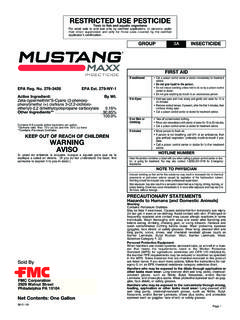
1 1 RESTRICTED USE PESTICIDE Toxic to fish and aquatic organisms. For retail sale to and use only by certified applicators, or persons under their direct supervision and only for the uses covered by the certified applicator s certification. GROUP 3 INSECTICIDE Tundra EC Agricultural Insecticide Active Ingredient: By Wt. Bifenthrin* (2 methyl[1,1 -biphenyl]-3 -yl) methyl 3-(2-chloro-3,3,3-trifluoro- 1 -propenyl)-2,2-dimethylcyclopropanecarbo xylate .. Inert Ingredients**: .. *Cis isomers 97% minimum, trans isomers 3% maximum. **Contains xylene range aromatic solvents This product contains 2 pounds active ingredient per gallon. KEEP OUT OF REACH OF CHILDREN WARNING AVISO Si usted no entiende la etiqueta, busque a alguien para que se la explique a usted en detalle. (If you do not understand the label, find someone to explain it to you in detail.) This label must be in the possession of the user at the time of application. FIRST AID If swallowed Immediately call a poison control center or doctor.
2 Do not induce vomiting unless told to do so by the poison control center or doctor. Do not give any liquid to the person. Do not give anything by mouth to an unconscious person. If in eyes Hold eye open and rinse slowly and gently with water for 15-20 minutes. Remove contact lenses, if present, after the first 5 minutes, then continue rinsing eye. Call a poison control center or doctor for treatment advice. If inhaled Move person to fresh air. If person is not breathing, call 911 or an ambulance, then give artificial respiration, preferably by mouth-to-mouth, if possible. Call a poison control center or doctor for further treatment advice. If on skin or clothing Take off contaminated clothing. Rinse skin immediately with plenty of water for 15-20 minutes. Call a poison control center or doctor for treatment advice. NOTE TO PHYSICIAN This product is a pyrethroid. If large amounts have been ingested, the stomach and intestine should be evacuated. Treatment is symptomatic and supportive.
3 Digestible fats, oils, or alcohol may increase absorption and so should be avoided. Contains petroleum distillates. Vomiting may cause aspiration pneumonia. Have the product container or label with you when calling a poison control center or doctor, or going for treatment. For Medical Emergency Assistance Call 1-877-424-7452. EPA Reg. No. 1381-196 EPA Est. No. 5905-GA-1 Net Contents Gals. ( Liters) Manufactured for: 1/0630/5 Winfield Solutions Box 64589 St. Paul, MN 55164-0589 2 PRECAUTIONARY STATEMENTS Hazards to Humans and Domestic Animals WARNING. May be fatal if swallowed. Causes substantial but temporary eye injury. Do not get into eyes or on clothing. Wear protective eyewear such as goggles or safety glasses. Harmful if inhaled, or absorbed through skin. Avoid breathing vapor or spray mist. Avoid contact with skin. Prolonged or frequently repeated skin contact may cause allergic reactions in some individuals.
4 Wash thoroughly with soap and water after handling and before eating, drinking, chewing gum, using tobacco or using the toilet. Personal Protective Equipment (PPE): Some materials that are chemical-resistant to this product are listed below. If you want more options, follow the instructions for category E on an EPA chemical resistance category selection chart. Applicators and Handlers must wear: Long-sleeved shirt and long pants Chemical-resistant gloves such as barrier laminate, nitrile rubber, neoprene rubber, or Viton Shoes plus socks Protective eyewear Discard clothing and other absorbent materials that have been drenched or heavily contaminated with this product s concentrate. Do not reuse them. Follow manufacturer s instructions for cleaning/maintaining PPE. If no instructions for washables exist, use detergent and hot water. Keep and wash PPE separately from other laundry. Engineering Controls: When handlers use closed systems, enclosed cabs, or aircraft in a manner that meets the requirements listed in the Worker Protection Standard (WPS) for agricultural pesticides (40 CFR (d)(4-6)), the handler PPE requirements may be reduced or modified as specified in the WPS.
5 USER SAFETY RECOMMENDATIONS Users should: Wash hands before eating, drinking, chewing gum, using tobacco, or using the toilet. Remove clothing/PPE immediately if drenched or if pesticide gets inside. Then wash thoroughly and put on clean clothing. Remove PPE immediately after handling this product. Wash the outside of gloves before removing. As soon as possible, wash thoroughly and change into clean clothes. Environmental Hazards This pesticide is extremely toxic to fish and aquatic invertebrates. Use with care when applying in areas adjacent to any body of water. Do not apply directly to water, to areas where surface water is present or to intertidal areas below the mean high water mark. Do not make applications when weather conditions favor drift from treated areas. Drift and run-off from treated areas may be hazardous to aquatic organisms in neighboring areas. Do not contaminate water when disposing of equipment washwaters. This product is highly toxic to bees exposed to direct treatment or residues on blooming crops or weeds.
6 Do not apply this product or allow it to drift to blooming crops or weeds while bees are actively visiting the treatment area. 3 The use of bifenthrin is prohibited in areas that may result in exposure of endangered species to bifenthrin. Prior to use in a particular county contact the local extension service for procedures and precautions to use to protect endangered species. Physical/Chemical Hazards Do not use or store near heat or open flame. DIRECTIONS FOR USE It is a violation of Federal Law to use this product in a manner inconsistent with its labeling. Do not apply this product in a way that will contact workers or other persons, either directly or through drift. Only protected handlers may be in the area during application. For any requirements specific to your State or Tribe, consult the agency responsible for pesticide regulation. Resistance Management Recommendations Tundra EC contains a Group 3 insecticide (or acaricide). Insect/mite biotypes with acquired resistance to Group 3 may eventually dominate the insect/mite population if Group 3 insecticides/acaricides are used repeatedly in the same field or in successive years as the primary method of control for targeted species.
7 This may result in partial or total loss of control of those species by Tundra EC or other Group 3 insecticides/acaricides. If poor performance cannot be attributed to improper application or extreme weather conditions, a resistant strain of insect may be present. If you experience difficulty with control and resistance is a reasonable cause, immediately consult your local company representative or agricultural advisor for the best alternative method of control in your area. To delay insecticide (or acaricide) resistance consider: Avoiding the consecutive use of Tundra EC or other group 3 insecticides/acaricides that have a similar target site of action, on the same insect/mite species. Using tank-mixtures or premixes with insecticides/acaricides from a different target site of action Group as long as the involved products are all registered for the same use and have different sites of action. Basing insecticides/acaricide use on a comprehensive IPM program. Monitoring treated insect/mite populations for loss of field efficacy.
8 Contacting your local extension specialist, certified crop advisors, and/or Winfield Solutions, LLC representative for insecticides/acaricide resistance management and/or IPM recommendations for the specific site and resistant pest problems. 4 AGRICULTURAL USE REQUIREMENTS Use this product only in accordance with its labeling and with the Worker Protection Standard 40 CFR part 170. This Standard contains requirements for the protection of agricultural workers on farms, forests, nurseries, and greenhouses, and handlers of agricultural pesticides. It contains requirements for training, decontamination, notification, and emergency assistance. It also contains specific instructions and exceptions pertaining to the statements on this label about personal protective equipment (PPE), and restricted-entry interval. The requirements in this box only apply to uses of this product that are covered by the Worker Protection Standard. Do not enter or allow worker entry into treated areas during restricted-entry interval (REI) of 12 hours.
9 PPE required for early entry to treated areas that is permitted under the Worker Protection Standard and that involves contact with anything that has been treated, such as plants, soil, or water, is: coveralls; chemical-resistant gloves, such as barrier laminate or nitrile rubber or neoprene rubber or Viton; and shoes plus socks. STORAGE AND DISPOSAL Pesticide Storage Keep out of reach of children and animals. Store in original containers only. Store in a cool, dry place and avoid excess heat. Carefully open containers. After partial use, replace lids and close tightly. Do not put concentrate or dilute material into food or drink containers. Do not contaminate other pesticides, fertilizers, water, food, or feed by storage or disposal. Do not freeze or store below 40 F. If crystals are observed, warm material to above 60 F by placing container in warm location. Shake or roll container periodically to redissolve solids. Spills In case of spill, avoid contact, isolate area and keep out animals and unprotected persons.
10 Confine spills. To confine spill: If liquid, dike surrounding area or absorb with sand, cat litter or commercial clay. If dry material, cover to prevent dispersal. Place damaged package and used absorbent material in a holding container. Identify contents. Pesticide Disposal Pesticide wastes are toxic. Improper disposal of excess pesticide, spray mixture, or rinsate is a violation of Federal Law. If these wastes cannot be disposed of by use according to label instructions, contact your State pesticide or environmental control agency, or the Hazardous Waste representative of the nearest EPA Regional Office for guidance. Container Handling: Use label language appropriate for container size and type. Nonrefillable containers. Do not reuse or refill this container. Clean container promptly after emptying. Nonrefillable container equal to or less than 5 gallons. Triple rinse as follows: Empty the remaining contents into application equipment or a mix tank and drain for 10 seconds after the flow begins to drip.