Transcription of 3rd Grade Life Science: Plants Unit
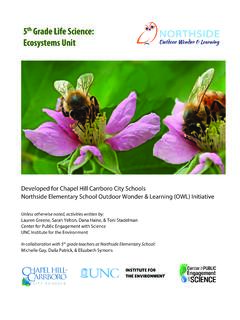
1 Developed for Chapel Hill Carrboro City Schools Northside Elementary School Outdoor Wonder & Learning (OWL) Initiative unless otherwise noted, activities written by: Lauren Greene, Sarah Yelton, Dana Haine, & Toni Stadelman Center for Public Engagement with Science UNC Institute for the Environment In collaboration with 3rd Grade teachers at Northside Elementary School: Whitney Dunlap, Brian Mason, & Tequila Powell 3rd Grade Life Science: Plants Unit ACKNOWLEDGEMENTS Many thanks to Dan Schnitzer, Coretta Sharpless, Kirtisha Jones and the many wonderful teachers and support staff at Northside Elementary for their participation in and support of the Northside OWL Initiative. Thanks to Steve Stadelman for sharing hands-on activities and boundless enthusiasm for all things soil and geology during the creation of this unit. Thanks also to Shelby Brown for her invaluable assistance compiling, editing, and proofreading the curriculum. Instructional materials and supplies to promote STEM-based outdoor learning were instrumental to the successful implementation of this curriculum.
2 The purchase of these materials was made possible with funding provided by the Duke Energy Foundation to Chapel Hill-Carrboro City Schools. Curriculum developed June 2018 July 2019 For more information, contact: Sarah Yelton, Environmental Education & Citizen Science Program Manager UNC Institute for the Environment Center for Public Engagement with Science 3rd Grade Plants UnitNorthside Outdoor Wonder & Learning InitiativeOverarching Unit QuestionHow do Plants survive in different environments?Essential Questions Arc 1: Why is soil important? Arc 2: How do the systems and structures of Plants function to support life? Arc 3: How do environmental conditions affect plant growth? Transfer Goals oUse scientific approaches and methodologies to investigate phenomenon, claims, results and scientific thinking to understand the relationships and complexities of the world around Understandings (Science) We can learn about the world around us by observing its features, patterns, and changes.
3 Living organisms have systems and structures that function to support life. Living organisms experience cycles that vary over the span of their Science Essential Standards Understand how Plants survive in their Remember the function of the following structures as it relates to the survival of Plants in theirenvironments: Roots absorb nutrients Stems provide support Leaves synthesize food Flowers attract pollinators and produce seeds for Explain how environmental conditions determine how well Plants survive and Summarize the distinct stages of the life cycle of seed Explain how the basic properties (texture and capacity to hold water) and components (sand, clay andhumus) of soil determine the ability of soil to support the growth and survival of many Plants . Secondary Target Standards (ELA, Math, Social Studies) ELA Determine the meaning of words and phrases as they are used in a text, identifying words that impact the meaning in a text. 3rd Grade Plants 3rd Grade Plants Unit1 Northside Outdoor Wonder & Learning Ask and answer questions to demonstrate understanding of a text, referring explicitly to the text as the basis for the answers.
4 Use text features and search tools to locate information relevant to a given topic efficiently. Write informative /explanatory texts to examine a topic and convey ideas and information clearly. Write narratives to develop real or imagined experiences or events using effective technique, descriptive details, and clear event sequences. Engage effectively in a range of collaborative discussions (one-on-one, in groups, and teacher-led) with diverse partners on Grade 3 topics and texts, building on others ideas and expressing their own clearly. Ask and answer questions about information from a speaker, offering appropriate elaboration and detail. Report on a topic or text, tell a story, or recount an experience with appropriate facts and relevant, descriptive details, speaking clearly in complete sentences at an understandable pace. Math Represent, interpret, and solve one-step problems involving multiplication and division. Solve problems involving customary measurement.
5 Represent and interpret scaled picture and bar graphs. Unit Overview In this unit, students will learn all about Plants starting with the soil in which they grow. Throughout the unit, students will be going outside to make connections between the content and the Plants around school. In Arc 1, students will begin to identify the importance of soil and how soil relates to Plants . Students will design experiments involving growing Plants from seeds. Exploring the parts of Plants and the life cycle of Plants is the focus of Arc 2. Each plant part deservingly receives its own learning activity. Two learning activities study the life cycle of Plants , one focusing on trees. In Arc 3, students will then investigate how environmental conditions affect Plants . The culminating activity examines how the environmental conditions students imposed affected the growth of their seeds planted during their experiment at the end of Arc 1. Note: You may want to ask students at the beginning of the unit to bring in materials, such as empty paper towel rolls, toilet paper rolls, cereal boxes, or granola bar boxes, to share with the class for Learning Activity 15: Design & Build a Plant.
6 Duration 21 days of 30 minute learning activities Vocabulary* Soil, sand, silt, clay, topsoil, humus, nutrients, plant, leaf, root, stem, seed, seedling, flower, fruit, function, photosynthesis, pollination, germinate, environment, drought, botanist * Definitions of vocabulary words can be found on the Arc overview pages. Relevant vocabulary is also listed on each learning activity page. 3rd Grade Plants Unit2 Northside Outdoor Wonder & Learning Initiative Go Outdoors! Tips & Tools Taking your class outside for science or any lessons can be rewarding and challenging. Along with behavior and materials management tips with each lesson, this section is intended to help you have the tools you need to successfully take your class outside. Before You Go Outside Create ground rules with students for all outdoor lessons. Post the rules for students to be able to easily see. Ask for parent volunteers. Extra help can make an outdoor learning experience much more manageable.
7 Teach students proper use, including safety, of the science tools they will be using. Set expectations before go. Give instructions both inside and repeat once outside. Have a clear objective for going outdoors. This will help focus students attention. Be flexible. Structure lessons to take advantage of opportunities and challenges. Establish a meeting spot and emergency plan. Have a signal for emergency situations. Take students outside for short exercises to practice rules before longer outdoor lessons. Use same door to always go outside for learning. Emphasize this is different than going outside for recess. While You Are Outside Model the activities and outdoor skills for students. Show them what you expect them to be doing. Participate in the activity. Get down on your students level. Get your hands dirty. Model respect for nature with your students. The outdoors is full of teachable moments. Use I wonder statements to engage students in questioning the experience.
8 Have students write down questions to be researched back in the classroom. Allow students to be leaders in the activity. Ask students to volunteer as teacher assistant or materials manager. Acknowledge that students want to explore and can do so once the assigned task is complete. Safety First! Scout outdoor areas ahead of time if possible, to note potential hazards such as poison ivy. Students should never be alone. If a student needs to go back to the building, send 2 students. Take a first aid kit and phone/walkie-talkie. Consider bringing along staff trained in first aid/CPR. Let office staff know where you and your class are going if headed out on a walking field trip. Stay on the trail/path, unless otherwise directed. On the greenway, stay on the right side of path. Do not eat wild Plants , unless harvesting in the garden with a teacher. Set boundaries for the students to stay within. You have to be able to see me and I have to be able to see you!
9 A Note on Nature Journaling Nature journals that you use with your class should be small composition books or other blank books that students use to make outdoor observations, including writing, drawing, and painting. Students can use colored pencils, watercolor pencils, or other materials to remember details of Plants , animals, and habitats they are investigating around the schoolyard. This is different from a science notebook. However, some teachers may choose to have students paste blank pages into their science notebook to use for nature journaling pages. 3rd Grade Plants Unit3 Northside Outdoor Wonder & Learning Initiative Essential Questions Why is soil important? NC Science Essential Standards Unpacked Content Students know that different soils possess different textures and capacities for the retention of water and nutrients. Students know that soil consists of different components. Students know that these characteristics of soil influence the growth and survival of Plants .
10 Lessons in this Arc Engaging Activity: What Do You See? Learning Activity 1: What is in soil? Learning Activity 2: How Does Water Move Through Soil? Learning Activity 3: Compost Learning Activity 4: From a Seed to a Plant - Part 1 Go Outdoors! Engaging Activity: What Do You See? Learning Activity 3: Compost Nature Journal Connection Engaging Activity: What Do You See? Learning Activity 3: CompostDuration 5 days of 30 minute lessons Background Information Soil is responsible for supporting the growth and survival of many Plants . Soil is made of weathered minerals, organic matter, water, and air and is the outermost layer of the earth. Soil texture refers to the particle size of the rock pieces, which are classified as sand, silt, or clay. Particles of s and are the largest pieces of weathered rock that make up soil. With large spaces between the grains, sand does not hold water well. In order to provide water to Plants , the soil must be able to retain it.


![Epictetus (55-135 C.E.), The Enchiridion [Manual]](/cache/preview/1/5/c/7/f/3/2/6/thumb-15c7f32666c5f32d8b67867743634dc3.jpg)