Transcription of 6 Powerful Patterns to Help You Dominate the …
1 6 Powerful Patterns to help You Dominate the fretboard My friends! You are about to learn a handful of the most Powerful tricks to FULLY Understand The Guitar fretboard . I have used and taught these tricks for years now and EVERY great guitarist knows how to use them. You see, everything in the universe has Patterns , and the guitar is no exception. However, SOME of these Patterns are more helpful than others and that is what I am going to show you here. I promise you that if you sit down with this document, and SLOWLY but surely digest each concept and start applying it to your knowledge and playing, you will find a LOT of liberation with this type of thinking.
2 I remember as I personally discovered each one of these concepts on my own and EACH one brought me closer to TRULY and FULLY understanding the guitar fretboard . See, when you can picture what it is that you want to say on the guitar before you play it, it becomes VERY Powerful . The 6 Powerful Patterns to help YOU Dominate the fretboard are as follows: 1. Open string notes - Found on the Diatonic Harmony page 2. The musical alphabet and how to use it and the open strings to name EVERY note on the guitar - Found on the Diatonic Harmony page 3.
3 Stationary Springboards - Found in the Springboards chapter. 4. Movable Springboards - Found in the Springboards chapter. 5. 1, 4, 5 Zig-zag or Magic Z - Found at the end of the Springboards chapter. 6. Note replication - using all of the concepts above SO, please look over all these materials and let me know if you have any questions. Good luck and PLEASE let me know how these concepts are transforming your playing! Keep up the practice! Talk soon, Erich Diatonic Harmony The musical alphabet goes from A to G (there is no H, I, J , etc.)
4 A half-step is the distance between 1 fret and the next on a guitar A whole step is equal to 2 half-steps or 2 frets distance A sharp (#) is when we raise a pitch by a half-step A flat (b) is when we lower a pitch by a half-step Every note has a sharp, except for B and E So, the musical alphabet reads like this A, A#, B, C, C#, D, D#, E, F, F#, G, G#.. and all the notes on a 23 fret board look like So, if W = whole step and H = half-step, then: Major Scale = W W H W W W H Scale steps: 1 2 3 4 5 6 7 8 (or 1) Distance between notes: W W H W W W H Have you ever heard the vocal exercise, Do-Re-Mi-Fa-So-La-Ti-Do ?
5 Those are the musical steps for the major scale. Or the Do Re Mi song Julie Andrews sings in The Sound of Music? That song is based on the steps of the major scale. It is VERY important to learn the major scale if you want a good foundation for learning everything else on the guitar. It is the basis of music theory, the field of study that deals with the mechanics of music and how music works. Definitions To Know Interval The pitch distance between 2 notes. Chords 3 or more notes played together. Arpeggio broken chord, or notes from a chord played apart from each other.
6 Major Chord 1st, 3rd and 5th scale steps (notes from the Major scale: 1, 3, 5. Minor Chord 1st, flat 3rd and 5th scale steps (notes) from the Major scale: 1, b3, 5. Springboards I m often asked by students, How can I find my way around the fret board more quickly? When watching a great guitarist, they often times, make it look effortless or even impossible. Without knowing the tricks it seems like magic. But alas, it s knowledge and VERY attainable. Let me emphasize that these are learned skills. Sometimes I m also asked why one would even care to know the notes on the fret board.)
7 Some players may never desire to know such things, or what they play does not require them to know it as readily. But what they don t know CAN hinder their playing. Don t misunderstand what I m trying to convey. You might go your whole life and play in a band and NOT know the notes on the fret board. However, in certain (and many) settings, if you don t have that knowledge, you are going to look pretty silly NOT being able to play something that is required of you. Let s say, I walk into a studio and the producer hands me a chart that is in the key of C - I sure better know where a C is!
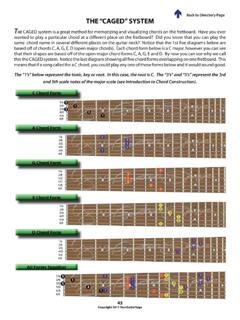
8 If I don t, I m going to have problem playing a solo or improvising in any way. So the short of it is, knowledge is power and since you are smart enough to be filling your head by reading this, I trust you are someone that wants to excel and are ready for the challenge. When it comes to knowing your fret board, there are a myriad of techniques that you can use to determine which note they are playing at any given point in a song. Below are two diagrams I refer to as springboards , which are great tools to enable you to know exactly where you are on the fret board.
9 Stationary Springboards Diagram 1. Know the names of your open strings E, A, D, G, B and E. Also, remember where your root notes are for all your open chords - E, A, D, C, G etc. 2. Know the octaves of your open strings which are at the 12th fret and those open chord roots which are exactly 12 frets higher than their originals. So there your E, A, D, G, B & E are again. 3. Remember how we learned to tune the guitar to itself using that 5th/4th fret technique? Well, since you know that already you have another springboard 4.
10 12 frets up from the notes found on that tuning technique will give you yet another springboard location. Movable Springboards Diagram *All the numbered dots are C notes.* 1. Notice numbers 1 and 5. They are strings E and A. ANY note on those strings will have an octave available down 2 strings and UP 2 frets as denoted by numbers 2 and 6. So 2 goes with 1 and 6 goes with 5. Get it? 2. Now notice numbers 2 and 6. These are on strings D and G. ANY note on those strings will have an octave available down 2 strings and up 3 frets as denoted by numbers 3 and 7.