Transcription of A Different Mirror
1 ADIFFERENTMIRRORA History ofMulticultural AmericaREVISED EDITIONR onald TakakiCopyright 1993, 2008 by Ronald TakakiAll rights reserved. Except as permitted under the Copyright Act of 1976, no part of thispublication may by reproduced, distributed, or transmitted in any form or by any means, or stored in adatabase or retrieval system, without the prior written permission of the revised edition, December 2008 Originally published in hardcover by Little, Brown andCompany, June 1993 This book is dedicated tomy wife,CAROL,for our forty-nine years of friendship,our joyous journey through a lifetime of scholarship,and our ceaseless collaborationin recovering and writing Americanhistory s missing for Ronald Takaki sA Different Mirror In our increasingly diverse society, the issues of race, ethnicity, and religion are often at the forefrontof American consciousness, and always in the backs of our minds, shaping our own identity and ourviews of others. They reverberate in our voting booths, town halls classrooms, and popular culture.
2 Inthis timely update of A Different Mirror : A History of Multicultural america , Professor RonaldTakaki examines the challenges we face in reconciling our differences and forming a secure,sustainable future for our country. Now more than ever, it s essential that we understand and embraceour diversity if we are to grow together as a nation. President Bill Clinton A valuable contribution to the discussion of america as a multicultural society. Boston Globe Takaki s book is nothing less than an attempt to a view all of American history from a multiculrualperspective. It is a laudable effort humane, well informed, accessible, and often incisive. It isclearly not intended to divide American but rather to teach them to value the nations inescapablediversity. New York Times Book Review A It s fascinating to watch Takaki weave these multifaceted strands into a singlenarrative text. San Francisco Chronicle While Takaki s subtitle is a history of multicultural america , his book is also a manifesto for thefuture.
3 New York Review of Books A Different Mirror demonstrates that employing a multicultural approach to American history is anecessary first step toward the binding together of our disunited nation. Detroit Free Press A Different Mirror advances a truly humane sense of American possibility. Henry Louis Gates, by Ronald Takaki A Pro-Slavery Crusade: The Agitation to Reopen the African Slave TradeViolence in the Black Imagination: Essays and DocumentsIron Cages: Race and Culture in Nineteenth-Century AmericaPau Hana: Plantation Life and Labor in HawaiiFrom Different Shores: Perspectives on Race and Ethnicity in AmericaStrangers from a Different Shore: A History of Asian AmericansHiroshima: Why American Dropped the Atomic BombA Large Memory: A History of Our Diversity with VoicesDebating Diversity: Clashing Perspectives on Race and Ethnicity in AmericaDouble Victory: A Multicultural History of america in World War IICONTENTS Copyright 1 A Different Mirror : The Making of Multicultural AmericaPART ONE: FOUNDATIONS Before Columbus: Vinland 2 The Tempest in the Wilderness: A Tale of Two Frontiers Shakespeare s Dream About america english Over Irish english Over Indian Virginia.
4 To Root Out Indians as a People New England: The Utter Extirpation of Indians Stolen Lands: A World Turned Upside Down 3 The Hidden Origins of Slavery A View from the Cabins: Black and White Together english and Negroes in Armes : Bacon s Rebellion White Over Black PART TWO: CONTRADICTIONS The Rise of the Cotton Kingdom 4 Toward the Stony Mountains : From Removal to Reservation Andrew Jackson: Tread on the Graves of Extinct Nations The Embittered Human Heart: The Choctaws The Trail of Tears : The Cherokees American Progress : Civilization Over Savagery 5 No More Peck o Corn : Slavery and Its Discontents North of Slavery Was Sambo Real? Frederick Douglass: Son of His Master Martin Delany: Father of Black Nationalism Tell Linkum Dat We Wants Land 6 Fleeing the Tyrant s Heel : Exiles from Ireland Behind the Emigration: John Bull Must Have the Beef An Immortal Irish Brigade of Workers Irish Maids and Factory Girls Green Power : The Irish Ethnic Strategy 7 Foreigners in Their Native Land : The War Against Mexico We Must Be Conquerors or We Are Robbers Anglo Over Mexican 8 Searching for Gold Mountain: Strangers from a Different Shore Pioneers from Asia Twice a Minority: Chinese Women in america A Colony of Bachelors A Sudden Change in Fortune: The San Francisco Earthquake Caught in Between : Chinese Born in AmericaPART THREE: TRANSITIONS The End of the Frontier: The Emergence of an American Empire 9 The Indian Question.
5 From Reservation to Reorganization The Massacre at Wounded Knee Where the Buffalo No Longer Roam Allotment and Assimilation The Indian New Deal : What Kind of a Deal Was It?10 Pacific Crossings: From Japan to the Land of Money Trees Picture Brides in america Tears in the Canefields Transforming California: From Deserts to Farms The Nisei: Americans by Birth11 The Exodus from Russia: Pushed by Pogroms A Shtetl in america In the Sweatshops: An Army of Garment Workers Daughters of the Colony Up from Greenhorns : Crossing Delancey Street12 El Norte: Up from Mexico Sprinkling the Fields with the Sweat of Their Brows Tortillas and Rotis: Mixed Marriages On the Other Side of the Tracks The Barrio: A Mexican-American World13 To the Land of Hope : Blacks in the Urban North The Wind Said North The Crucible of the City Black Pride in Harlem But a Few Pegs to Fall : The Great DepressionPART FOUR: TRANSFORMATIONS The Problem of the Color Lines14 World War II: American Dilemmas Japanese Americans.
6 A Tremendous Hole in the Constitution African Americans: Bomb the Color Line Chinese Americans: To Silence the Distorted Japanese Propaganda Mexican Americans: Up from the Barrio Native Americans: Why Fight the White Man s War? Jewish Americans: A Deafening Silence A Holocaust Called Hiroshima15 Out of the War: Clamors for Change Rising Winds for Social Justice Raisins in the Sun: Dreams Deferred Asian Americans: A Model Minority for Blacks?16 Again, the Tempest-Tost From a Teeming Shore : Russia, Ireland, and China Dragon s Teeth of Fire: Vietnam Wars of Terror: Afghanistan Beckoned North: Mexico17 We Will All Be Minorities Author s Note: Epistemology and EpiphanyNotesIndexA Different MIRRORA Different Mirror The Making ofMulticultural america I HAD FLOWN from San Francisco to Norfolk and was riding in a taxi. The driver and I chattedabout the weather and the tourists. The sky was cloudy, and twenty minutes away was Virginia Beach,where I was scheduled to give a keynote address to hundreds of teachers and administrators at aconference on multicultural education.
7 The rearview Mirror reflected a white man in his forties. How long have you been in this country? he asked. All my life, I replied, wincing. His questionwas one I had been asked too many times, even by northerners with s. I was born in the UnitedStates, I added. He replied: I was wondering because your english is excellent! Then I explained: My grandfather came here from Japan in the 1880s. My family has been here, in america , for over ahundred years. He glanced at me in the Mirror . To him, I did not look like an , we both became uncomfortably conscious of a divide between us. An awkward silenceturned my gaze from the Mirror to the passing scenery. Here, at the eastern edge of the continent, Imused, was the site of the beginning of multicultural america . Our highway crossed land that SirWalter Raleigh had renamed Virginia in honor of Elizabeth I, the Virgin Queen. Taking lands fromthe Indians, the english colonizers founded Jamestown in 1607, and six years later they shipped thefirst four barrels of tobacco to London.
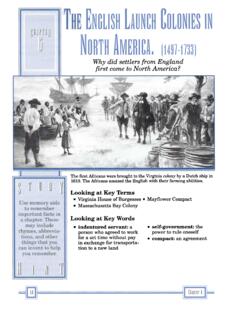
8 Almost immediately, tobacco became an immensely profitableexport crop, and the rise of the tobacco economy generated an insatiable demand for Indian land aswell as for labor from England, Ireland, and Africa. In 1619, a year before the arrival of the Pilgrimsat Plymouth Rock, a Dutch slave ship landed the first twenty Africans at Jamestown. Indeed, historysaturated the surrounding like the one that my taxi driver asked me are always jarring. But it was not his fault thathe did not see me as a fellow citizen: what had he learned about Asian Americans in courses called history ? He saw me through a filter what I call the Master Narrative of American to this powerful and popular but inaccurate story, our country was settled by Europeanimmigrants, and Americans are white. Race, observed Toni Morrison, has functioned as a metaphor necessary to the construction of Americanness : in the creation of our national identity, American has been defined as white.
9 1 Not to be white is to be designated as the Other Different , inferior, and Master Narrative is deeply embedded in our mainstream culture and can be found in thescholarship of a long list of preeminent historians. The father of the Master Narrative was FrederickJackson Turner. In 1893, two years after the Census Bureau announced that Americans had settled theentire continent and that the frontier had come to an end, Turner gave a presentation at the meeting ofthe American Historical Association. Entitled The Significance of the Frontier in AmericanHistory, his paper would make him famous. Turner would become the dean of American history, hisinfluence spanning generations of historians to what would be hailed as the frontier thesis, Turner declared that the end of the frontiermarked the closing of a great historic movement the colonization of the Great West. He explainedthat the frontier had been the meeting point between savagery and civilization.
10 At this intersection,the Europeans had been Americanized by the wilderness. Initially, the wilderness masters thecolonist. It finds him a European in dress, industries, tools, modes of travel and thought. It takes himfrom the railroad car and puts him in a birch canoe. It strips off the garments of civilization, andarrays him in the hunting shirt and moccasin. It puts him in the log cabin of the Cherokee and Before long he has gone to planting Indian corn and plowing with a sharp stick; he shouts the warcry and takes the scalp in orthodox Indian fashion. But little by little he transforms the wilderness ;in a series of Indian wars, the stalwart and rugged frontiersman takes land from the Indians forwhite settlement and the advance of manufacturing civilization. The outcome is not the OldEurope, Turner exclaimed. The fact is that here is a new product that is American. 2In Turner s footsteps came Harvard historian Oscar Handlin.