Transcription of A GUIDE FOR SECONDARY SCHOOL TEACHERS - …
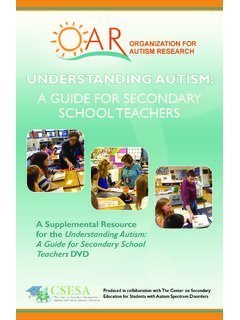
1 A Supplemental Resource for the Understanding Autism: A GUIDE for SECONDARY SCHOOL TEACHERS DVDORGANIZATION FOR AUTISM RESEARCHUNDERSTANDING AUTISM:A GUIDE FOR SECONDARY SCHOOL TEACHERSP roduced in collaboration with The Center on SECONDARY Education for Students with Autism Spectrum Disorders23 INTRODUCTION Refer to Module 1: CharacteristicsMiddle and high SCHOOL students with Autism Spectrum Disorder (ASD) are increasingly being taught in general education settings. This GUIDE reviews common characteristics associated with autism and provides TEACHERS with practical tips and strategies for supporting their students with autism in the classroom setting. It is also designed to supplement the Understanding Autism: A GUIDE for SECONDARY SCHOOL TEACHERS DVD, a training resource developed by the Organization for Autism Research.
2 More information about how to access the DVD is available on page 12. WHAT IS AUTISM? Autism is a developmental disor-der that impacts the way a person perceives and communicates, often resulting in challenges with social interactions and processing informa-tion. It is a spectrum disorder that affects each person to a varying degree, ranging from mild to severe. Although there are some common characteristics, no two individuals with autism are exactly alike. It is important to understand how the characteristics of autism affect each student. You have children with autism who are non-verbal, and then you have children with autism who know more words than a university professor. You have children with autism who would rather be by themselves.
3 And then you have those who want friends, but who do not know how to make them. BRENDA SMITH MYLES, Ohio Center for Autism and Low Incidence Columbus, OH23 IMPAIRED COMMUNICATION AND SOCIAL INTERACTIONS Students with autism may have difficulties with comprehension, casual conversation skills, and understanding the subtleties of language ( jokes, sarcasm, idioms, clich s). REPETITIVE BEHAVIORSS tudents with autism may engage in repetitive body movements, such as rocking back and forth or flapping their hands. Some repetitive behaviors may be less prominent ( cracking knuckles, chewing on pencils or pens, perseveration on thoughts or topics).RESTRICTIVE INTERESTS AND DIFFICULTY WITH CHANGE Some students have very specific or fixated interests ( Civil War battle strategy, carnivorous houseplants) and often display anxiety when routines are SENSITIVITIES Students with autism can be unusually sensitive to certain aspects of the classroom environment.
4 This may include but is not limited to the humming of a computer, the glow of fluorescent lighting, the smell of dry-erase markers, or the [sound of] turning of a page. CHARACTERISTICS OF AUTISM 45 AUTISM IN MIDDLE AND HIGH SCHOOL Refer to Module 1: CharacteristicsCHALLENGES OF SECONDARY SETTINGS SECONDARY settings can be especially challenging for students with autism because of the complexity of the environment, both social and academically. Some things that these students may struggle with are: Learning the different rules and expectations of each class, such as obtaining a hall pass or which materials to have ready when the bell rings Basic skills such as organizing papers, following directions, and understanding how the components of each assignment fit togetherLEARNING STYLES Students with autism have unique learning styles.
5 TEACHERS can support these students by incorporating their strengths and needs when planning for instruc-tion. This thoughtful preparation will help students with autism maximize their potential and make valuable contributions to class discussions and with autism are visual learners They need the opportunity to see information in order to interpret its meaning. Students with autism are literal learnersThey need expectations, instructions and feedback to be explicitly stated. Students with autism need consistency and predictabilityThey need well-structured, predictable classrooms and schedules. THE HIDDEN CURRICULUM The Hidden Curriculum refers to the unwritten rules and codes of social interactions that most people just naturally know.
6 It becomes increasingly important as students reach middle and high SCHOOL . These rules are especially challenging for students with autism to grasp because they are not explicitly discussed; they may not know how to behave or engage with others in various social contexts, such as the SCHOOL bus or cafeteria. This could include unwritten rules such as providing enough personal space when choosing a seat on the bus. 45 INTEGRATING SUPPORTS IN THE CLASSROOM Refer to Module 2: Integrating Supports in the ClassroomFor most SECONDARY SCHOOL students, the classroom is a comfortable environment. This isn t necessarily the case for students with autism. As a teacher , there are a number of strategies you can implement to help students with autism be successful and avoid frustration.
7 Remember to work in collaboration with special educators and instructional aides when integrating these supports for any #1: PRIMING Definition: Priming is exposure to academic course material or tasks before instruction. How it helps: Priming allows students to become familiar with the material, reduce stress, and ensure that key concepts are understood in greater depth. Practical Tips: Provide an agenda or list of potential questions the day before a class discussion Explain which concepts are most important before teaching a lesson Ask parents to help prime their students at home by reminding them about upcoming tests, projects, or field tripsFIVE ESSENTIAL SUPPORT STRATEGIES: Priming Academic Modifications Home SupportsReinforcement67 SUPPORT #2: ACADEMIC MODIFICATIONS Definition: Academic modifications are any adaptations to the content or format of an assignment to meet the specific needs of a student.
8 *Note: Check the IEP to find specific modifications or accommodations required for each it helps: Academic modifications make the scholastic environment easier to navigate while still ensuring that a student learns necessary Tips: Break homework assignments down into smaller components Provide test questions in a different format ( multiple choice instead of open-ended, bullet lists instead of essays) Offer read-aloud instructions for testsSUPPORT #3: HOME BASE Definition: Home base is a designated place where a student can go to regain control during times of high anxiety or stress. How it helps: Home base can help a student cope with a particularly challenging situation without distracting other classmates.
9 Practical Tips: Have a place in your room where a student can take a break If your classroom isn t an option, work with the student s instructional team to find another location ( nurse s office, resource room) Students may need to be explicitly taught when to access home base, and how to access home base ( communicating their need) Develop a plan for how a student will return to classroom activities [Help] learners with out of those situations in a safe and quiet way that doesn t disrupt the rest of the classroom or lead to a behavior escalation that would also be very stigmatizing for them in front of their peers. MARY JANE WEISS, , BCBA Endicott College Beverly, MA67 SUPPORT #4: VISUAL SUPPORTS Definition: Visual supports are any materi-als that illustrate important information.
10 This ranges from labels that identify the contents of a drawer or indicate where homework should be placed, to charts that help students track their progress toward completion of a particular assignment. How it helps: Visual supports help students with autism stay focused on their schoolwork throughout the day and help streamline the learning Tips: Display the daily or weekly agenda in an area of the classroom that is highly visible Provide students with a printed schedule Use graphic organizers as an alternative to typed notes or outlinesSUPPORT #5: REINFORCEMENT Definition: Reinforcement is rewarding students for behaving in ways that are productive and support their continued personal growth. How it helps: Reinforcement increases the likelihood that a student will behave in the same way again.