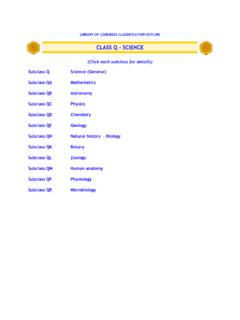
Transcription of A guide to the Dewey Decimal Classification Scheme
1 LIBRARY A guide to the Dewey Decimal Classification Scheme This library uses the Dewey Decimal Classification Scheme (DDC) to arrange books and other library materials on the shelves so they may be easily retrieved. It is used in many libraries and allows items about the same subject to be shelved together. How does the Dewey Decimal system work? DDC is an hierarchical number system that organizes all human knowledge into ten main categories. These are: 000 Computer Science, information and general works 100 Philosophy and psychology 200 Religion 300 Social sciences 400 Language 500 Science 600 Technology 700 Arts and recreation 800 Literature 900 History and geography Each main category is then divided into ten sub-categories.
2 For example: 500 Science 510 Mathematics 520 Astronomy 530 physics 540 Chemistry 550 Earth sciences and geology 560 Fossils and prehistoric life 570 Biology 580 Plants (Botany) 590 Animals (Zoology) Each sub-category is then also divided into ten specific topics. For example: 530 physics 531 Classical mechanics 532 Fluid mechanics 533 Gas mechanics 534 Sound and related vibrations 535 Light and related radiation 536 Heat 537 electricity and electronics 538 magnetism 539 Modern physics Research guide 13 Each of these topics may be further divided into more specific subject areas. A Decimal point is used after the first three digits to separate the specific subjects - it also makes the numbers easier to read.
3 You will see that as the subject becomes more specific, so does the numbering. For example: Sound and related vibrations Generation of sound Transmission of sound Transmission in solids Transmission in liquids DDC at Oxford Brookes When an item arrives in the library it is assigned a DDC number, often called the classmark or shelfmark . Each of the numbers in this shelfmark has a meaning and is not assigned randomly. For example, the book The Royal doctors 1485-1714 by Elizabeth Furdell has been assigned the shelfmark FUR. These numerals indicate: 610 = Medical sciences = Professions = Medical personnel = Specific kinds of medical personnel = Physicians = Physicians in England and Wales = Physicians in England and Wales 1485-1603 Most items will also be assigned some letters at the end of the numerals, FUR in the above example.
4 These are taken from the author s surname or the first word of the title. Finding items on the shelves The shelfmark will always have at least three numbers, followed by some letters. It is usually displayed on the spine of the item, but is sometimes placed on the front cover. Here are some examples: 361. 382. 576 599. 647. 823. 3 63 JON 935 944 914 HIG COC PHI 21 BAI/B LON The DDC system places items about the same subject at the same number. This means that once you have identified the DDC number for the subject you are interested in, you can browse the shelves at that number. On each shelf the items are arranged in a numerical sequence from left to right by their DDC number.
5 Where several items have an identical DDC number, the letters are used to further arrange them. For example, 361. 361. 361. 363. 363. 363. 3 32 32 35 377 377 HIG BOR STO CIV PRE PRO Beware of separate sequences If you are looking for a specific item you should check the library catalogue and make a note of the full shelfmark (numbers and letters) and any words that appear before the shelfmark. The majority of library materials are shelved together but there are several separate sequences that are kept in different areas, but which are all indicated on the Library catalogue. Look out for sequences such as Oversize, Local Collection, Short Loan, Music Scores, Quick Reference, Subject Floor Quick Reference.
6 Journals Journals are also shelved in a separate section. The same DDC numbers are used, but the catalogue shows these items with a shelfmark that is preceded by a J , and which only has one letter after the numbers. For example, the journal Nursing Standard has the shelfmark J N. And finally .. Art and Architecture materials When looking for items in this area you may be confused to find two alphabetic sequences at the same number. For example, general items about French painting can be found at the shelfmark and have three letters after the numbers. At the end of these come works about specific French artists, at the same number , but these have four letters after the numbers.
7 For example: 759. 759. 759. 759. 759. 759. 4 4 4 4 4 4 BOI FRI ROS DEL/J LAT/C LAT/O This happens in some other areas in the 700s, so when checking the library catalogue remember to make a note of the full shelfmark numbers and letters. If you have any questions or would like more help, please ask a member of library staff. Quick guide to Dewey numbers used in this library This is only a brief guide to subjects. For more information, especially when looking for specific items, please remember to check the library catalogue. WJ 08/12 000 Computer science, knowledge and systems 500 Science 010 Bibliographies 510 Mathematics 020 Library and information sciences 520 Astronomy and allied sciences 030 Encyclopaedias and books of facts 530 physics 040 Not used 540 Chemistry and allied sciences 050 Magazines, journals and serials 550 Earth sciences 060 Associations, organizations and museums 560 Palaeontology 070 News media, journalism and publishing 570 Biology 080 General knowledge 580 Plants (Botany) 090 Manuscripts and rare books 590 Animals (Zoology)
8 100 Philosophy and Psychology 600 Technology 110 Metaphysics 610 Medicine and health 120 Epistemology, causation and humankind 620 Engineering and allied operations 130 Parapsychology and occultism 630 Agriculture and related technologies 140 Specific philosophical schools 640 Home economics, catering 150 Psychology 650 Management 160 Philosophical logic 660 Chemical engineering, food technology 170 Ethics 670 Manufacturing 180 Ancient, medieval, and eastern philosophy 680 Manufacture for specific uses 190 Modern western philosophy 690 Construction of buildings 200 Religion 700 Arts and recreation 210 Philosophy and theory of religion 710 Planning and landscape architecture 220 Bible 720 Architecture 230 Christianity 730 Sculpture and related arts 240 Christian moral and devotional theology 740 Graphic arts and decorative arts 250 Christian orders and local church 750 Painting and paintings 260 Social and ecclesiastical theology 760 Printmaking and prints 270 History, geography, biography of Christianity 770 Photography, computer art, film.
9 Video 280 Christian denominations and sects 780 Music 290 Other religions 790 Recreational and performing arts, sport 300 Social sciences 800 Literature 310 Collections of general statistics 810 American literature 320 Political science 820 English and Old English literatures 330 Economics 830 German and related literatures 340 Law 840 French and related literatures 350 Public administration & military science 850 Italian, Romanian and related literatures 360 Social problems and services 860 Spanish, Portuguese, Galician literatures 370 Education 870 Latin and Italic literatures 380 Commerce, communications, transportation 880 Classical Greek and related Literatures 390 Customs, etiquette, folklore 890 Literature of other languages 400 Language 900 History and geography 410 Linguistics 910 Geography and travel 420 English and Old English language 920 Biography 430 German and related languages 930 History of the ancient world 440 French and related languages 940 History of Europe 450 Italian, Romanian and related languages 950 History of Asia 460 Spanish, Portuguese.
10 Galician 960 History of Africa 470 Latin and related Italic language 970 History of North America 480 Classical Greek and related languages 980 History of South America 490 Other languages 990 History of other areas