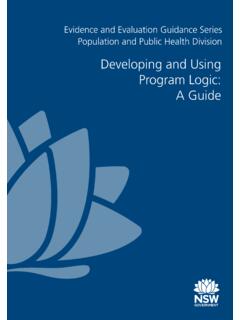
Transcription of A Planning Framework For Public Health Practice
1 Public Health Planning andPractice ImprovementA Planning Framework ForPublic Health PracticePlanning FrameworkNATIONALPUBLICHEALTHPARTNERSHIP Public Health Planning ANDPRACTICE IMPROVEMENTA Planning Framework forPublic Health PracticePlanning FrameworkEndorsementThis document was endorsed by the Australian Health Ministers Advisory Council on the 1 June 2000, for jurisdictionsto incorporate, adapt and apply to their respective Public Health Planning , management and quality assurance Planning Framework for Public Health Practice went through various stages of development. Numerous people,too many to name, have contributed ideas, suggestions and provided criticisms that have led to the completion of thisdocument. The National Public Health Partnership expresses its sincere thanks to all contributors and in particular toDr Andrew Penman who provided the initial overall Planning cycle described herein has been adapted from A Framework for Environmental Health RiskManagement. The US Presidential Congressional Commission on Risk Management : National Public Health Partnership, September 2000 This work is copyright.
2 This work may be reproduced in whole or in part for research ortraining purposes subject to the inclusion of an acknowledgment of the source and providedno commercial usage or sale is to be made. Reproduction for purposes other than thoseindicated above requires prior written permission of the National Public Health Partnership,GPO Box 1670N, Melbourne 3001, Victoria, copiesContact the National Public Health Partnership Secretariat, 120 Spencer Street, Melbourne 3000, Victoria, : (61 3) 9637 5512 Facsimile: (61 3) 9637 5510 Email: Website: PagePrinciples (i)Why Public Health Practice needs a Planning framework1 The challenges in Planning A common language1 A systematic approach1 Integrating action by recognising commonalities1 Levels of Planning and practice2An overview of the framework3 The Planning cycle3 The key elements5 Determinants of health5 Characterising determinants by the type of causal link - proximate or contributory5 Specifying the level of determinants5 Characterising determinants by their effect5 Determinants in context6 Summary6 Health risks and benefits6 Public Health action areas and domains7 Public Health interventions7 Intervention portfolios8 Custodianship - managing portfolios9 Applying the framework11 Identify the determinants define the problem and its causes11 Define the Health problem to be addressed11 Identify and characterise the determinants of the problem11 Assess the possible returns from investing13 Engage stakeholders and put the problem into context13 Develop
3 Custodianship14 Assess the risks and benefits posed by the determinants15 Appraise intervention options17 Decide portfolios18 Implement intervention portfolios20 Review portfolios21 Further development23 AppendixPublic Health domains and their related action areas25 PRINCIPLESThe following principles1 should underpin the implementation of the Planning Framework forPublic Health Practice each community or population sub-group should have access to strategies, services andactivities which optimise their Health ; each community or population sub-group should have access to a healthy and safeenvironment including clean air and water, and adequate food and housing; Public Health efforts must proceed in partnership with non- Health sectors and in collaborationwith international partners; a supportive legal and political environment is integral to the Public Health effort; improvements in knowledge about current and emerging Health determinants and risks are vitalto effective Public Health efforts; priority setting and decision making should be based on scientific evidence as far as possibleand on criteria that are open to Public scrutiny and debate; optimising population Health outcomes requires effective linkage between Public Health andhealth system Planning ; and an ongoing capacity to scan and monitor the social and environmental trends likely to impacton future Health status is essential for long term Planning to prevent ill As stated in the Memorandum of Understanding between members of the National Public Health Planning Framework for Public Health Practice (the Framework ) is a tool to improve Planning andmanagement in Public Health .
4 It complements existingplanning processes2 in Public Health and draws themtogether under a common, over-arching Health is a diverse field. However, there isenough commonality in Public Health issues, methodsand Practice to make a general Planning frameworkboth possible and Framework is not a new definition of Public healthbut a method for continually defining and reviewingwhat Public Health does. It promotes a rigorous,strategic and collaborative approach to Planning . Themethod can be used both within specific areas of publichealth, and as an overarching process to integrateplanning across different Public Health areas. In thelatter sense, the Framework promotes Planning from asystems challenges in planningThe focus of Public Health Planning has generally beenon longer-term Health outcomes. Whilst improved healthoutcomes are the ultimate measure of success, greaterattention needs to be paid to the means by which theseare to be achieved. Long lead times make it hard to linkmany Public Health interventions with Health evaluation needs to focus on the intermediateindicators of success as well as the ultimate healthoutcomes.
5 The Framework is concerned with ensuringthat Public Health action is as effective as simple terms the Planning task entails: defining theproblem; working out what to do about it; acting; andevaluating what impact this has had. In the real world ofpublic Health however, it is more complex. It requirespartnerships between government, communities andorganisations, and collaboration across levels ofgovernment and between different sectors. The oftenmultiple causes of Public Health problems need to beunderstood and judgements made about what can bechanged. Judgements also need to be made about whatlevels of evidence are needed before action can betaken. Expertise from a diverse range of disciplinesneeds to be harnessed for effective action. Decisionsmay also need to be made about allocating resourcesbetween different Public Health Framework is a method for working through theseissues systematically and collaboratively. It aims tocontribute to Public Health Planning in three broad ) A common languagePublic Health encompasses a wide variety of activitiesand structures within Health and related servicessystems.
6 It has evolved into a collection of verticalprograms, which have a common focus on protectingand improving the Health of the population, but whichare quite distinct and separate in the way they areplanned, funded and implemented. Many areas are wellmanaged and effective, but a system to promoteconsistency and quality of activity overall is communication and coordination betweenareas is also an issue since responsibility for publichealth is split between levels of government andbetween various agencies. The Framework will helpaddress these issues, by providing a common methodand language of common feature of the diverse programs andservices labelled Public Health is the focus on thedeterminants of Health and the systematic managementof these determinants. This is the Framework s startingpoint in defining a common approach to Planning inpublic ) A systematic approachThe Framework is intended to assist individual publichealth programs to achieve rigour and consistency intheir Planning .
7 It promotes thorough problem analysis;soundly based and comprehensive interventionapproaches; considered decisions on Public healthinvestment; setting Practice standards and evaluatingresults; clarity about who is responsible for what; andinfrastructure to support ) Integrating action by recognising commonalitiesPublic Health covers diverse areas but there are commondeterminants (especially social ones) and populationgroups which could be better addressed by workingacross specific issue boundaries and working with othersectors. By emphasising thorough problem analysis anda search for comprehensive solutions, the frameworkencourages artificial boundaries of administration andbarriers between disciplines and vertical programs to Various generic and issue specific Planning models are used in Public healthto address different aspects and levels of Planning . The Framework is intendedto complement existing Public Health PRACTICENEEDS A Planning FRAMEWORK2 Levels of Planning and practiceThe Framework is intended to assist Planning andmanagement at all levels of the Public Health system.
8 Itsprimary target audience is Public Health decision-makersand the basic Planning method proposed by theframework has universal application, the specificplanning and management issues will vary at differentlevels of the Public Health system. The different types ofissues could include: deciding what is to be done about a specificproblem; deciding, within an area of Public Health which setof problems should be given priority; balancing investment between different areas ofpublic Health ; and coordinating action at a local How the Framework can be applied at other levels of the system is beingexplored through pilots in a number of Public Health this document, the Framework is explained in terms ofits application to national planning3. The focus is onspecific Public Health problems, their determinants andthe interventions needed to address Framework approach to Planning can also be appliedto other levels of the system. However, a population orsettings-based approach, rather than a problem-basedone may be more appropriate to Planning Public healthactivity at local and state/territory levels.
9 Localapplication of the Framework can draw on theinformation about interventions generated at thenational level but will need to adapt this to Framework is a process for analysing and acting onpublic Health issues and evaluating the results. Itcomprises a cycle4 of six inter-related steps common tomany problem-solving approaches. Within each step,various analytical and decision-making tools arerequired. A number of these are described in Framework is not intended to be the only planningmethod for Public Health . However it is intended to bean overarching one, which provides a commonlanguage or interface between the various planningactivities of the different areas of Public Health . Indoing so it also provides a systematic way for thevarious players in Public Health to manage a problem-solving method, the Framework containsconcepts, tools and steps which are particular topublic Health . For instance in problem analysis, thefocus is on developing a rigorous understanding of thedeterminants of Health .
10 A number of the frameworkconcepts deal with identifying Health key concepts highlight the fact that Public healthaction needs to be based on a realistic assessment ofwhat can be done about the determinant. Theframework also underlines the need for comprehensive,not one-sided, approaches to interventions. Engagingstakeholders throughout the Planning process is also acritical Planning cycleThe overall process of the Framework is illustrated inFigure 1. The steps in summary are: identify the determinants of the Health problem,the context in which they operate and thepopulation groups affected; assess the risks and benefits posed by eachdeterminant to identify what should be addressed; identify intervention options and appraise themincluding the level of evidence; decide the portfolio of interventions which canaddress the problem; implement the portfolio; and evaluate the Framework process can begin at any point in thecycle and can be used in different ways. It can be appliedto define responses to new and emerging issues, and canalso be a way to review what is being done about new areas of Public Health , the focus might be onunderstanding the determinants of the problem in orderto design interventions.