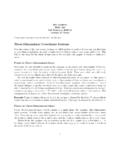
Transcription of A Quick Guide to Using UTM Coordinates
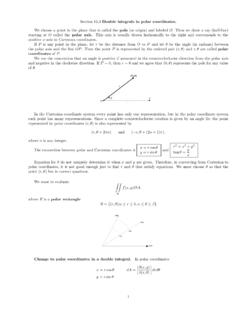
1 A Quick Guide to Using UTM Coordinates Standing at the road junction marked with the star on the topographic map pictured above, a GPS unit set to display position in UTM Coordinates , would report a location of: 10 S 0559741 4282182 The 10 S represents the zone you are in. The zone is necessary to make the Coordinates unique over the entire globe. The top set of numbers, 0559741, represent a measurement of East-West position, within the zone, in meters. It's called an easting. The bottom set of numbers, 4282182, represent a measurement of North-South position, within the zone, in meters. It's called a northing.
2 The map has Universal Transverse Mercator (UTM) grid lines spaced every kilometer or 1000 meters. The vertical grid lines determine East-West position and the horizontal grid lines determine North-South position. Look along the bottom edge of the map at the labels for the vertical grid lines. 559 and 560000 mE. The label, 560000 mE., reads "five hundred and sixty thousand meters East." The label, 559, is an abbreviation for, 559000 mE. The two grid lines are 1000 meters apart. The horizontal grid lines are labeled in a similar manner. Getting to Know the Metric System If the metric system gives you heartburn, here are a few tips to help you out.
3 The Truth (to within 3 or 4 significant digits) What you can remember (You'll be about 10% too short.) 1 meter = feet = yards 1 meter ~= 3 feet ~= 1 yard 100 m = 109 yards 100 m ~= 100 yards ~= length of a football field 1000 m = 1 kilometer = 1 km = miles ~= 5/8 mile 1000 m ~= 1/2 mile Shorthand for UTM Coordinates Most land navigation activities focus on a very small portion of the globe at any one time. Typically the area of interest to an outdoorsman is less than 20 miles on a side. This focus on a small area allows us to abbreviate UTM Coordinates . The zone information and the digits representing 1,000,000m, and 100,000m are dropped.
4 The 1m, 10m and 100m digits are used only to the extent of accuracy desired. A GPS unit might read 10 S 0559741 4282182 Using a notation similar to the one found on a USGS topographic map, this would be written as: Zone 10 S 559741 mE. 4282182 mN. An abbreviated format for the same Coordinates would look like: 59 82 Describes a 1000m by 1000m square. 597 821 Describes a 100m by 100m square. 5974 8218 Describes a 10m by 10m square. 59741 82182 Describes a 1m by 1m square. The 100m abbreviated format, 597 821, and the 10m abbreviated format, 5974 8218, are the most commonly used. Notice that the easting is reported first, followed by the northing.
5 Remember the phrase "read right up" to help you remember to read the easting from left to right, followed by the northing from the bottom up. Also notice that when you abbreviate Coordinates you should not do any rounding. 0559651 becomes 596 not 597. This ensures that your position is still within the reported square. As accuracy decreases, the square gets bigger. Using a UTM grid overlay tool If you want to find your location with more precision than is available from the grid lines on the map, you will need a tool that is marked in finer divisions. One such tool is a grid overlay. The grid overlay is placed on the map with its edge aligned with the grid lines.
6 Then the position of the mark can be determined Using the tool's additional precision. Additional precision is available by either by "eyeballing" or by Using a UTM Corner Ruler with finer markings. For many land navigation situations 100m precision is quite adequate. The example shown here locates the to a precision of 100m. The 10,000m and 1,000m digits of the coordinate are taken from the map. Thus the Coordinates 59 82 locate the 1,000 meter square containing the star. The grid overlay is placed over the grid and the 100m digit is determined. Remember to read the Easting followed by the Northing. In 100m abbreviated format the Coordinates of the are 597 821.
7 The "pocket sized" UTM grid overlay shown here is available from Map Tools. Try it out Using your overlay and the following Click on the map to get a pdf file containing this exercise. Your GPS unit 10 S 0294324 3925702 Plot your position on the map. What would that be in 100m abbreviated format? Locate the following on the 943 265 948 264 9375 2702 Report the positions of the following symbols in 100m abbreviated You should have come up with the following Your plotted position should be just north of the 5784 elevation mark on Sawtooth Ridge. That would be 943 257 in 100m abbreviated format. 943 265 5400 ft level in Burnett Canyon 948 264 Dawson Spring 9375 2702 x5862 946 272 948 255 951 263 954 276 Why Use UTM Coordinates The UTM coordinate system offers the following benefits: A square grid UTM Provides a constant distance relationship anywhere on the map.
8 In angular coordinate systems like latitude and longitude, the distance covered by a degree of longitude differs as you move towards the poles and only equals the distance covered by a degree of latitude at the equator. Since land navigation is done in a very small part of the world at any one time Using large scale maps. The UTM system allows the coordinate numbering system to be tied directly to a distance measuring system. No negative numbers or East-West designators Grid values increase from left to right and bottom to top This is just like the X Y Cartesian coordinate system you learned high school math class.
9 Simple Cartesian coordinate mathematics can be used. No spherical trigonometry is required! Coordinates are decimal based Ones, tens, hundreds and so on. No more minutes and seconds to convert. Coordinates are measured in metric units All UTM Coordinates are measured in meters. Most of the world has already adopted the metric system. Now you won't need to remember how many feet are in a mile. And what's that in yards? More details about the UTM coordinate system The Universal Transverse Mercator projection and grid system was adopted by the Army in 1947 for designating rectangular Coordinates on large scale military maps.
10 UTM is currently used by the United States and NATO armed forces. With the advent of inexpensive GPS receivers, many other map users are adopting the UTM grid system for Coordinates that are simpler to use than latitude and longitude. The UTM system divides the earth into 60 zones each 6 degrees of longitude wide. These zones define the reference point for UTM grid Coordinates within the zone. UTM zones extend from a latitude of 80 S to 84 N. In the polar regions the Universal Polar Stereographic (UPS) grid system is used. UTM zones are numbered 1 through 60, starting at the international date line, longitude 180 , and proceeding east.