Transcription of A Randomized Trial Comparing Surfactant Administration ...
1 J Compr Ped. 2017 November; 8(4) online 2017 November : ArticleA Randomized Trial Comparing Surfactant Administration UsingInSurE Technique and the Minimally invasive Surfactant Therapy inPreterm Infants (28 to 34 Weeks of Gestation) with RespiratoryDistress SyndromeZiba Mosayebi,1 Maliheh Kadivar,1 Nima Taheri-Derakhsh,2 Shahin Nariman,2 Sayed Mahdi Marashi,3and Zohreh Farsi2, *1 Department of Neonatology, Children Medical Center, Tehran University of Medical Sciences, Tehran, Iran2 Department of Neonatology, Arash Women s Hospital, Tehran University of Medical Sciences, Tehran, Iran3 Trauma Research Center, Shiraz University of Medical Sciences, Shiraz, Iran*Corresponding author: Zohreh Farsi, Arash Women s Hospital, Rashid Ave, Resalat Highway, Tehranpars, Tehran, Iran.
2 Tel: +98-9121960848, Fax: +98-2177883196, August 22;Accepted2017 September :The present study was conducted to investigate and compare the effectiveness of the minimally invasive surfac-tant therapy (MIST) and the INSURE technique (Intubation, Surfactant Administration , and extubation) in spontaneously breathingpreterm :Preterm infants (28-34 weeks of gestation) born with respiratory distress syndrome between April 2013 and February 2014were randomly selected to receive 200 mg/kg of Surfactant (Curosurf ) using either MIST or INSURE techniques. In the MIST group, Surfactant was instilled via a thin tracheal catheter (5-f ) that was then removed. In the INSURE group, the infants were first intubated,administered Surfactant through passing a feeding tube through the endotracheal tube, and then extubated after 30 seconds ofpositive pressure ventilation.
3 Nasal CPAP for respiratory support continued in both groups after performing the procedures. Theamounts of supplemental oxygen required, intensive care requirements, and outcomes were compared between the two :The present study examined 27 infants in the MIST group and 26 in the INSURE group. The amount of oxygen required bythe MIST group was consistently less than that in the other group over the first 48 hours of life. The overall mean FiO2was in the MIST group and in the INSURE group (P = ). The mean duration of stay in the neonatal intensive care unitwas days in the MIST group and 9 days in the INSURE group (P = ). In terms of early and delayed complications,no differences were observed between the two :The MIST technique is a feasible and effective alternative to the INSURE technique and is advised to be performed withimpunity in preterm infants (28 to 34 weeks of gestation).
4 Keywords:InsurE, MIST, Preterm, Respiratory Distress Syndrome, Surfactant1. BackgroundRespiratory distress syndrome (RDS) due to the lack ofsurfactant is one of the main causes of mortality and mor-bidity in preterm infants. The risk of this complication isrelated to gestational age at birth (1-3). The Surfactant isproduced in the fetal lung tissue during the third trimesterof pregnancy and naturally reduces alveolar surface ten-sion, facilitates alveolar expansion, and reduces the pos-sibility of collapse and atelectasis (4). The exogenous sur-factant was used for the first time in 1980 to treat RDS inpreterm infants. Studies have demonstrated the effective-ness of this treatment in reducing RDS-induced mortalityand complications (5). Today, preterm infants at risk of RDSreceive an early treatment with Surfactant within 2 hoursof birth, which improves their survival rate and reducesthe likelihood of bronchopulmonary dysplasia (BPD) (6).
5 Despite the benefits of Surfactant Administration , com-plications may also occur after this procedure depend-ing on the Administration method used and the successin respiratory management. Occasionally, laryngoscopyand endotracheal intubation fail and may then causehypoxia, bradycardia, elevated ICP, and respiratory tracttrauma (7, 8). Mechanical ventilation may also cause baro-trauma and lung damage and thus predisposes the infantCopyright 2017, Journal of Comprehensive Pediatrics. This is an open-access article distributed under the terms of the Creative Commons Attribution-NonCommercial License ( ) which permits copy and redistribute the material just in noncommercial usages, provided theoriginal work is properly Z et chronic lung disease (CLD).
6 Today, healthcare providersprefer to use noninvasive ventilation techniques for mit-igating these complications (9, 10). CPAP is an alterna-tive method to endotracheal intubation that can preventsuch complications in infants who are capable of sponta-neous breathing, and together with the prenatal adminis-tration of corticosteroids, this technique can help reducethe number of infants with clinical symptoms of RDS toa significant degree (11). Nevertheless, these measures arenot sufficient per se. Since assisted ventilation before sur-factant Administration may cause severe lung damage dueto low lung compliance, the InsurE (intubation- Surfactant -extubation) technique has been proposed to reduce therisk of lung damage as well as the need for mechanical ven-tilation (10, 12).
7 This method is used in infants on CPAPwho show increased symptoms of RDS and require supple-mental oxygen. To perform the procedure, infants are in-tubated after sedation, the Surfactant is administered tothem through the endotracheal tube, and they are then ex-tubated and placed under respiratory support with CPAP until they reach respiratory stability (13). Birth at less than30 weeks of gestation, weighing below 750 grams at birth,and having an a/A gradient < in the initial arterialblood gases test have been identified as risk factors for IN-SURE failure (14).The INSURE may be beneficial in that it helps establishsufficient functional residual capacity (FRC) in preterm in-fants; yet, intubation and mechanical positive pressureventilation (even for a relatively short period) can causecomplications (10).
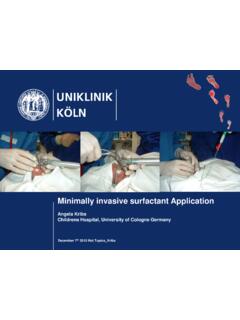
8 As a result, the minimally invasivesurfactant Administration (MIST) technique has been pro-posed as an alternative, in which, following direct laryn-goscopy, the Surfactant is slowly administered through athin tracheal catheter to infants capable of spontaneousbreathing and supported by CPAP. This technique does notrequire the Administration of sedatives or the use of posi-tive pressure ventilation and causes less damage to the air-ways and is well-tolerated by tinier infants (15, 16).2. ObjectivesThe present study was conducted to assess the presentcapacities for performing the MIST technique and to exam-ine its long- and short-term complications and to comparethem with the conventional INSURE technique in the treat-ment of RDS in preterm infants (28 to 34 weeks of gesta-tion).
9 3. Study Design and PatientsThe present study examined preterm infants (28 to34 weeks of gestation) with respiratory distress syndrome(RDS) admitted to the neonatal intensive care unit ofRoointan-Arash maternity hospital in Tehran from May2013 to February 2014. The study was approved by the ethicscommittee of Tehran University of Medical Sciences. Thisstudy is registered with the Iranian registry of clinical tri-als, IRCT2014080716937N4. Infants with an Apgar score of 4or less at 5 minutes, those who needed intubation and me-chanical ventilation, and those with congenital anomaliesor lacking parental consent were excluded from the was diagnosed in the infants based on their needfor supplemental oxygen, clinical signs of tachypnea, re-tractions, and grunting and it was confirmed by a chest X-ray and blood gases infants who required supplemental oxygenand had good respiratory efforts were put on nasal levels ranged from 5 to 8 cm H2O and FiO2was ad-justed so as to maintain an oxygen saturation of 85% - 92%.
10 Infants requiring FiO2> 50% and those with respiratoryacidosis (pH < ) or prolonged apnea were intubated (17).Infants with RDS who required FiO2> 40% to maintainan oxygen saturation (SpO2) in the range of 85% - 92% wererandomized to receive Surfactant by either the INSURE orthe MIST caffeine was administered with a loadingdose of 20 mg/kg and continued with a maintenance doseof 5 mg/kg per the randomization, informed written consentswere obtained from the Randomization and MaskingSimple randomization was used in the allocation ofparticipants. In case of multiple pregnancies, each infantwas examined separately. Blinding was not performed inany of the stages of the study, from the intervention to thedata analysis and the interpretation of the The INSURE ProcedureThe infant was first intubated through the mouth withan endotracheal tube appropriate to his weight and ges-tational age.