Transcription of A Revision to the Revised Bloom’s Taxonomy
1 A Revision to the Revised bloom s Taxonomy Afnan N. Darwazeh An-Najah National University Robert Maribe Branch University of Georgia Key Words: bloom , Taxonomy , cognitive domain, cognition, metacognition, component display Introduction We propose a Revision to the [ Revised ] bloom s Taxonomy based on the results of an extensive review of related literature and analyses of studies in the field of cognition and human information processing. This paper 1) presents the original bloom Taxonomy , 2) presents Anderson s Revision of bloom s Taxonomy , 3) provides an analysis of Anderson s Revision of bloom Taxonomy , and 4) offers a Revision to the [ Revised ] bloom s Taxonomy . In early 1940 s, the cognitive researchers and psychologists had stated, based on cognitive and human information processing theories, that a human s mind applies different mental processes while he or she manipulates, develops, insights, stores, and retrieves information (Gagne, 1977; Guilford, 1956; Lindsay& Norman, 1977; Piaget, 1952; Rothkoph, 1966; Rumelhart, & Ortony, 1977; Wittrock, 1974).
2 These mental processes differ in terms of types, such as memorization, comprehension, discrimination, analysis and the like, and also in terms of level of difficulty, such as simple, medium or complex. Accordingly, a number of instructional psychologists have utilized the results of cognitive research and applied its principles into field of education ( bloom , 1956; Guilford, 1967; Gagne, & Briggs, 1979; Merrill, 1983). They aim to help teachers and curriculum developers to design instruction that will induce students to use different forms of mental processes ,on different levels of difficulty, so that the whole instructional process will be remarkably enhanced. One of the most prominent instructional psychologists who tried to apply the cognitive principles was Benjamin bloom . bloom (1956) published a Taxonomy of educational objectives within the cognitive domain. bloom and his associates classified different forms and levels of learning based on mental processes that students involved in while they learn.
3 bloom s Taxonomy gained immediate popularity; however, after almost six decades of using bloom s original Taxonomy , some educators began to wonder whether the Taxonomy was still valid to this age that characterized of lot of research and studies on intellectual skills and human thinking and learning. One of those educators was Lorin Anderson, a former student of Benjamin bloom . Anderson and Krathwohl (2001) Revised bloom s Taxonomy to be more adaptive to our current age by proposing another Taxonomy that will meet curriculum designers, teachers, and students needs better than the bloom s one. However, based on a thorough assessment we contend that Anderson and Krathwohl s (2001) Revised bloom s Taxonomy still fails to match the cognitive psychologists recently discovered types and difficulty levels of mental processing ( bloom , 1956; Darwazeh, 1995, 2011; Lindsay & Norman, 1977; Merrill, 1983; Tuckman, 1992;West, Farmer, and Wolff, 1991).
4 Therefore, based on a current review of the literature on cognition, and particularly based on Merrill s Component Display Theory (1983), further Revision to the Revised bloom s Taxonomy is appropriate. The original bloom s educational Taxonomy bloom et. al (1956) published the Taxonomy of educational objectives: a cognitive domain. bloom et. al (1956) classified forms and levels of learning based on cognitive processes that learners involved in when they learn. bloom considered his initial effort to be a starting point, as evidenced in memorandum from 1971 in which he stated Ideally each major field should have its own Taxonomy in its own language more detailed, closer to the special language and thinking of its experts, reflecting its own appropriate sub-division and levels of education, with possible new categories, combinations of categories and omitting categories as appropriate ( ). Anderson s Revised Taxonomy as a match to bloom s Taxonomy Anderson (1990), a former student of bloom , updated and Revised the Taxonomy reflecting relevance to 21st century work for both students and teachers as she said (Anderson& Krathwohl, 2001).
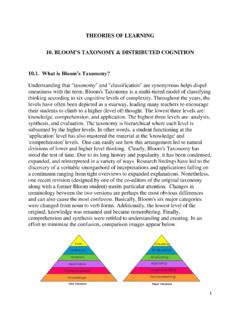
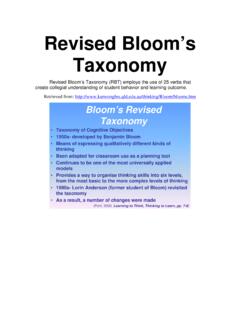
5 Anderson changed the Taxonomy in three broad categories: terminology, structure and emphasis (Forehands, 2005). Anderson modified the original terminology by changing bloom s categories from nouns to verbs. Anderson renamed the knowledge 220 category into remember, comprehension into understanding and synthesis into create categories. Anderson also changed the order of synthesis and placed it at the top of the triangle under the name of Create (Taylor & Francis, 2002). Thus, Anderson and Krathwohl s (2001) Revised bloom s Taxonomy became: Remember, Understand, Apply, Analyze, Evaluate and Create ( Figure 1). Figure 1. The Revised bloom 's Taxonomy by Anderson and Krathwohl (2001). Anderson and Krathwohl (2001) also made structural changes to the original bloom s Taxonomy . Anderson considered two dimensions in the Revised Taxonomy instead of one, a products dimension. The two dimensions are: 1) knowledge (or the kind of knowledge to be learned) and 2) cognitive process (or the cognitive processes to be used in acquiring knowledge).
6 The intersection of the knowledge and cognitive categories form 24 separate cells as represented in Figure 2. Based on Anderson s perspective, the Knowledge Dimension on the left side is composed of four kinds: Factual, Conceptual, Procedural, and Meta-Cognitive knowledge. The Cognitive Process Dimension across the top of the grid consists of six levels: Remember, Understand, Apply, Analyze, Evaluate, and Create. The Cognitive Process Dimension RememberUnderstandApplyAnalyze EvaluateCreateFactual Knowledge List Summarize Classify Order Rank Compile Conceptual Knowledge Describe Interpret Experiment Explain Assess Plan Procedural Knowledge Tabulate Predict Calculate Differentiate Conclude Compose Meta-Cognitive Knowledge Appropriate use Execute Construct Achieve Action Actualize Figure 2. Knowledge and Cognitive Dimensions of bloom s Taxonomy as Revised by Anderson. Notes, Comments and Justifications on the Revised bloom s Taxonomy Based on an analysis of the Anderson and Krathwohl (2001) Revision of bloom s original 1956 Taxonomy , the authors recommend further revisions based six reasons: First.
7 Anderson s Revised bloom s Taxonomy omits several points within the cognitive dimension and the knowledge dimension. Second. The organizing process is missing. Third. The sequence of cognitive processes should be reconsidered. Fourth. Remembering level should be sub-divided. Fifth. The difficulty level for analysis, organize, and application should be replaced. Sixth. A principle type of knowledge has been omitted. 221 First: The Revised bloom s Taxonomy , which had been proposed by Anderson and her associates, omits several points either in the cognitive process dimension, or in the knowledge dimension. The review of the literature on Meta-Cognitive processes which have been conducted after the appearance of bloom s Taxonomy in 1956 (Baker & Brown, 1984; Bondy, 1984; Brown, 1981; Burley, Brown, & Saunders; 1985; Darwazeh, 2004; Dermody, 1988; Flavell, 1976; Gagne, 1977; Gilbert, 1986; Haller, et al. 1988; Kaufman, & Randlett, 1983;Lindsay & Norman, 1977; Paris & Winogard, 1990; Pressley, Borkowski, & Sullivan, 1985; Scarr, & Zanden, 1984; Tregaskes, 1989; Wham, 1987; Wade, &Reynolds, 1989) and studies on instructional design (Darwazeh, 1994; 2001, 2011; Gagne, Briggs, & Wager, 1992; Merrill, 1983; Reigeluth, 1983; West, et al.)
8 1991), stated that the Meta-cognitive process is a process of thinking rather than a type of knowledge, with the primary definition of meta-cognition is thinking about thinking. Second: Another note on Anderson s Revised bloom s Taxonomy is related to the levels of cognitive processes. The cognitive dimension is missing a major process that the mind performs from the earliest stages of human development. It is the Organizing process, which was named by bloom as a synthesis process. Therefore, we cannot integrate this process under the application process and put the two of them in one category. We cannot also look at the organizing process as a creative process like Anderson did in her Revision . The organizing or synthesizing process should be separated in a different category as bloom did in his original Taxonomy . Third: The sequence of cognitive processes should be reconsidered. Anderson and Krathwohl (2001) looked at the organizing or syntheses process as a creative process, which we dispute, because the synthesis process is easier to perform than the creation process (Figure 1).
9 Creation needs form the person to give something new and original, whereas, the syntheses needs to put the elements or parts together according to a certain model or principle. In this case, the synthesis is a prerequisite of the creation process. Based on the perspective of synthesis as a prerequisite for creation, we differ from Anderson, et al. in their proposed Taxonomy that considers the synthesizer process as an organizing process. The organizer usually comes after the analysis process. Fourth: The Remembering level should be sub-divided. Anderson and Krathwohl s (2001) Revised bloom s Taxonomy did not differentiate between two levels of remembrance, (i) remember specific information and (ii) remember general information. Merrill (1983) has clearly differentiated in his Component Display Theory between the two levels based on the content type: a) remember specific information and b) remember general information. Merrill defined the specific information as a kind of knowledge or data which cannot be generalized or transferred to another situation, because, it is just valid on itself such as, dates or events, names, symbols, terms, labels, examples, lists, instances; whereas, the general information is a kind of knowledge that can be generalized and applied to more than one situation, such as concepts, principles and procedures.
10 Merrill also claimed that remembering specific information is easier to recall or recognize than remember general information, and so it should actually come before remembering general information. Fifth: The difficulty level for analysis, organization, and application should be replaced. The application process is more difficult to perform than the analysis or organizing processes when encountering a situation for the first time, so the application should come afterward. The reason is, the application process defined by both bloom (1956) and Merrill (1983) as the usage of previous acquired knowledge (generalities)in new situations. The contention here is that learners can only use or apply the acquired knowledge in a new, novel, or strange situation unless he or she inspects, analyzes, organizes, and re-organize its components. These processes of analyzing and organizing will help him or her to see where the previous learned knowledge will fit in a new situation, thus, to use and apply them correctly.