Transcription of A Six-Step Process for Teaching T Vocabulary
1 2 The importance of Vocabulary knowledge to reading and general literacy has been recognized for decades. Additionally, years of research and theory have provided rather clear guidance about direct instruction in Vocabulary terms. Much of that research has been described and interpreted in the book Building Background Knowledge for Academic Achievement (Marzano, 2004). In brief, the research and theory point to instructional activities that help students understand new Vocabulary terms that are taught directly and also remember what they have learned at a later date.
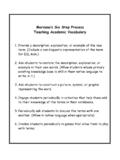
2 Those instructional activities can be organized into six instructional first three steps are used to introduce a new term to students. The last three steps address different types of multiple exposures that students should experience over time to help them shape and sharpen their understanding of the terms. The six steps are as follows:Step 1: Explain Provide a student-friendly description, explanation, or example of the new 2: Restate Ask students to restate the description, explanation, or example in their own 3: Show Ask students to construct a picture, symbol, or graphic representation of the 4: Discuss Engage students periodically in structured Vocabulary discussions that help them add to their knowledge of the terms in their Vocabulary 5.
3 Refine and reflect Periodically ask students to return to their notebooks to discuss and refine entries. Step 6: Apply in Learning Games Involve students periodically in games that allow them to play with is a brief description of each of the 1: Explain Provide a description, explanation, or example of the new , a teacher should provide students with information about the new term. There are a number of different ways that teachers can help students build their initial understanding of the term. Teachers tell a story using the term.
4 Use video or computer images as a source of information. use current events to connect the term to something familiar. describe their own mental pictures of the term. find or create pictures that exemplify the term. Notice that some of these suggestions include providing images. Using both linguistic and nonlinguistic explanations of a new term will help students develop an initial understanding of the term, as well as help prepare them to create their own pictures or graphic representations in Step 3 of the Process .
5 Step 2: Restate Ask students to restate the description, explanation, or example in their own the second step, the teacher asks students to restate the meaning of the term in their own words. It is critical that instead of simply copying what the teacher has said, the students own the new terms by constructing their own descriptions, explanations, or examples. Their constructions need not be comprehensive, but efforts should be made to ensure they do not contain major errors. It is very useful to have students record their descriptions, explanations, and examples in a Vocabulary notebook.
6 For each term, the notebooks should provide a space for students descriptions (Step 2), students picture or representation of the term (Step 3), and room for additional information students might add as a result of Steps 4, 5, and 6. Step 3: Show Ask students to construct a picture, symbol, or graphic representation of the Step 3, students are asked to construct a picture, symbol, or graphic representation of a term; this forces them to think of the term in a totally different way. Written or oral descriptions require students to Process information in linguistic ways.
7 Pictures, symbols, and graphic representations require students to Process information in nonlinguistic Six-Step Process for Teaching VocabularyRobert J. 284/12/06 5:46:11 PMVocabulary2 If students are not accustomed to creating pictures and graphics for ideas, they might initially need significant guidance and modeling. Even if they have experience with nonlinguistic representations, it is likely that they will still need help with terms that are difficult, new to them, or abstract. Step 4: Discuss Engage students in discussion activities that help them add to their knowledge of the terms in their vocabu-lary the fourth step, students are engaged in activities designed to help them discuss and review the terms in their Vocabulary note-books.
8 These activities include having students compare and contrast terms, classify terms, identify antonyms and synonyms, and create analogies and metaphors using the terms. During this time, students should be provided with opportunities to add to or revise the entries in their Vocabulary notebooks. Step 5: Refine and reflect Ask students to return to their note-books to discuss and refine entries. Both research and common sense suggest that interacting with other people about what we are learning deepens the understanding of everyone involved particularly when we are learning new terms.
9 During Step 5, students examine the entries in their Vocabulary note-books to make changes, deletions, and additions. The teacher might ask students to do this in pairs or small groups. Students might: compare their descriptions of the term. describe their pictures to each other. explain to each other any new information they have learned or new thoughts they have had since the last time they reviewed the terms. identify areas of disagreement or confusion and seek 6: Apply in Learning Games Involve students in games that allow them to play with might be one of the most underused instructional tools in education.
10 Many types of games can help teachers keep new terms in the forefront of students thinking and allow students to reexamine their understanding of terms. It is important to set aside blocks of time each week to play games in order to energize students and guide them in the review and use of important instruction in Vocabulary is a critical aspect of literacy development. Synthesizing research and theory on direct Vocabulary instruction into an innovative Six-Step instructional Process enables classroom teachers to teach and reinforce selected Vocabulary terms with , (2004).