Transcription of A1
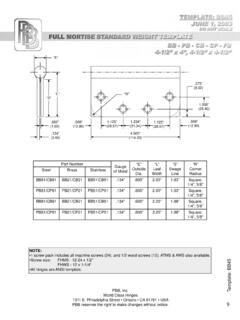
1 A1 BUTT HINGES - Table 2-8A of the National Fire Protection Association (NFPA) handbook No. 80 sets forth the minimum quantity, size and weight (thickness) for swinging fire doors. Table 2-8A also stipulates that All hinges or pivots, except spring hinges, must be of the BALL BEARING type. As far as quantity is concerned, Table 2-8A requirements correspond exactly with the hardware industry standards (up to 60 inches in height, 2 hinges and an additional hinge for each additional 30 inches or fraction thereof) and should be followed in all cases.
2 Table 2-8A calls for size 4-1/2 inch hinges to be used on full sized doors with mortise or surface type hinge application. Good hardware practice would require 5 inch hinges to be used on doors over 3 feet 6 inch in width. The difference between 5 and 4-1/2 inch hinges, in terms of bearing surfaces, pin sizes, fastenings and weight of leaf metal, is vast, A knowledgeable hardware consultant will insist upon the larger size where wide, heavy doors are being or gauge of hinge metal, more commonly referred to as weight, varies with the door size. Standard weight hinges in size 4-1/2 inch have leaves of thickness, while heavy weight hinges in the same size have leaves of thickness.
3 Table 2-8A (below) allows the former to be used on 4 0x8 0x1-3/4 in size, while calling for the heavy on doors up to 4 0x10 0x1-3/4 . Since these two requirements overlap, the practical effect is to permit standard weight hinges to be used on all size doors to and including 4 0x8 0x1-3/4 , and to call for the heavy weight hinge only on larger again good practice calls for a somewhat different rule. If 4-1/2 inch hinges are being used, heavy weight should be provided on all door widths greater than 3 0. For door size exceeding 3 6x8 0x1-3/4 hinges should be 5 inches high on (heavy weight) hinges of the olive knuckle type may be used on labeled doors when permitted in the door manufacturer s procedure.
4 Observe hinge and door size limitations as listed in Table : ALL HINGES OR PIVOTS, EXCEPT SPRING HINGES, MUST BE OF THE BALL BEARING up to 60 inches in height shall be provided with two hinges and an additional hinge for each additional 30 inches of height or fraction thereof. 1995 NFPA, All Rights Reserved NFPA 80-1995 Mortise and Surface Hinges, Pivots, or Spring Hinges for Swinging DoorsDoors up to 60 in. ( m) in height shall be provided with two hinges and an additional hinge for each additional 30 in. ( ) of door height or fraction thereof. The distance between hinges may exceed 30 in.
5 ( m). When spring hinges are used, at least two shall be Rating, HrMaximum Door SizeMinimum hinge SizeType HingeWidth,Ft (m)HeightFt (m)HeightIn. (mm)ThicknessIn. (mm)For 1-3/4-In. ( ) or Thicker Doors31-1/213/41/21/34 ( )10 ( )4-1/2 ( ) ( )Steel, Mortise or Surface31-1/213/41/21/34 ( )8 ( )4-1/2 ( ) ( )Steel, Mortise or Surface1-1/23/41/21/33 ft. 2 in. ( )8 ( )6 ( ) ( )Steel-Olive Knuckle or Paumelle31-1/23/43/41/21/34 ( )10 ( )4 ( ) ( )Steel Pivots (including top, bottom and intermediate)1-1/213/41/21/33 ( )5 ( )4 ( ) ( )Steel, Mortise or Surface1-1/213/41/21/32 ( )3 ( )3 ( ) ( )Steel, Mortise or Surface31-1/213/41/21/33 ( )7 ( )4-1/2 ( ) ( )Steel, Mortise or Surface (labeled self-closing spring type)31-1/213/41/21/33 ( )7 ( )4 ( ) ( )Steel, Mortise or Surface (labeled self-closing spring type)For 1-3/8-In.
6 ( ) Doors31-1/23/41/21/33 ( )7 ( )3-1/2 ( ) ( )Steel, Mortise or Surface31-1/213/41/21/32 ft. 8 in. ( )7 ( )3-1/2 ( ) ( )Steel, Mortise or Surface (labeled self-closing spring type)NOTE 1: All hinges or pivots, except spring hinges, shall be of the ball bearing type. Hinges or pivots employing other antifriction bearing surfaces are permitted if they meet the test requirements of Standard for Butts and Hinges (ANSI ). Spring hinges shall be 2: 4-1/2 in. (114-mm) high, in. ( ) thick hinges should be used on doors which are usually wide and heavy or which will receive high frequency use or unusual 3: Some manufacturers may provide fire doors with hinges of lighter weight which are not ball bearing when they are part of a listed assembly and meet the test requirements of ANSI and have been tested to a minimum of 350,000 4.
7 Pivot sets made up of components smaller and/or of a lighter gauge than shown in Table 2-8A may be used provided they meet the requirements of ANSI Door Controls (Closers), and are in accordance with the manufacturers labeled service DETERMINES KIND OF HINGEUse Three Hinges To A Door - Use Anti-Friction Bearing Hinges On Doors Equipped With ClosersTO SELECT THE PROPER HINGETHE FOLLOWING FACTORS SHOULD BE CONSIDERED The material of the door and frame determine method of application, mortised, surface mounted, half surface mounted, or half mortised. The size, thickness and weight of the door - Wider doors, put more strain on hinges, so taller hinges should be used.
8 Thicker doors require wider hinges. Heavy doors require taller, heavier gauge, narrower hinges. Clearance of the trim when a door swings 180 effects the width of the hinge . The frequency of use and the abuse the door will be subjected to effect hinge choice .. heavy duty ball bearing, average ball bearing or non-ball bearing hinges. It also effects the need for additional hardware such as closers, panic devices, MORTISEWood Doors, Wood FrameFULL MORTISEWood Doors, Hollow Metal FrameFULL MORTISEH ollow Metal Doors, Hollow Metal FrameHALF MORTISEH ollow Metal Doors, Channel Iron FrameHALF SURFACEWood Doors, Wood FrameHALF SURFACEM ineral Core Doors, Hollow Metal FrameFULL SURFACEM ineral Core Doors, Channel Iron FrameFULL SURFACEH ollow Metal Doors, Channel Iron Frame SWING CLEAR FULL MORTISEWood Doors, Hollow Metal Frame SWING CLEAR HALF MORTISEWood Doors.
9 Channel Iron Frame SWING CLEAR HALF SURFACEM ineral Core Doors, Hollow Metal Frame SWING CLEAR FULL SURFACEM ineral Core Doors, Channel Iron FrameA3 Face of FrameBacksetDoor ThicknessInsetClearanceDoor OpenDoorThicknessHOW TO SELECT THE PROPER WEIGHT AND BEARING STRUCTURET here are three groups of hinges: Standard Weight - Plain Bearing Standard Weight - Ball Bearing Heavy Weight - Ball BearingTo determine the weight and structure of the hinge you must consider: 1. Frequency of use 2. Weight of door 3. Weight of door hardwareBall bearing hinges should always be used on doors where door closers are applied and in all fire rated openings.
10 Heavy weight ball bearing hinges should be used on heavy doors and high frequency use TO DETERMINE THE FREQUENCY OF USEF requency Of Use General GuidelinesTYPE OF BUILDING/USEHIGH FREQUENCYL arge Department Store EntranceLarge Office Building EntranceHospital Corridor and Surgical DoorsSchool EntranceOffice StairwellMEDIUM FREQUENCYH ospital Consultation RoomsSchool CorridorOffice Building CorridorStorage RoomLOW FREQUENCYR esidential EntranceResidential InteriorEXPECTEDDAILY5,0004,0005,0001,25 050010010080503020 FREQUENCYYEARLY1,825,0001,460,0001,825,0 00356,250182,50036,50036,50029,20018,250 10,9507,300 HOW TO DETERMINE THE DOOR WEIGHTE stimated Door Weights in Pounds Per Sq.