Transcription of Accelerating Improvement - Ohio Perinatal Quality ...
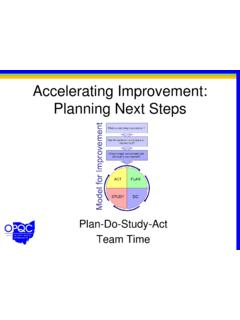
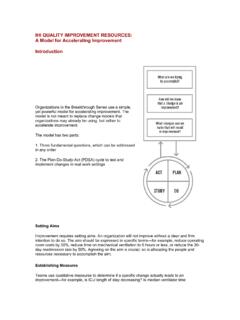
1 Accelerating Improvement Michael P. Marcotte, MD. Maternal Fetal Medicine Director of Quality for Maternity Services TriHealth Cincinnati Objective Discuss PDSA Ramps as a means to accelerate Quality Improvement in the Perinatal Period PDSA. Plan Look at a particular aspect of project Review intervention options Plan implementation of intervention What do you predict will happen? Do Execute the intervention PDSA. Study How did the intervention go? Did it go the way you expected? What was the outcome? Was the a measure? Act Accept Adopt Abandon PDSA Cycles PDSA Cycles help us execute true tests by helping QI teams: Think small Develop detailed plans to execute the tests of change (who, when, where ). Be methodical and make predictions Allow rapid adaptation and implementation of changes in busy healthcare settings OPQC: Decreasing births < 39 weeks gestation without medical indication and improving birth registry accuracy project Interventions Goal.
2 Assure that all initiation of labor or caesarean Inform consumers of risk/benefits of deliveries < 39 weeks sections on women who are not in labor occur only when Communicate to patient/clinic/hospital ultrasound results obstetrically or medically indicated Promote need for early dating to practitioners and consumers Public awareness campaign Aim Key Drivers Promote need for early dating to practitioners and consumers Promote sonography < 20 weeks to establish dates Awareness of risks & Document criteria used to establish EDC. expected benefit of Appropriate use of fetal maturity testing scheduled delivery prior Empower nurses /schedulers to require dating criteria Identify a specific contact for authorization dispute re: dating In 9 months, to weeks by Provide patient with hard copy results of ultrasound patients and other reduce to 5% or less, consumers Empower nurses /schedulers to require dating criteria the number of Document rationale and risk/benefit for scheduled deliveries at women in Ohio of to weeks gestation Dating criteria.
3 Optimal Document discussion with patient about the above to weeks estimation of Both patient and MD sign consent statement for scheduled delivery gestation for whom gestational age between and weeks delivery is scheduled Physician awareness campaign: what are the reason(s) for scheduled delivery? in the absence of Maximize access to Delivery and OR for optimal scheduling appropriate medical Hospital and physician Facilitate scheduling policies that respect ACOG criteria indication practice policies that facilitate ACOG criteria Prenatal caregivers receive feedback from postnatal caregivers about neonatal outcomes of scheduled deliveries Ensure complete and accurate handoffs OB/OB and OB/Peds Document discussion with patient about risk/benefits of near-term Awareness of risks & delivery expected benefit of Promote need for early dating to practitioners and consumers near-term delivery by Continuous monitoring of data & discussion of this effort in clinician staff/division meetings.
4 Project outcomes posted on units and websites. Develop ways to include staff and physician input about Culture of safety and communications and handoffs Connect with organizational initiatives on safety and use existing Improvement approaches as possible Empower nurses/schedulers to require data criteria Revised: Dating Criteria: Best OB. Estimate of Gestational Age Promote need for early dating to practitioners and consumers Promote sonography < 20 weeks to establish dates Document criteria used to establish EDC. Appropriate use of fetal maturity testing Empower nurses /schedulers to require dating criteria Identify a specific contact for authorization dispute re: dating Provide patient with hard copy results of ultrasound First PDSA.
5 PLAN. Plan: Use scheduling form that requires dating criteria to be included as part of scheduling inductions/CS. office will send US report and first page of prenatal record so scheduler can fill out dating information DO: Doctor's Office calls to schedule Desires repeat CS on 6/1/2013. Scheduler requests copy of first US. and First page of prenatal record Enters data into dating criteria and determines the best OB estimate Due Date is 6/15/2013 making her 38 weeks (1st trimester US) at date requested not 40 weeks (by LMP). Study The doctor's office did not have authorization to send in records to scheduling No records sent Patient scheduled CS on 6/1/2013 and baby to NICU for respiratory difficulty on CPAP for 2. days ACT. Analysis of case reveals that dates should have been changed and patient not scheduled until at least 6/8/2013.
6 ADAPT. Determining the Best Obstetric . Estimate of gestational Document first day of last menstrual period (LMP). age Do Ultrasound before 20 weeks gestation First trimester ultrasound measurement of Crown Rump Length (CRL)*. accurate in determining gestational age +/- 5 days Second trimester ultrasound measurement of:*. Head circumference (HC), Abdominal Circumference (AC). Bipariatal diameter (BPD). Femur Length (FL). To calculate US estimate of gestational age accurate in determining gestational age +/- 10 days Use earliest US to establish best OB estimate of gestational age (GA). and Estimated Due Date (EDD). If no LMP known use earliest US to establish best Ob estimate of gestational age and EDD. If first trimester CRL suggests GA is > 5 days different than LMP use CRL GA as best estimate If first trimester CRL suggests GA is within 5 days of LMP use LMP as best estimate If no first trimester ultrasound try to get US before 20 weeks If second trimester measurements suggest GA is > 10 days different than LMP use US GA as best estimate If second trimester measurements suggest GA is < 10 days different use LMP as best estimate *Fetal Imaging Workshop, NICHD December 2012.
7 Dating Criteria Measure date Gest age EDD Best Criteria LMP (first day) 8/25/2012 06/01/2013. First US 11/7/2012 8w5d 06/15/2013 . Next PDSA. PLAN: memo to all doctor's office notifying them that in future to schedule Delivery they need to provide first page of prenatal record and report of First US done in pregnancy Prediction: no baby will be delivered before 39 weeks unless clear indication for delivery DO. Memo sent for chief of OB to 5. practices that delivery at hospital Next case scheduled after prenatal record reviewed and report of first US. reviewed Case scheduled as requested at 39. weeks by LMP (Best OB estimate). Study Hospital Record had Best OB Estimate of Due date in record at time of scheduled repeat CS and baby known to be 39 weeks Baby did not have any respiratory problems and had an uneventful stay in hospital ACT.
8 ADOPT process All stakeholders support the new process for scheduling deliveries Next PDSA. Plan: ramp up for next week use for all cases scheduled Prediction: all babies will have best OB. estimate of Due date determined at the time of scheduling delivery No baby will be born before 39 weeks determined by best OB Estimate STUDY. For the next week Prediction found to be true One case rescheduled as best OB. estimate found to place pregnancy at 38 3/7 weeks at time of scheduled IOL. The first US was done at 12 weeks and was 7 days off from LMP date ACT. ADOPT scheduling process for all cases scheduled for delivery On going study of process with regular audits of scheduling forms All unusual cases and any that are rescheduled are reviewed and feedback given to provider about determining the best OB estimate of Gestational Age Multiple PDSA Cycle Ramps Use Memo:to Use of 1st pg Continuous scheduling schedule prenatal &US learning form w/ provide report to system dating schedule criteria prenatal deliveries for record & 1st all practices US report (5.)
9 In Conclusion Having a plan to ramp up a change and analyzing at each test allows for rapid learning, adoption of change and spread. This allows for dissemination of new knowledge and buying from all key stake holders It often takes an adverse event to drive stakeholders to buy in to change Questions (513)254-8512.