Transcription of Accelerating the Pace of Improvement
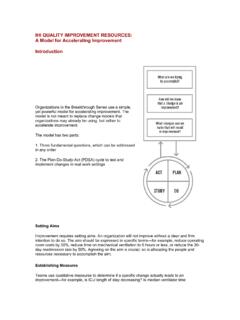
1 JournalonQuaLITY IMPROVEMENTINTERVIEWA ccelerating the Pace of Improvement :An Interview with Thomas NolanINTERVIEWED BY STEVEN BERMANA w idely used fram ew ork for im provement, which its de- v e lo p e r s , Associates in Process Improvement , called a M odel f o r Improvement , is based on the PDSA (plan, do, study, a c t ) cycle and three fundam ental questions; What are we t r y i n g to accom plish? How w ill we know that a change is a n im provem ent? What changes can we make that will r e s u lt in im provem ent? This m odel reflects a focus on c h a n g e on developing, testing, and im plem enting spe c i f i c , identifiable changes.
2 In an interview with Steven B er m a n in February 1997, Thomas Nolan, PhD, a statis- t i c i a n , im provem ent consultant, and co-author o f The Improvement Guide: A Practical Approach to Enhanc in g Organizational Performance (San Francisco: Jossey- B a ss, 1996), discusses methods and issues in Improvement a n d change. Dr Nolan can be reached at Associates in Pro c e s s Improvement , 1110 Bonifant Street; Suite 420, Sil- v e r Spring, MD 20910; phone 301/589-7981; fax 301/ 5 8 9 -0 154; e-m ail t seem s almost tautologic to say that im p ro vem en t depends on change. What are y o u really getting at in focusing your im p ro v e m e n t m odel and m ethods on ch a n g e?
3 All Improvement will require change, hut not all change will result in Improvement . Change and improve m e n t are not synonymous. The science of Improvement is actually based on making informed and intelligent 1997 by the Joint Commission on Accreditation of Healthcare OrganizationsWhen you refer to the science of improve- ment' what do you include in that science?The science includes methods to develop, test, and implement changes that result in Improvement with respect to a set of defined criteria. The knowledge that underlies these methods include an appreciation of how people and processes interact in a system, standards for the design of effective tests, and principles for the col- lection and analysis of did not mention any tools such as flow- charts that are commonly associated with quality improvementFlowcharts and other tools can be helpful, but they can be overemphasized to the point that it ap- pears using them is the aim.
4 If a physician were asked to describe what was included in the science of medi- cine, one would not expect 'stethoscope, for example, to be part of the focus on specific, identifiable changes' as apart from broad or vague organizational or cultural change; butdon t you need an overall climate that fa- cilitates making and testing changes?It is desirable to reliably produce improvements in a variety of settings. The organizational climate in a trucking company is very different from that in a law firm. The culture in a teaching hospital is often differ-VOLUME 23 NUMBER 4 Used with Permission: JOINT COMMISSIONent from that in a community hospital.
5 Each organiza- tion needs to improve to stay competitive and accom- plish its mission. We must develop methods that are robust to different organizational cultures. However, I will admit that it is very difficult to make substantial Improvement if one or more of the following ingredi- ents are missing: a spirit of cooperation to achieve a common aim, the intention and will to make changes, and an investment of rime and other does your approach of testing change compare to the use of randomized trials with controls, which is the standard for medical research?All the authors have been involved in the design of research studies or other complex experiments.
6 We discuss some of these designs in the book. However, it is neither feasible nor desirable to conduct a random- ized controlled trial every time we make a change to a process of care. This is not an invitation to be careless in the design of tests. As a practical supplement to ran- domization and the use of blind controls, we advocate the use of sequential, small-scale tests, graphical display of data to facilitate understanding of the sources of varia- tion, and measures plotted over time to estimate the impact of and your colleagues advocate a trial- and-learning method of testing change on a small scale before making very broad changes.
7 Doesn t the recent health care insurance legislation mandating limited, experimental use of medical spending ac- counts show that perhaps we have learned something, after the massive, overnight introduction of DRGs (diagnosis-related groups) in the early 1980s or of the failed Clinton health care reform initiative?The example you cite is encouraging, but I see little evidence that the federal government is inclined to test changes routinely on a small scale. To be fair, meth- ods for testing changes in a politically charged environ- ment unnder media scrutiny are nor well developed. This is an important area for it often seems that people want the changes they implement to be dramaticand large scale.
8 How do you get them to be patient and learn to live with sequen tial small-scale tests of change?Your question contains elements of some of the misunderstandings that many people have when they hear the phrase sequential small-scale tests of change. My colleagues and I aim to increase the impact of im- provements and the pace at which they are made. Small scale refers to the size of the test or the current scope of the implementation. The change being tested could be very innovative and a significant depar- ture from current practice. Testing a change on a small scale actually speeds up the pace and increases the im- pact of Improvement for a variety of reasons, For ex- ample, people are less resistant to a test than to a large-scale implementation; fewer people will be involved in a small-scale test, which means less logistics to be planned.
9 Problems with the change can be identified and corrected early is it important to conduct tests of change under a wide range of conditions, as you suggest?Making a change to improve a system involves a prediction that the change will be beneficial in the long run. Yet conditions in the future will be different from the conditions of the rest. Circumstances will arise that were unforeseen or not present at the time of the test. It is difficult if not impossible to accurately predict all the impacts of a change. The recent recognition that air bags may be harmful for young children or very short adults sitting in the front seat of a car is an example of a change that is an Improvement only under cer- tain conditions.
10 If a change remains an Improvement over a wide range of conditions, the degree of belief in its worth is you cite an example of where a test of a change worked initially but not later and how varying the conditions for the tests might have helped?A hospital was attempting to reduce its medica- tion errors. To decrease errors of omission, standard times for administering medications were tested on one test was very successful. Hospital administration decreed that standard administration times would be used on all 1997 JOURNALUsed with Permission: O U R N A L O N Q U A L I T Y I M P R O V E M E N TPatients in the unit on which the test was per- formed were there (or a relatively long time and their medication orders were not changed very often.)