Transcription of Acceptance and Commitment Therapy (ACT) and …
1 Acceptance and Acceptance and Commitment Therapy Commitment Therapy (ACT) and chronic Pain(ACT) and chronic PainLance M. McCracken, PhDLance M. McCracken, PhDCentre for Pain ServicesCentre for Pain ServicesRoyal National Hospital for Rheumatic Diseases Royal National Hospital for Rheumatic Diseases Centre for Pain ResearchCentre for Pain ResearchUniversity of BathUniversity of BathBath UKBath UKOutline of TalkOutline of Talk Propose that psychological approaches to Propose that psychological approaches to chronic pain are developingchronic pain are developing Describe an ACT an ACT model. Summarize the state of outcome literature Summarize the state of outcome literature on ACT for chronic ACT for chronic pain. Suggest thatSuggest thatoSuffering is normalSuffering is normalocontrol is often unworkablecontrol is often unworkableoyour mind cannot be trustedyour mind cannot be trustedThe Evolution of Clinical PsychologyUnderlying FrameworkProcesses of PathologyTargetTherapy ProcessesOperantConditioningBehaviorCond itioningCognitiveBehavioralConditioning, attention, cog bias, thinking,believingBehavior andsymptoms(physical &emotional)Skills training,exposure,cognitivetherapyContex tual(MBSR, ACT)Avoidance,cog fusion,self, values, Commitment ,loss of presentBehaviorAcceptance,defusion,mindf ulness,values, skillstraining,relationship.
2 There is little empirical support for there is little empirical support for the role of cognitive change as causalthe role of cognitive change as causalin symptomatic improvements in symptomatic improvements achieved in CBT. achieved in CBT. (Longmore & Worrell, 2007)(Longmore & Worrell, 2007) MethodMethod N = 2,345 people attending treatment N = 2,345 people attending treatment for chronic chronic pain. Measures of outcome administered Measures of outcome administered pre-, post, and 1 month , post, and 1 month follow-up. Measures of adherence to treatment Measures of adherence to treatment methods measured at 1 month follow-methods measured at 1 month ResultsResults Adherence to pacing, thought Adherence to pacing, thought challenging, stretching, and exercise challenging, stretching, and exercise had very small relations with outcome had very small relations with outcome Variance in wellbeing at follow-up Variance in wellbeing at follow-up accounted for by adherence factors accounted for by adherence factors ranged from 1 to 2%.
3 Ranged from 1 to 2%. If taken at face value, the findings If taken at face value, the findings suggest that both theory and practicesuggest that both theory and practiceof recommending adherence to of recommending adherence to treatment methods require re-treatment methods require re-examination if not overhaul. (p 187)examination if not overhaul. (p 187) Therapist DriftTherapist Drift Therapists often to not fully implement Therapists often to not fully implement This usually includes shifting focus This usually includes shifting focus from from doingdoing to to This arises from therapist cognitive This arises from therapist cognitive distortions, emotional reactions, and distortions, emotional reactions, and G. Evidence-based treatment and therapist drift. BRAT 2009; 47: 119-127. Our biggest single problem in implementing CBT Our biggest single problem in implementing CBT is that many clinicians fail to push for behavior is that many clinicians fail to push for behavior change ( , exposure, behavioral activation.)
4 Change ( , exposure, behavioral activation, ..) despite the evidence that these elements of despite the evidence that these elements of treatment are the most important. treatment are the most important. Our being nice to or protective of the patient Our being nice to or protective of the patient can worsen the problem. can worsen the problem. International Journal of Stress Management 2005:12 is Normalo15% to 30% of adults have chronic to 30% of adults have chronic to 30% of the population suffers 19% to 30% of the population suffers from a diagnosable psychological from a diagnosable psychological disorder in any given in any given lifetime prevalence of psychological The lifetime prevalence of psychological disorders is nearly 50%.disorders is nearly 50%.Kessler et al. Arch Gen Psychiatry 2005; 62: ACT model of PsychopathologyPsychological InflexibilityDominance of the Conceptualized Past and Feared FutureLack of Values ClarityInaction, Impulsivity,or AvoidantPersistenceAttachment to theConceptualized SelfCognitiveFusionExperientialAvoidance From: Hayes et al.
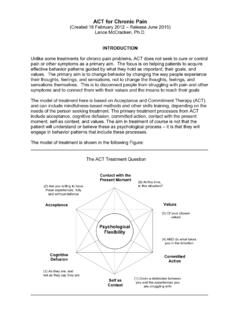
5 Behav Res Ther 2006; 44: 1-25. Psychological Inflexibility A process based in interactions of A process based in interactions of language and cognition with direct language and cognition with direct experiences that produces an inability experiences that produces an inability to to persistpersist in, or in, or change,change, a behavior a behavior pattern in the service of long term pattern in the service of long term goals or or values. ACT Treatment ProcessesPsychological FlexibilityContact with the Present MomentValuesCommitted ActionSelf as ContextCognitiveDefusionAcceptanceExperi ence Thoughts and FeelingsExperience Thoughts and Feelings Detect Detect know a thought or know a thought or feeling is presentfeeling is present Register the contentRegister the content understand the understand the message of the message of the experienceexperience Believe/heedBelieve/heed take it as truetake it as true FuseFuse contact it as the only contact it as the only experience presentexperience presentChronic Pain and SufferingChronic Pain and SufferingUnwillingnessInflexibilityAvoid ancePoor FunctioningDistress &DiscomfortPainChronic Pain and SufferingChronic Pain and SufferingUnwillingnessInflexibilityAvoid ancePoor FunctioningDistress &DiscomfortPainChronic Pain and SufferingChronic Pain and SufferingUnwillingnessInflexibilityAvoid ancePoor FunctioningDistress
6 &DiscomfortPain ACT-Based Treatment for ACT-Based Treatment for chronic PainChronic Pain Dahl et al., 2004. Behav TherDahl et al., 2004. Behav Ther McCracken et al., 2005. Behav Res TherMcCracken et al., 2005. Behav Res Ther McCracken et al., 2007. Eur J PainMcCracken et al., 2007. Eur J Pain Vowles & McCracken, 2008. J Consult Clin Vowles & McCracken, 2008. J Consult Clin PsycholPsychol Wicksell et al., 2008. Eur J PainWicksell et al., 2008. Eur J Pain Vowles et al. 2009. Cog Behav PracticeVowles et al. 2009. Cog Behav Practice 3 Year Follow-up Survey in Bath3 Year Follow-up Survey in BathNote: Thanks to Kevin Vowles & Jane Zhao-O'BrienNote: Thanks to Kevin Vowles & Jane Zhao-O'Brien N = 90 (61% of those contacted)N = 90 (61% of those contacted) 64% women64% women Pain Duration M = 135 months (SD = Pain Duration M = 135 months (SD = MeasuresMeasures 0-10 rating of pain0-10 rating of pain Sickness Impact ProfileSickness Impact Profile Pain Anxiety Symptoms ScalePain Anxiety Symptoms Scale British Columbia Major Depression British Columbia Major Depression InventoryInventory Medical Visits (past six months)Medical Visits (past six months) chronic Pain Acceptance QuestionnaireChronic Pain Acceptance Questionnaire Pre-Tx3 Yr F-upSigEffect Size (d)Pain ( ) ( )<.))
7 (.12).12(.10)<. (.16).18(.14)<. ( ) ( )<. at 3 YearsOutcome at 3 Years ..continuedcontinuedPre-Tx3 Yr F-upSigEffect Size (d) ( ) ( )<. ( ) ( )<. ( ) ( )<. > .2 small, > .5 medium, > .8 larged > .2 small, > .5 medium, > .8 large. Impact of CBT and ACT Models in Impact of CBT and ACT Models in Psychology Trainee TherapistsPsychology Trainee Therapists Participants were 28 people seeking Participants were 28 people seeking treatment for depression or interpersonal treatment for depression or interpersonal Matched pairs randomly assigned to be Matched pairs randomly assigned to be treated for 10 session of either ACT or for 10 session of either ACT or CBT. Therapists: 14 master s students with 3-4 Therapists: 14 master s students with 3-4 years study in psychology with little or no years study in psychology with little or no prior treatment treatment experience. Each therapist treated one ACT and one Each therapist treated one ACT and one CBT et al.
8 Behavior Modification 2007;31:488-511. Therapist TrainingTherapist TrainingCBTCBT 12 hours lecture in 12 hours lecture in CBTCBT 85 pages reading85 pages reading weekly group weekly group supervisionsupervisionACTACT 6 hour lecture in ACT6 hour lecture in ACT 39 pages reading39 pages reading weekly group weekly group supervisionsupervisionNote: Both training conditions were embedded in a one semester ordinaryNote: Both training conditions were embedded in a one semester ordinary Clinical Teaching program consisting of 20 hours lecture and 30 hours Clinical Teaching program consisting of 20 hours lecture and 30 hours clinical case Supervision. The course emphasized evidence-based approachesclinical case Supervision. The course emphasized evidence-based approaches. Primary Client Outcome: Primary Client Outcome: GSI of SCL-90 GSI of SCL-90 GroupEffect at post TxEffect at : Calculated as Cohen s Note: Calculated as Cohen s dd.
9 (small > .20; medium > .50; large > .80). (small > .20; medium > .50; large > .80) Other ResultsOther Results Acceptance appeared to be the most Acceptance appeared to be the most important process to outcome in both important process to outcome in both At the start of treatment therapists At the start of treatment therapists reported less knowledge of less knowledge of ACT. Therapists fear and tension during Therapists fear and tension during treatment decreased in CBT but not in treatment decreased in CBT but not in More Impactful Treatment in More Impactful Treatment in the Futurethe Future ContextualContextual Able to experientially manipulate functional Able to experientially manipulate functional active influences outside of talking and active influences outside of talking and thinking thinking CompassionateCompassionate Able to include empathy, intimacy, and Able to include empathy, intimacy, and caringcaring CourageousCourageous Able to radically contact pain and suffering, Able to radically contact pain and suffering, and to learn to sit with it, openly, without and to learn to sit with it, openly, without resistance, whenever , whenever required.
10 Summary Psychological approaches to chronic pain are developing and now include the notion of psychological flexibility They emphasize that suffering is normal, and include Acceptance . These approaches require treatment providers to face discomfort act with awareness and flexibility enter caring relationships with people with youThank you