Transcription of Accident Reporting and Investigation Training
1 Accident Reporting and Investigation Training What is an Accident , what is a near miss? What should be reported? Why should you investigate? What are you looking for? How should you investigate? What should be the results of the Investigation ?Objectives Unplanned Unwanted Controllable event Disrupts the work process Causes injury to people or damage to property. What is an Accident ? Unplanned Unwanted Controllable event Disrupts the work process Does not cause injury to people or damage to property. What is a Near Miss?Hazardous conditions/actsNear MissMinor incidentsAccidentsFatalities Most are not an Act of God They are caused occurrences Predictable: the logical outcome of hazards Preventable and avoidable: hazards do not have to exist. They are caused by hazardous conditions or is an Accident ? A 50 lb box falls off the top shelf of a 12 high rack and lands near a worker.
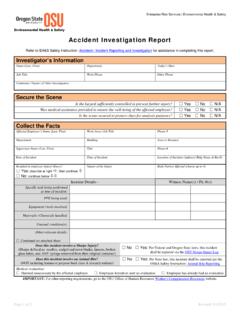
2 Is this event unplanned, unwanted, and have the potential for injury? Should this be investigated?Example Near MissEmployees should report all accidents and near misses regardless of the extent of injury or damage. Supervisors should investigate the near Practice for Accident Prevention Two weeks later: Another 50 lb box falls off the top shelf of the 12 high rack but this time, hits a worker causing a serious head injury. Predictable? Yes. Preventable? Yes. Reporting the previous incident and taking corrective action may have prevented this from becoming an Investigate Near Misses?Won t Reporting near misses make our insurance costs go up?Claims involving no costs are not used in the calculation of Workers Compensation near misses are reported and investigated, future accidents may be avoided, and may actually reduceWC Accident Report FormAccident InvestigationAccidents should always be investigated and reviewed by the injured employee s immediate supervisor or designated safety coordinator.
3 An Accident Investigation Form provides an outline for the supervisor to complete the Investigation . Accident Investigation Form The goals of Accident Investigation are to: Find the root causes Take the appropriate corrective action(s) Prevent a similar Accident / incident from happening again No Accident Investigation has ever changed what has already happened and therefore should not assign blame, but instead should identify breakdowns in the safety processGoals of Accident Investigation Prevents future accidents by identifying and eliminating hazards Exposes deficiencies in processes and/or equipment Reduces injury frequency and workers compensation costs. Maintains worker morale Promotes greater safety awareness Facts are gathered in the event of litigationBenefits of Accident Investigation Direct Cause Unplanned release of energy or hazardous materials Indirect Cause Unsafe acts and/or unsafe conditions Root Cause Policies and decisions, personal factors, environmental factorsCauses of AccidentsHazardousConditionsHazardousPra cticesAccident WeedMissing guardPoor housekeepingHorseplayIgnored safety rulesDon t know howNot using PPEE quipment failureLack of safety leadershipLack of supervisionNo formal safety policiesRules not enforcedLack of maintenance, unsafe equipmentPoor safetymanagementRoot CausesIndirect CausesDoes This Meet the Goal?
4 What was the employee doing when injured? Where in the facility/job site did the Accident happen?Employee was working in the maintenance shop. Employee was working what happened: Employee was moving welding gas bottles in the shop. While moving a bottle, felt a sharp pain in the lower corrective steps will be taken (or could be taken) to prevent recurrence?Employee was not lifting correctly. Employee should be reprimanded and re-trained in proper lifting techniques. Basic Question -Keeping asking What caused or allowed this condition/practice to occur? or simply Why? until you find the root cause. The five whys is probably the simplest of the root cause analysis methods. It is a question-asking method used to explore the cause/effect relationships that led to the Accident / incident . Finding Root Causes The 5 did the employee lose his fingers?
5 The ram on the press he was working on unexpectedly came down. did the ram come down? Another employee, not seeing the worker, started up the machine. The machine was shut down, but not locked out. 5 Whys Real Life ExampleInjury -Employee lost four fingers on each hand during equipment CauseIndirect didn t the employee lock the press out? Employee had never been trained on hazardous energy control. hadn t the employee been trained on hazardous energy control? Company has no formal lockout/ tagoutprogram. doesn t the Company have a lockout/ tagoutprogram? Management does not see safety as a priority and the use of lockout procedures is not enforced. 5 Whys Real Life ExampleIndirect CauseRoot CauseRoot Cause is easy to use and requires no advanced mathematics or tools. truly helps to quickly separate symptoms from causes and identify the root cause(s) of a problem.
6 Aids in determining the relationships between various problem causes. works well alone and when combined with other quality improvement and trouble shooting techniques. Benefits of the Five Whys its very nature, it fosters and produces teamwork. is a guided, team focused are no additional costs. Note: You may not need all five whys in every situation. Sometimes you ll need more, often less. Benefits of the Five WhysAccident Investigation ProcessBeing PreparedTimingProceduresInformationCorre ctive ActionFollow UpAccident Investigation Kit Accident Investigation Forms Clipboard Diagram Paper Caution Tape Flashlight Tape Measure Camera Sample Containers/ Bags Protective GlovesIt is crucial to collect evidence and interview witnesses as soon as possible because evidence will disappear and people will Investigation Immediately First priority is care for the injured employee.
7 Also, remove any danger that still exists, if it is safe to do so. Secure the scene, if necessary. Gather the facts. Complete Accident Investigation form Diagram the scene including location of injured worker, witnesses Take photos of the scene and related areaPerforming the InvestigationRecord all observations made at the scene, such as: Environmental conditions temperature very high or very low, chemicals being used, inadequate lighting or ventilation, excessive noise, poor housekeeping practices, etc. Date and time of the Accident near the beginning or end of the shift, overtime involvement, usual shift the employee works, etc. Condition of the worker fatigued, stressed, strained, experienced, supervised, any indication of drug or alcohol use, past medical conditions and prescription medications, etc., that may be relevant and may have played a role in or contributed to the Accident .
8 Machine, tool, or equipment involved was the worker wearing appropriate personal protective equipment, trained on how to use the equipment, any apparent malfunctions with the equipment, etc. Task employee was performing repetitive motions being used, materials being handled by the worker (number of pounds, ease of handling, etc.).Performing the Investigation Interview promptly after the incident Choose a private place to talk Keep conversations informal Talk to witnesses as equals Ask open ended questions Listen. Don t blame, just get facts Ask some questions you know the answers toIf You Need to Interview WitnessesCorrective ActionsWhen deficiencies are discovered, corrective actions should be taken. There is no better way to ruin moral than to investigate then do nothing. Hierarchy of hazard control (HHC) is used to recommend the most appropriate measure for controlling an observed hazard Always start from the top, and work your way towards the bottom Best Method For Hazard Control Elimination Substitution Engineering Controls Administrative Controls Personal Protective Equipment Elimination Where no hazard exists, no chance of injury or illness exists.
9 The hazard is often eliminated through job, part, or workstation redesign. Example Employees are experiencing shoulder and back injuries due to repetitions tasks of manually stripping floor. Risk factors are eliminated by purchase and use of a riding floor If it s not feasible to eliminate a hazard, the next most effective approach is substitution by removing something that produces a hazard and replacing it with a lesser hazard. Examples Replace a larger parts container (70 lbcapacity)\with a smaller part containers (20 lbcapacity) to reduce lifting risk Substitute a natural pesticide for a pesticide that is a known carcinogenEngineering Controls Use engineering controls when you cannot eliminate the hazard or provide a less hazardous substitute. Examples: Use mechanical aids (lift tables, hoists) to minimize bending, lifting, etc. Provide adjustable workstations to accommodate employees of different heights.
10 Providing machine ControlsAdministrativecontrolsarethemana gementproceduresthatdonotactuallyelimina teorreducethehazard,buttrytoreducetheemp loyee sexposuretothehazard. Examples Trainingemployeesonsafeliftingtechniques . Jobrotationforintensejobs. Requiringworkersinhotenvironmentstotakeb reaksincoolrestareasandprovidingfluidsfo rre-hydration. PostingDanger,Warning,Caution,signs. Devices used by employees who must work in hazardous environments Does not eliminate the hazard and success relies on proper use of the equipment Common PPE includes protection for the: head, eyes and face, hands, feet, breathing zonePersonal Protective EquipmentPersonal Protective , Investigation ExampleA food service worker for YourtownSchool District was injured while cleaning filters in the exhaust hood system. The injury was serious and resulted in a torn rotator cuff, surgery, and extended time away from the job.