Transcription of Accupyc II - Micromeritics
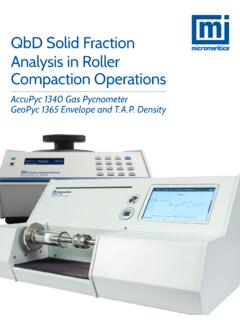
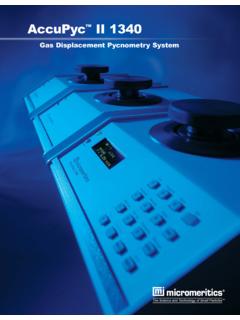
1 Accupyc IIgas displacement pycnometry systemThe Accupyc II 1340 Series Pycnometers are fast, fully automatic pycnometers that provide high-speed, high-precision volume measurements and true density calculations on a wide variety of powders, solids, and slurries. The instrument completes most sample analyses in less than three minutes without sacrificing accuracy. After analyses are started with a few keystrokes, data are collected, calculations are performed, and results displayed. A minimal amount of operator attention is instruments, in more countries, to more satisfied usersBenefits8gMaximize your results with superior speed of analysis, accuracy, repeatability.
2 And reproducibilityAdapt instrument configuration to meet your sample size needsOperate with either a keypad or Windows softwareUse a variety of gasesMaintain product integrity with thisnon-destructive testEliminate error with programmable automatic repeat and data acquisition set to your tolerances to comply with your SOPsIncrease efficiency and compliancewith barcoding compatibilityEliminate procedural steps with directinput from an analytical balanceAppLIcATIONSGas pycnometry is recognized as one of the most reliable techniques for obtaining true, absolute, skeletal, and apparent volume and densi-ty.
3 This technique is non-destructive as it uses the gas displacement method to measure volume. Inert gases, such as helium or nitrogen, are used as the displacement medium. Density calculations using the gas displacement method are much more accurate and reproducible than the traditional Archimedes water displacement IIGas Displacement pycnometry SystemApplicationPowder MetallurgyRefractory MaterialsCalcined Petroleum CokeSoilPowder CoatingsClear or Pigmented CoatingsRigid Cellular PlasticsPharmaceuticalsResults of many intermediate and final processing steps are controlled by or related to skeletal density of the metal.
4 In addition, the performance of many sintered or cast metal structures may be predicted from the skeletal density of the starting metal density is a useful value for: classification, detecting differences in chemi-cal composition between supposedly similar samples, indicating mineralogical phases or phase changes, calculating total porosity when the bulk density is known, and for any other test method that requires this value for the calculation of density of calcined petroleum coke directly influences the physical and chemical properties of the manufactured carbon and graphite artifacts for which it is used.
5 Density, therefore, is a major quality specification of calcined petroleum coke and is used as a control in coke specific gravity of soils that contain extraneous matter (such as cement, lime, etc.) or water-soluble material (such as salt) must be corrected because of the precipitate that forms on the specimen after drying. If the precipitate has a specific gravity less than the parent soil grains, the uncorrected test result will be too low. If the precipitate has a higher specific gravity, then the uncorrected test value will be too solids content can be used to determine minimum coverage obtainable with different coating blends.
6 Mixtures of dry pigments can be monitored by comparing measured density with theoretical density based upon composition of the film density can be used in the determination of Volatile Organic Compound (VOC) content of clear and pigmented coatings. VOC is required by government foams exhibit different properties based upon the ratio of open and closed cells. Insulation foams limit thermal conductivity through pockets of trapped gases contained within closed pores. Flotation devices owe buoyancy to closed air-filled pores that prohibit water of active and excipient ingredients can be monitored and controlled through determination of product density.
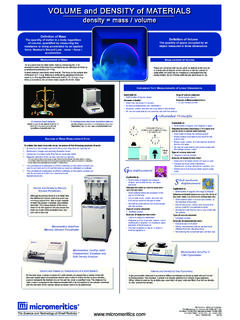
7 Polymorphic, hydrated, and amorphous forms of products, as well as purity, can be determined by comparing measured density with theoretical and historical C604-02 ASTM D2638-10 ASTM D5550-06 ASTM D5965-20 ASTM D6093-97 ASTM D6226-10 USP 699 ReferenceDiscussionMinimize cost and space requirements -low maintenance and small footprintDENSITy MEASuREMENTOn an elementary level, the volume of a solid material can be calculated by measuring its length, width, and thickness. However, many materials have within their structure surface irregularities, small fractures, fissures, and pores.
8 Some of these voids or pores are open to the surface or closed within the structure of the solid material. Therefore, differences in the material volume depend on the measurement technique, measurement method, and the conditions under which the measurements were Volume Interparticle voidAssemblage of porous particles in a containerA single particle containingopen and closed poresKnowledge of the bulk density is of interest in package sizing, in calibrating volumetric feeders or applicators, and in determining the storage capacity of bins and transport vehicles.
9 Apparent density information can be used in segregation studies and development of granulation processes. True density measurements are important in process control and the design of process presence of air bubbles in cosmetic preparations, such as lipsticks and powder cakes, is undesirable for a number of reasons. Trapped air can create pinholes and poor appearance in lipsticks and compromise the integrity of cakes. The effectiveness of different methods of air bubble removal can be evaluated by comparing the true density measurements of the material before and after air bubble physical measurements of a circular core cylinder s diameter and length allow the envelope volume to be calculated.
10 A gas displacement pycnometer, with a larger sample chamber designed specifically to accept intact drill cores, provides a low-cost, time-saving, non-destructive technique for measuring the skeletal volume. Knowing the envelope and skeletal volumes allows the total pore volume and percent porosity of the core sample to be envelopeSurface voidincluded withinthe envelopeVolumes Included in DefinitionMaterial VolumeOpen-PoreVolumeClosed-PoreVolumeIn ter particleVolumeExternalVoid VolumeAddressed byGeoPycAccuPyc IIAccuPyc IIGeoPycGeoPyc functionThe mass of a substance divided by its volume, excluding open and closed (or blind)