Transcription of Acoustic Design Guide - Caice
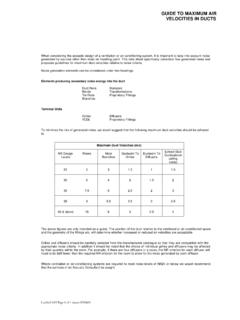
1 Acoustic Design Guide NR and NC Curves CIBSE Noise Ratings Environmental Noise Control maximum Air velocities in Ducts Privacy in Cellular Offices 14th February 2012 i Caice Acoustic Design Guide Contents Noise Curves NR Curves and Table 1 NC Curves and Table 2 CIBSE Noise Ratings 3 Environmental Noise Control 4 maximum Air velocities in Ducts 5 Privacy in Cellular Offices A Background to Privacy 6 Medium privacy in cellular offices 7 High privacy in cellular offices 9 1 Caice Acoustic Design Guide NR Curves and Table 2 Caice Acoustic Design Guide NC Curves and Table 3 Caice Acoustic Design Guide CIBSE Noise Ratings 4 Caice Acoustic Design Guide Environmental Noise Control 5 Caice Acoustic Design Guide maximum Air velocities in Ducts 6 Caice Acoustic Design Guide Privacy in Cellular Offices A Background to Privacy What is privacy?
2 The isolation of normal or raised speech produced in one room from possible listeners in another room. What main factors determine privacy? 1. The voice level of the person speaking within the source room. 2. The background noise level within the receiving room. 3. The noise reduction of the building structure between the rooms. Selecting an appropriate privacy criterion or rating The table below shows privacy criteria in terms of speech intelligibility, with a corresponding privacy rating. The index values shown are calculated by adding the required Noise Rating (NR) level within the receiving room to the average dB noise reduction of the building structure between the two rooms. For example to achieve a high privacy rating when the receiving room background noise level is NR40, the building structure must provide an average noise reduction of between 40 and 50dB. Speech levels The index values shown in the table assume normal speech noise levels.
3 Add 6dB if the criteria are to be achieved based on raised speech. Selecting a suitable building structure The table below shows a range of average room-to-room noise reductions for different types of building structure. Eliminating noise flanking paths Noise reduction performance of structures will be undermined, unless noise flanking paths, such as those listed below, are eliminated. Doors and door seals Glazed sections within demountable partitioning Demountable partition joint to the suspended ceiling Apertures in the suspended ceiling, such as grilles, etc Privacy Criteria Privacy Rating Index Intelligible Low Below 75dB Between intelligible and unintelligible Medium 75 to 80 dB Unintelligible High 80 to 90 dB Inaudible Very High Above 90 dB Building Structure Between Rooms Average Noise Reduction Budget demountable partitioning and suspended ceiling Below 35 dB Quality demountable partitioning and suspended ceiling 35 to 40 dB Full height standard studded plasterboard partition-ing 40 to 50 dB Full height jumbo studded plasterboard partitioning 50 to 55 dB Full height single leaf dense block wall 50 to 55 dB 7 Caice Acoustic Design Guide Privacy in Cellular Offices Medium privacy in cellular offices Medium privacy is normally acceptable for cellular offices, and two methods for achieving this are shown, based on the follow-ing.
4 Demountable partitioning system Suspended ceiling system Void mounted fan coil units (omitted from drawings for clarity) Return air ceiling void Background noise level of NR35 to 40 Before selecting one of these methods the following factors should be considered: Will the office layout change or is it fixed? Is it a new or existing building? How many cellular offices are there? Which method would be easier to install? Which would be most cost effective? This method utilises HG Acoustic hoods, which are detailed in the Caice Acoustic Hood data sheet. In addition high quality demountable partitioning and suspended ceiling systems are incorporated throughout the office. Hoods should be fitted to the rear of all ceiling penetrations, such as return air grilles, diffusers or luminaires, to ensure that the Acoustic integrity of the ceiling system is maintained.
5 The major benefit of this method is that the demountable parti-tions can be moved to modify the size and position of the cel-lular offices, without affecting privacy. To achieve medium privacy a 40dB (R w) partition system and a 40dB (Dncw) ceiling system should be used as a minimum. Method 1 - Cellular offices with maximum flexibility and medium privacy Ideal for new build if office layouts may change Partitions can be moved without affecting privacy HG Acoustic hoods protect all ceiling apertures Return air ceiling void remains clear Simple installation makes privacy easy to achieve Return air grillesfitted withHG Acoustic hoodsNR35 to 40 cellular officeReturn air ceiling voidHigh quality suspendedceiling systemHigh quality demountablepartitioning system8 Caice Acoustic Design Guide Privacy in Cellular Offices This method utilises Acoustic void barriers, penetrated by return air crosstalk attenuators.
6 Although high quality partitioning is still required, a budget ceiling system can be used, as noise be-tween adjacent rooms has to pass through the ceiling and the void barrier. This method is ideal where the office layout is fixed, or where only a few cellular offices are located within a large office area. However it may not be suitable for new buildings with many cel-lular offices, where the layouts are subject to change. This is because the void barriers must be moved in conjunction with the partitions. To achieve medium privacy a 40dB (R w) partition system, a 32dB (Dncw) ceiling system, and a 35dB (R w) void barrier shoud be used. Typically the return air crosstalk attenuator should be 900mm long, with an average insertion loss of 30dB between 500 and 4000Hz. Method 2 - Cellular offices with medium privacy and limited flexibility Ideal for existing offices where layout is fixed Acoustic void barriers required above partitions Existing partitions and ceiling may be retained Crosstalk attenuators protect return air path Void barrier enables budget ceiling to be used Return air ceiling voidNR35 to 40 cellular officeHigh quality demountablepartitioning systemReturn air grillesBudget suspendedceiling systemReturn air crosstalk attenuatorAcoustic void barrier9 Caice Acoustic Design Guide Privacy in Cellular Offices High Privacy in Cellular Offices High privacy would only normally be required for cellular offices if they were being used for sensitive or confidential discussions.
7 For example a conference room, a board room, an interview room, etc, may all need a higher degree of privacy, but it is diffi-cult to achieve this with demountable partitioning systems. This method is therefore based on cellular offices with full height studded plasterboard partitioning, which should achieve 50dB (R w). However because the partitioning is fixed, there is limited flexibil-ity to subsequently change the office layouts. Ceiling Acoustic performance is not critical, as the noise reduc-tion between rooms is provided by the full height partition. Typi-cally the return air crosstalk attenuator should be 1200mm long, with an average insertion loss of 40dB between 500 and Details on rectangular and circular attenuators suitable for cross-talk applications can be found in the Caice Attenuator Bro-chure. Cellular Offices with high privacy but limited flexibility Layout of cellular offices is fixed Plasterboard partition must be full height Crosstalk attenuators protect return air path Partition enables budget ceiling to be used Return air grillesFull height fixed studdedplasterboard partitioningSuspendedceiling systemReturn air ceiling voidNR35 to 40 cellular officeReturn air crosstalk attenuatorTelephone 0118 918 6470 Facsimile 0118 918 6480 Caice Acoustic Air Movement Ltd.
8 Riverside House 3 Winnersh Fields Gazelle Close Winnersh Wokingham RG41 5QS