Transcription of ACT Made Simple - Client Handouts and Worksheets
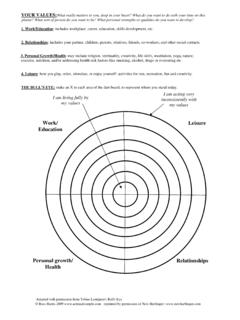
1 YOUR VALUES:What really matters to you, deep in your heart? What do you want to do with your time on this planet? What sort of person do you want to be? What personal strengths or qualities do you want to develop? 1. Work/Education: includes workplace, career, education, skills development, etc. 2. Relationships: includes your partner, children, parents, relatives, friends, co-workers, and other social contacts. 3. Personal Growth/Health: may include religion, spirituality, creativity, life skills, meditation, yoga, nature; exercise, nutrition, and/or addressing health risk factors like smoking, alcohol, drugs or overeating etc 4.
2 Leisure: how you play, relax, stimulate, or enjoy yourself; activities for rest, recreation, fun and creativity. THE BULL S EYE: make an X in each area of the dart board, to represent where you stand today. I am acting very inconsistently with my values Relationships Personal growth/ Health Leisure Work/ Education I am living fully by my values Adapted with permission from Tobias Lundgren's Bull's Eye Russ Harris 2009 reprinted by permission of New Harbinger: The Problem This form is to help gather information about the nature of the main challenge, issue, or problem facing you.
3 First, please summarize, in 1 or 2 sentences, what the main issue or problem is: Second, please describe, in 1 or 2 sentences, how it affects your life, and what it stops you from doing or being: Regardless of what your problem is whether it is a physical illness, a difficult relationship, a work situation, a financial crisis, a performance issue, the loss of a loved one, a severe injury, or a clinical disorder such as depression - when we dissect the problem, we usually find four major elements that contribute significantly to the issue. These are represented in the boxes below. Please write as much as you can in each box, about the thoughts, feelings and actions that contribute to or worsen the challenge, problem or issue facing you.
4 Entanglement With Thoughts Life-draining Actions: What memories, worries, fears, self-criticisms, or other unhelpful thoughts do you dwell on, or get caught up in, related to this issue? What thoughts do you allow to hold you back or push you around or bring you down? What are you currently doing that makes your life worse in the long term: keeps you stuck; wastes your time or money; drains your energy; restricts your life, impacts negatively on your health, work or relationships; maintains or worsens the problems you are dealing with? Avoiding Challenging Situations: Struggle With Feelings What emotions, feelings, urges, impulses, or sensations (associated with this issue) do you fight with, avoid, suppress, try to get rid of, or otherwise struggle with?
5 What situations, activities, people or places are you avoiding or staying away from? What have you quit, withdrawn from, dropped out of? What do you keep putting off until later? Russ Harris 2009 reprinted by permission of New Harbinger: The Life Compass In the main part of each large box, write a few key words about what is important or meaningful to you in this domain of life: What sort of person do you want to be? What sort of personal strengths and qualities do you want to cultivate? What you want to stand for? What do you want to do?
6 How do you ideally want to behave? (If a box seems irrelevant to you, that s okay: just leave it blank. If you get stuck on a box, then skip it, and come back to it later. And it s okay if the same words appear in several or all boxes: this helps you identify core values that cut through many domains of life.) Once you ve done that for all boxes, go through them and in the upper small square inside each box, mark on a scale of 0-10 how important these values are to you, at this point in your life: 0= no importance, 10= extremely important. (It s okay if several squares all have the same score.) Finally, in the lower small square inside each box, mark on a scale of 0-10 how effectively you are living by these values right now.
7 0= not at all 10= living by them fully (Again, it s okay if several squares all have the same score.) Finally have a good look at what you ve written. What does this tell you about: a) What is important in your life? b) What you are currently neglecting? Parenting Personal Growth Leisure Spirituality Community & Environment Social Relationships Intimate Relationships Family Relationships Work Adapted with permission by New Harbinger Publications, Inc. from Living Beyond Your Pain, J. Dahl & T. Lundgren, Health The Problems and Values Worksheet Acceptance & Commitment Therapy aims to reduce suffering and enrich life, as shown in the diagram below.
8 To help in this process, there are four lots of information that are particularly important. These are represented in the four columns below. Between now and the next session, see what you can write in or add to each column. STRUGGLE & SUFFERING RICH & MEANINGFUL LIFE Problematic Thoughts And Feelings: What memories, worries, fears, self-criticisms, or other thoughts do you get caught up in? What emotions, feelings, urges, or sensations do you struggle with? Problematic Actions: What are you doing that makes your life worse in the long run: that keeps you stuck; wastes your time or money; drains your energy; impacts negatively on your health or your relationships; or leads to you missing out on life?
9 Values: What matters to you in the big picture ? What do you want to stand for? What personal qualities and strengths do you want to develop? How do you want to enrich or improve your relationships? How would you like to grow or develop, through addressing your issue(s) or problem(s)? Goals & Actions: What are you currently doing that improves your life in the long run? What do you want to start or do more of? What life-enriching goals do you want to achieve? What life-enhancing actions do you want to take? What life-improving skills would you like to develop? Russ Harris 2009 reprinted by permission of New Harbinger: VITALITY VS.
10 SUFFERING DIARY Between now and next session, keep a record of what you do when painful thoughts and feelings arise, and notice if these actions lead to increased vitality or increased suffering Russ Harris 2009 reprinted by permission of New Harbinger: Painful Thoughts/ Feelings/ Urges/ Sensations/ Memories that showed up today Things I did - when those thoughts and feelings showed up - that lead to VITALITY ( enriched my life, or improved my health, wellbeing, or relationships in the long term) Things I did - when those thoughts and feelings showed up - that lead to SUFFERING ( restricted or worsened my life, drained my health and wellbeing, or hurt my relationships in the long term)