Transcription of Activity 1: Solar System Model (Distance)
1 2 IntroductionOur Solar System is the Sun and everything that travels around it. Traveling around the Sun are eight official planets, at least five dwarf planets, nearly 200 moons (or natural satellites of the planets), and a large number of comets and asteroids. Supplies Tape measure Rolls of toilet paper Index cards or paper Markers Tape Solar System Statistics cards (See printable cards after page 45. The cards are set up to print double-sided.) 28 Day 2: The Solar System Activity 1: Solar System Model (Distance)2 Get kids thinkingOur Solar System is BIG! The sizes of the planets vary greatly as do the distances between planets and their distance from the Sun.
2 Start by asking about distances kids have traveled. How many miles is it from home to school? How much time does the trip take? How long would it take and how many miles would you have to travel from where you live to get to London, England, or to La Paz, Bolivia? What about to Mars? Let's get started!Mars is relatively close to Earth, while the Sun and other planets even farther away. Talk about scale and how good a way to show the vast distances among the planets is to make a scale Model that is smaller than the actual size of the Solar System . Talk about the planets with the kids. Step 1: Identify the planetsAsk kids: Can they can name all the planets in the Solar System ?
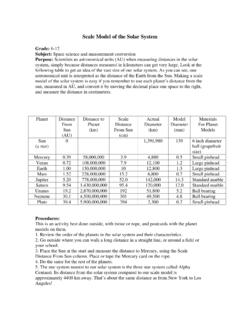
3 As you name them together, have kids write each planet name down on its own index card or small piece of paper along with the average distance (in miles) of each planet from the Sun. These are big numbers, so share the distance chart on page 31 to help. Instead of writing, kids can cut out and use the Solar System Statistics cards. (See printable cards after page 45. The cards are set up to print double-sided.) Once you have cards for each planet, have kids put them in order from nearest the Sun to 2: The Solar System Activity 1: Solar System Model (Distance)230 Day 2: The Solar System Activity 1: Solar System Model (Distance)Step 2: Decide on the scale for your modelToilet paper sheets are going to represent the distances of planets from the Sun in this Model .
4 What s fun about making this Model is deciding the scale. If you have a lot of space , consider a scale of 10,000,000 (10 million) miles equals 1 square of toilet paper. That will put Neptune about 1,100 sheets or 94 feet away from your Sun. (See the Expanded Distance Table on the fiollowing page if you plan to use this scale.) As you think about your scale, ask kids to estimate space available for the Model . Have them measure a square of toilet paper and predict if their Model will fit into the available space. Provide kids with a copy of the Expanded Distance Table. The table is for this scale: 10,000,000 miles = 1 square of toilet paper (95 feet of floor or outdoor space needed)Alternative scale options If you do not have access to 95 feet of room, you can calculate the numbers for a scale that requires only about 20 feet of space.
5 This is a good math challenge for kids who like to do calculations! 50,000,000 miles = 1 square of toilet paper (19 feet of floor or outdoor space needed)For younger kids, you can use this simplified chart below: Planet Squares Average distance from Sun Mercury 36 million miles Venus 67 million miles Earth 93 million miles Mars 142 million miles Jupiter 484 million miles Saturn 888 million miles uranus billion miles Neptune billion miles PLANETTrue Average Distance to the Sun in MilesRounded Average Distance to Sun in MilesDistance to Sun in Sheets* (10,000,000 miles/sheet)* 4-inch toilet paper squaresDistance to Sun in Inches Distance to Sun in FeetDistance Between Each Planet in Sheets MERCURY 35,983,610 36,000,000 VENUS 67,232,360 67,000,000 EARTH 92,957,100 93,000,000 MARS 141,635,300 142,000,000 JUPITER 483,632,000 484,000,000 SATURN 888,188,000 888,200,000 URANUS1,783,950,000 1,800,000,000 180 720 60 NEPTUNE2,798,842,000 2,800,000,000 280 1.
6 120 Distance Table 10,000,000 miles = 1 square of toilet paper (95 feet of floor or outdoor space needed) 312 Day 2: The Solar System Activity 1: Solar System Model (Distance)Step 3: Make your Model Make an index card for the Sun (or a construction paper Sun) and secure it on the ground (with tape if you are inside, set a rock on top of it if you are outside). Attach the toilet paper to the index card with tape. Lay the toilet paper down, slowly walk and unroll the toilet paper. (If you are outside and it is even a little windy, get some rocks to hold the toilet paper in place.) As you unroll, count the number of squares. When you reach Mercury ( sheets on a 10,000,000 mile scale), use a marker to make a dot on the toilet paper and secure the Mercury card next to that square.
7 If you want to be precise about where to put the dot, turn a square of toilet paper into a tool that can help. (See photo on the right) Continue unrolling the toilet paper and placing the planet cards until you get all the way to Neptune! Far out, right? For an added challengeAsk kids if they have a plan for keeping track of their mileage. For example, Venus is sheets from the Sun, but only sheets from Mercury. Will they count sheets from the Sun for each planet? See if they can calculate the number of sheets between each planet and add that information to their distance chart. Or, find out if they have another idea to keep their Model accurate. 322 Day 2: The Solar System Activity 1: Solar System Model (Distance)Step 4: Talk about your modelNow that kids have an idea of the relative distance between planets, what do they think?
8 Ask kids: Why is it important to know these distances? Who is it important to? How do the distances between planets get measured? What units are the best units for measuring these distances? As you discuss, be sure to explain to kids that the distances they used to create their Model represent the planets average distances from the Sun. Planetary orbits are elliptical and not circular, so the distances change depending on the planet s orbit. Also, be sure to point out that orbiting planets are never all in a straight line going out from the Sun as they are represented in this toilet paper Model . And worth sharing: astronomers measure distances in the Solar System in astronomical units or AU.
9 1 AU = 93 million miles, the distance from the Sun to the Earth. Talk about what a Solar System Model that demonstrates the relative average distances between the planets and the Sun and the relative sizes of the planets would look your Solar System Statistics cards for future Model Solar System activitiesScale Model of our Solar System (University of Manitoba) The Thousand-Yard Model or, the Earth as a Peppercorn (National Optical Astronomy Observatory) Solar System Bead Activity (NASA)