Transcription of ADMINISTERING EMERGENCY OXYGEN - …
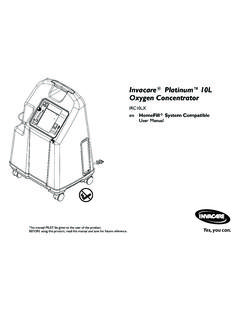
1 EMERGENCY OXYGEN can be given for many breathing and cardiac emergencies. It can help improve hypoxia (insuffi cient OXYGEN reaching the cells) and reduce pain and breathing discomfort. Always follow local protocols for using EMERGENCY OXYGEN . Consider ADMINISTERING EMERGENCY OXYGEN for:An adult breathing fewer than 12 or more than 20 breaths per minute. A child breathing fewer than 15 or more than 30 breaths per minute. An infant breathing fewer than 25 or more than 50 breaths per minute. A person who is not breathing. EMERGENCY OXYGEN Delivery SystemsEmergency OXYGEN delivery systems include the following equipment:An OXYGEN cylinder. OXYGEN cylinders come in different sizes and have various pressurecapacities. Cylinders are labeled (United States Pharmacopeia) and marked witha yellow diamond that says OXYGEN , which indicates the OXYGEN is medical cylinders contain gas under high pressure.
2 If mishandled, cylinders can cause serious damage, injury or pressure regulator with fl owmeter. The pressure regulator controls the pressure coming outof the cylinder and is indicated on the gauge in pounds per square inch (psi). The fl owmetercontrols how rapidly the OXYGEN fl ows from the cylinder to the victim. The fl ow rate can beset from 1 to 25 liters per minute (LPM).A delivery device. The equipment a victim breathes through is an OXYGEN delivery device. Tubing carries the OXYGEN from the regulator to the delivery device. Delivery devicesinclude nasal cannulas, resuscitation masks, non-rebreather masks and bag-valve-maskresuscitators (BVMs). EMERGENCY OXYGEN units are available without prescription for fi rst aid use, provided they contain at least a 15-minute supply of OXYGEN and are designed to deliver a preset fl ow rate of at least 6 LPM.
3 The type of system used (variable or fi xed fl ow) impacts the type of delivery devices that can be used and the concentration of OXYGEN that can be delivered to a ow-rate OXYGEN systems allow the rescuer to vary the fl ow of OXYGEN . This type ofsystem must be assembled and the appropriate fl ow rate ow-rate OXYGEN systems include a regulator set at a fi xed-fl ow rate, usually 15 LPM,or may have a dual (high/low) fl ow setting. The cylinder, regulator and delivery device arealready connected. ADMINISTERING EMERGENCY OXYGEN | Online Resources | 2011 The American National Red Cross 1 ADMINISTERING EMERGENCY OXYG E NFACT SHEETO xygen Delivery DevicesOxygen should be delivered with properly sized equipment for the victim and appropriate fl ow rates for the delivery device.
4 Various sizes of OXYGEN delivery devices are available for adults, children and infants. Delivery DeviceDescriptionCommon Flow RateOxygen ConcentrationsSuitable VictimsNasal cannula Held in place over the victim s ears; OXYGEN is delivered at a low level through two small prongs inserted into the nostrils1 6 LPM24 44% Victims with breathing diffi cultyVictims unable to tolerate maskResuscitation mask with OXYGEN inletPliable, dome-shaped breathing device that fi ts over the mouth and nose6 15 LPM35 55% Victims with breathing diffi cultyVictims who are not breathingNon-rebreather mask Face mask with an attached OXYGEN reservoir bag and one-way valve between the mask and bag; victim inhales OXYGEN from the bag and exhaled air escapes through fl utter valves on the side of the mask10 15 LPMUp to 90%Breathing victims onlyBVM Hand-held breathing device consisting of a self-infl ating bag, a one-way valve and a face mask15 LPM or higher90% or moreVictims with diffi culty breathing Victims who are not breathing 2 ADMINISTERING EMERGENCY OXYGEN | Online Resources | 2011 The American National Red CrossFor young children and infants who are frightened by a mask being placed on their face, use a blow-by technique.
5 To perform this technique, hold the mask about 2 inches from the child s face, waving it slowly from side-to-side, thus allowing the OXYGEN to pass over the face and be inhaled. A conscious, breathing victim can hold the BVM to inhale the OXYGEN or you can squeeze the bag as the victim inhales to deliver more OXYGEN . Squeeze the bag between each breath for victims breathing less than 10 times per minute. For a victim breathing more than 30 times per minute, squeeze the bag on every second Safety PrecautionsUse EMERGENCY OXYGEN equipment according to the manufacturer s instructions, in a manner consistent with federal and local regulations, and according to local protocols. Never attempt to refi ll an OXYGEN cylinder; only an appropriately licensed professional should do this.
6 Specifi c attention should be given to the following areas concerning OXYGEN cylinders:Check for cylinder leaks, abnormal bulging, or defective or inoperative valves or safety for the physical presence of rust or corrosion on a cylinder or cylinder neck, and any foreign substances or residues, such as adhesive tape, around the cylinder neck, OXYGEN valve or regulator assembly. These substances can hamper OXYGEN delivery and in some cases may have the potential to cause a fi re or , follow these guidelines: Do not stand OXYGEN cylinders upright unless they are well secured. If the cylinder falls, the regulator or valve could become damaged or cause injury due to the intense pressure in the not use OXYGEN around fl ames or sparks, including smoking materials such as cigarettes, cigars and pipes.
7 OXYGEN causes fi re to burn more rapidly and defi brillating, make sure that no one is touching or is in contact with the victim or the resuscitation equipment. Do not defi brillate someone when around fl ammable materials, such as free-fl owing OXYGEN or not use grease, oil or petroleum products to lubricate or clean the regulator. This could cause an not drag or roll cylinders. Do not carry a cylinder by the valve or regulator. Do not hold on to protective valve caps or guards when moving or lifting cylinders. Do not deface, alter or remove any labeling or markings on the OXYGEN cylinder. Do not attempt to mix gases in an OXYGEN cylinder or transfer OXYGEN from one cylinder to OXYGEN SaturationPulse oximetry, using a pulse oximeter, is used to measure the percentage of OXYGEN saturation in the blood and appears as a percentage of hemoglobin saturated with OXYGEN (Figure).
8 Pulse oximetry readings are recorded using the percentage and then SpO2 ( , 95 to 99 percent SpO2). Pulse oximetry should be used as an added tool for victim care, as it is possible for victims to show a normal reading but have diffi culty breathing or to have a low reading but appear to be breathing normally. When treating the victim, all symptoms should be assessed, along with the data provided by the device. ADMINISTERING EMERGENCY OXYGEN | Online Resources | 2011 The American National Red Cross 3 The pulse oximeter reading never should be used to withhold OXYGEN from a victim who appears to be in respiratory distress or when it is the standard of care to apply OXYGEN despite good pulse oximetry readings, such as in a victim with chest OXYGEN Saturation LevelDelivery DeviceNormal95 100% SPO2 NoneMild hypoxia91 94% SPO2 Nasal cannula or resuscitation maskModerate hypoxia86 90% SPO2 Non-rebreather mask or BVMS evere hypoxia<85% SPO2 Non-rebreather mask or BVM To use a pulse oximeter, apply the probe to the victim s fi nger or any other measuring site, such as the earlobe or foot.
9 According to the manufacturer s recommendation. Let the machine register the OXYGEN saturation level and verify the victim s pulse rate on the oximeter with the actual pulse of the victim. Monitor and record the victim s saturation levels while ADMINISTERING EMERGENCY OXYGEN . If the OXYGEN level reaches 100 percent and local protocols allow, you may decrease the fl ow rate of OXYGEN and change to a lower-fl owing delivery factors may reduce the reliability of the pulse oximetry reading, including:Hypoperfusion, poor perfusion (shock). Cardiac arrest (absent perfusion to fi ngers). Excessive motion of the victim during the reading. Fingernail polish (remove it using an acetone wipe). Carbon monoxide poisoning (carbon monoxide saturates hemoglobin).
10 Hypothermia or other cold-related illness. Sickle cell disease or anemia. Cigarette smokers (due to carbon monoxide). Edema (swelling). Time lag in detection of respiratory insuffi ciency. (The pulse oximeter could warn too late of a decrease in respiratory function based on the amount of OXYGEN in circulation.)4 ADMINISTERING EMERGENCY OXYGEN | Online Resources | 2011 The American National Red CrossUSING A RESUSCITATION MASKNote: Always follow standard precautions when providing care. Always select the properly sized mask for the victim. ASSEMBLE THE RESUSCITATION MASKA ttach the one-way valve to the resuscitation mask, if necessary. POSITION THE MASKK neel to the side of or above the victim s head and place the rim of the mask between the victim s lower lip and the resuscitation mask until it covers the victim s mouth and nose.