Transcription of ADMINISTRATIVE RESOURCE GUIDE - DOT Home Page
1 ADMINISTRATIVE RESOURCE GUIDE . DRIVER AND TRAFFIC SAFETY EDUCATION. IN NORTH DAKOTA. North Dakota Department of Public Instruction Kirsten Baesler State Superintendent North Dakota Department of Transportation Tom Sorel Director North Dakota Education Standards and Practices Board Dr. Rebecca Pitkin Executive Director Effective September 2014. (Rev. 09/18). i TABLE OF CONTENTS. INTRODUCTION ..3. TEACHING THE DRIVER AND TRAFFIC SAFETY EDUCATION COURSE .. 4. DRIVER AND TRAFFIC SAFETY EDUCATION COURSES .. 4. Two-phase program.
2 5. Three-phase program .. 5. Four-phase program .. 5. Driver and traffic safety education program for students with disabilities .. 6. SUMMER DRIVER AND TRAFFIC SAFETY EDUCATION PROGRAM .. 6. DRIVER AND TRAFFIC SAFETY EDUCATION PROGRAM REQUIREMENTS .. 7. The driver and traffic safety education 7. Driver and traffic safety education instructor requirements .. 7. THE DRIVER AND TRAFFIC SAFETY EDUCATION VEHICLE .. 8. Vehicle specifications .. 8. Obtaining the vehicle .. 9. Licensing the 9. Insuring the vehicle .. 10. Vehicle identification.
3 10. Maintaining the vehicle .. 10. Procedures for breakdown or crash .. 10. DRIVER AND TRAFFIC SAFETY EDUCATION PROGRAM RECORDS .. 10. Parental or legal guardian approval .. 10. Student record of behind -the- wheel instruction .. 11. Student permanent school record .. 11. Vehicle records .. 11. Certificates of completion & training .. 11. Letters to parents or legal guardians .. 11. Record keeping for budget purposes .. 12. Driver Education DIVISION OF RESPONSIBILITIES FOR LICENSING PURPOSES .. 12. Schools .. 12. Students.
4 12. Parents .. 13. North Dakota Department of Transportation .. 13. North Dakota Department of Public Instruction .. 13. North Dakota Education Standards and Practices Board .. 13. RESOURCES AND REFERENCES .. 14. GLOSSARY .. 15. ii INTRODUCTION. We are pleased to work collaboratively among the North Dakota Department of Transportation (NDDOT), the North Dakota Department of Public Instruction (NDDPI), and the North Dakota Education Standards and Practices Board (NDESPB) to provide guidance for schools as they implement quality driver and traffic safety education programs.
5 This ADMINISTRATIVE RESOURCE GUIDE for Driver and Traffic Safety Education in North Dakota is a RESOURCE for driver and traffic safety education instructors and schools in planning and implementing a driver and traffic safety education program. The success of the driver and traffic safety education program depends on many things, including well-trained, enthusiastic instructors; a comprehensive, up-to-date curriculum; focused diligent students; supportive parents who provide encouragement and supervise practice time, and classroom and driving experiences reflecting good driver and traffic safety practices.
6 The NDDPI, the NDESPB, and the NDDOT gratefully acknowledge the assistance of the North Dakota Driver and Traffic Safety Education Association (NDDTSEA) in revising this RESOURCE GUIDE . Departmental contacts: Josef Kolosky Carol Thurn Rebecca Pitkin Assistant Director Program Manager Executive Director Teacher and School Effectiveness Safety Division Education Standards and Dept of Public Instruction Dept of Transportation Practices Board 600 E. Boulevard Ave., Dept. 201 608 E. Boulevard Ave. 2718 Gateway Ave., Ste 204.
7 Bismarck, ND 58505-0440 Bismarck, ND 58505-0700 Bismarck, ND 58503. Phone: 701/328-2295 Phone: 701/328-4354 Phone: 701/328-9641. Fax: 701/328-0201 Fax: 701/328-0310 Fax: 701/328-9647. email: email: email: 3. TEACHING THE DRIVER AND TRAFFIC SAFETY EDUCATION COURSE. Driver and traffic safety education instructors, working with local school administrators, should develop programs to meet the driver and traffic safety education needs of all students. Classroom and laboratory driver and traffic safety education instruction must meet minimum time requirements.
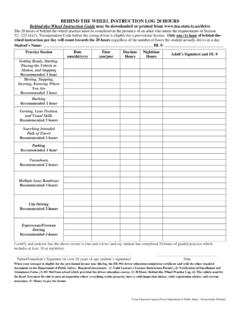
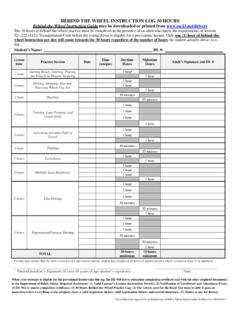
8 NDAC 37-03-04-02 requires that 30 hours of classroom instruction and 6 hours of supervised behind -the- wheel instruction be completed successfully in order for students to receive credit and receive a certificate of completion or training. It is most effective if classroom and laboratory instruction are taught concurrently. Laboratory instruction includes behind -the- wheel on-street instruction, driving simulation, and/or on-range behind -the- wheel driving. It is strongly recommended that the classroom portion of a summer school driver and traffic safety education program be scheduled over a time period of at least two weeks, not to exceed three hours of classroom instruction in any day.
9 It is also recommended that the driver and traffic safety education instructor schedule behind -the- wheel lessons to provide ample time between lessons allowing students to participate in parental supervised practice on skills taught during the previous lesson by the course instructor. Students should be given as much in-car observation time as scheduling procedures allow and individual differences require. The program should be developed to make the observation time meaningful and relevant so it will make a contribution to the effectiveness of the total program.
10 Students should receive at least 6 hours of in-vehicle observation time in a dual-control vehicle. Driver and traffic safety education programs may be included in the regular school curriculum whenever possible. It is recommended that the class size for classroom driver and traffic safety education not exceed 30 students. Classes may be offered during and after regular school hours, at night, or on Saturdays. Scheduling either classroom or laboratory instruction on Sundays or other holidays specified in NDCC is prohibited.