Transcription of ADVANCED DIPLOMA IN MIDWIFERY …
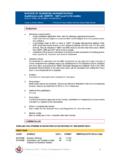
1 South African Nursing Council (Under the provisions of the Nursing Act, 2005) e-mail: web: P O Box 1123, Pretoria, 0001 Republic of South Africa Tel: 012 420-1000 Fax: 012 343-5400 602 Pretorius Street, Arcadia, Pretoria, 0083 ADVANCED DIPLOMA IN MIDWIFERY qualification FRAMEWORK SAQA QUAL ID qualification TITLE N/A ADVANCED DIPLOMA in MIDWIFERY ORIGINATOR REGISTERING PROVIDER SANC QUALITY ASSURING ETQA SANC and CHE qualification TYPE FIELD SUBFIELD ADVANCED DIPLOMA Field 09 - Health Sciences and Social Services Promotive, Preventive, Curative Health and Developmental Services ABET BAND MINIMUM CREDITS NQF LEVEL QUAL CLASS Undefined 120 Level 7 Whole qualification This qualification does not replace any other qualification and is not replaced by any other qualification .
2 PURPOSE AND RATIONALE OF THE qualification Purpose: The primary purpose of the qualification is to produce competent, independent and critical thinking midwives who will provide scientific, safe and comprehensive quality MIDWIFERY care to individuals, families and communities within the legal and ethical framework. On successful completion of this qualification , the learner is eligible for registration with the South African Nursing Council as a Midwife. qualification Framework ADVANCED DIPLOMA in MIDWIFERY 2 The qualification aims to: Produce competent, independent and critical thinking midwives within a wide range of MIDWIFERY health care settings Provide midwives with a wide range of skills, knowledge and attitudes that will enable them to make a meaningful and sustained contribution to MIDWIFERY services Equip midwives with a developed sense of equity, justice and service ethics that will ensure that they work in a responsible and accountable manner irrespective of their chosen work place Offer a wide range of transferable skills for application in other professions, disciplines and general life.
3 These include: - A methodical solution based approach to problem solving - An empowerment- based approach to development of self and others - Competence in written and oral communication - Capacity to assess and implement MIDWIFERY practice and other policies - Ability to plan, implement and manage projects of a varied nature - Research capacity ATTRIBUTES The graduate of this qualification will be able to: Apply knowledge of theory, bio-natural sciences, bio-medical, bio-technological and psychosocial sciences to the practice of MIDWIFERY Develop, implement and evaluate community based MIDWIFERY services Assess, plan, implement and evaluate MIDWIFERY care for individuals and groups throughout the life cycle perspective of reproductive health, Promote health, prevent illness, provide MIDWIFERY care and rehabilitate individuals.
4 Families and groups Deliver safe MIDWIFERY care Utilise research in investigating MIDWIFERY problems Manage a MIDWIFERY unit and facility Maintain professionalism in MIDWIFERY practice Register with the SANC for the duration of learning Access to clinical facilities of health service that are accredited by SANC that has a Memorandum of Understanding in place with the relevant health establishment for the practical component Clinical and work- based experiences must comply with the regulations of the SANC qualification Framework ADVANCED DIPLOMA in MIDWIFERY 3 Rationale This qualification will enable the graduate to function as a clinically focused, service orientated, independent midwife, who is able to render comprehensive MIDWIFERY care from the pre-natal stage to postnatal stage.
5 The World Health Organisation (2006) report indicated that the reduction of maternal mortality rate (MMR) is one of the major goals included in the Millennium Development Goals (MDGs). The target for Goal 5 of the Millennium Development is that 90% of births should be attended by skilled attendants by 2015 in the regions where they are not routinely available. There is however slow progress towards achievement of this goal due to shortages of professional midwives in many countries in Africa. According to health statistics in the Health Systems Trust report, the maternal mortality rate increased by 7% between 1998 and 2004. According to Snyman (2007:8) South Africa had 3 maternal deaths every day of the year for the period 2002-2004. Corresponding with this is also an alarming number of peri-natal deaths.
6 WHO (2003) states that every year over 4 million babies, less than one month of age die, most of them during the critical first week of life. In South Africa Pick et al (2001) found that 80% of MIDWIFERY and neonatal services in the country are delivered by midwives and in view of the high peri-natal and maternal mortality and morbidity rates, it is essential to have a properly trained MIDWIFERY practitioner who is able to provide quality MIDWIFERY and neonatal nursing. Taylor (2008:2)reported that some countries that had similar mortality rates and similar gross national incomes to South Africa in 1990, such as Brazil, Mexico, Egypt, are on track to meet MDG 4 and have halved their under-five mortality rate since then. These countries have managed mortality rates providing professional MIDWIFERY care at childbirth (WHO, 2003).
7 Appropriate preparation and skilling of health works, including midwives, is viewed by WHO (2006) as one of the solutions, hence the need for this MIDWIFERY qualification . MINIMUM ADMISSION REQUIREMENTS Appropriate DIPLOMA or equivalent qualification in nursing/ Staff nurse and/or Professional nurse (General) LEARNING ASSUMED TO BE IN PLACE Assumed learning listed below is recommended but not compulsory for admission: Communication Skills at NQF Level 4 Mathematical Literacy at NQF Level 4 Life Sciences at NQF Level 4 Computer Literacy at NQF Level 3 Applied knowledge of Bio-Natural Sciences and Social Sciences qualification Framework ADVANCED DIPLOMA in MIDWIFERY 4 RECOGNITION OF PRIOR LEARNING Recognition of prior learning (RPL) for access to this qualification or credit bearing exemptions, an application must be submitted according to the RPL policy of the Nursing Education Institution for individual assessment to R425 candidates that have undergone MIDWIFERY course but were unsuccessful as well as to R254 candidates that have undergone MIDWIFERY course but were unsuccessful qualification REQUIREMENTS In terms of current relevant legislation.
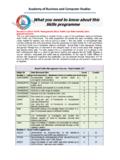
8 The Nursing Education Institution (NEI) is required to register learners with the South African Nursing as for the duration of the period of training The NEI can only offer programmes and accept students for approved and accredited qualification Learners must have access to approved clinical facilities according to training regulations issued by SANC that has a Memorandum of Agreement in place. qualification RULES Total Credits: 120 of which 52 credits must be acquired in appropriate and accredited clinical facilities and 70% of clinical acquired credits must be supervised and mentored. qualification MATRIX THEORY CREDITS WORK INTEGRATED LEARNING PRACTICAL CREDITS TOTAL CREDITS 1. FUNDAMENTAL 16 16 2. CORE 52 52 104 TOTAL: 68 52 120 Note to table: Hours are interpreted as notional hours (1 credit = 10 notional hours) 720 Hours work integrated learning (which can be work-based, clinical skills laboratory or other clinical experiences) of which 70% must be supervised and mentored.
9 ARTICULATION OPTIONS The Advance DIPLOMA in MIDWIFERY , articulates with the Post graduate DIPLOMA in MIDWIFERY qualification Framework ADVANCED DIPLOMA in MIDWIFERY 5 EXIT LEVEL OUTCOMES 1. Apply specific knowledge of bio-natural, pharmacology and social sciences in MIDWIFERY using an integrated approach. 2. Provide safe and quality MIDWIFERY and neonatal care in a scientific, integrated and evidence based approach in all health care settings. 3. Practice independently and professionally within an appropriate ethical-legal framework. 4. Improve quality of MIDWIFERY and neonatal care through an analytical, reflective and problem solving approach. 5. Effectively manage a MIDWIFERY unit through appropriate clinical governance strategy. FUNDEMANTAL EXIT LEVEL OUTCOMES ASSOCIATED ASSESSMENT CRITERIA 1.
10 Apply specific knowledge of bio-natural, pharmacology and social sciences in MIDWIFERY using an integrated approach. Knowledge of bio-natural sciences and pharmacology is applied during assessment and care of a mother and neonate Knowledge of social sciences is applied in the counselling and advocacy for a mother and baby through the pre-conception, antenatal, intrapartum and postnatal stages CORE EXIT LEVEL OUTCOMES ASSOCIATED ASSESSMENT CRITERIA 2. Provide safe and quality MIDWIFERY and neonatal care in a scientific, integrated and evidence based approach in all health care settings. The preparation of a woman and family for pregnancy, childbirth and family changes is appropriate, takes into consideration the woman s context/background and is facilitated by means of antenatal classes and appropriate health education Obstetric history-taking and physical examination of the mother is conducted in a comprehensive manner, using a variety of available technology Observations of significant changes and laboratory results are accurately interpreted and appropriately referred where potential risk to mother and/or foetus exists Monitoring of the well-being of the foetus is ensured by monitoring foetal movement.