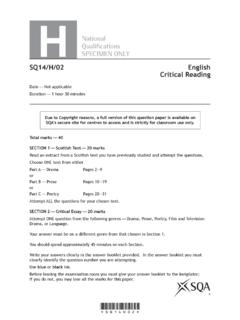
Transcription of Advanced Higher English - SQA
1 Advanced Higher English Course code: C824 77 Course assessment code: X824 77 SCQF: level 7 (32 SCQF credit points) Valid from: session 2019 20 This document provides detailed information about the course and course assessment to ensure consistent and transparent assessment year on year. It describes the structure of the course and the course assessment in terms of the skills, knowledge and understanding that are assessed. This document is for teachers and lecturers and contains all the mandatory information required to deliver the course.
2 The information in this document may be reproduced in support of SQA qualifications only on a non-commercial basis. If it is reproduced, SQA must be clearly acknowledged as the source. If it is to be reproduced for any other purpose, written permission must be obtained from This edition: May 2019 (version ) Scottish Qualifications Authority 2014, 2019 Contents Course overview 1 Course rationale 2 Purpose and aims 2 Who is this course for? 3 Course content 4 Skills, knowledge and understanding 5 Skills for learning, skills for life and skills for work 7 Course assessment 8 Course assessment structure: question paper 9 Course assessment structure: portfolio writing 11 Portfolio writing marking instructions 14 Course assessment structure: project dissertation 18 Project dissertation marking instructions 23 Grading 26 Equality and inclusion 27 Further information 28 Appendix.
3 Course support notes 29 Introduction 29 Developing skills, knowledge and understanding 29 Approaches to learning and teaching 31 Preparing for course assessment 32 Developing skills for learning, skills for life and skills for work 45 Version 1 Course overview This course consists of 32 SCQF credit points, which includes time for preparation for course assessment. The notional length of time for candidates to complete the course is 160 hours. The course assessment has four components. Component Marks Duration Component 1: question paper Literary Study 20 1 hour and 30 minutes Component 2: question paper Textual Analysis 20 1 hour and 30 minutes Component 3: portfolio writing 30 see Course assessment section Component 4: project dissertation 30 see Course assessment section Recommended entry Progression Entry to this course is at the discretion of the centre.
4 Candidates should have achieved the Higher English course or equivalent qualifications and/or experience prior to starting this course. other qualifications in English or related areas further study, employment and/or training Conditions of award The grade awarded is based on the total marks achieved across all course assessment components. Achievement of this course gives automatic certification of the following Core Skill: Communication at SCQF level 6 Version 2 Course rationale National Courses reflect Curriculum for Excellence values, purposes and principles.
5 They offer flexibility, provide time for learning, focus on skills and applying learning, and provide scope for personalisation and choice. Every course provides opportunities for candidates to develop breadth, challenge and application. The focus and balance of assessment is tailored to each subject area. This course focuses on the critical and creative study of complex and sophisticated literature and language. It gives candidates opportunities to add specialism, depth and independence to their English and study skills. There is opportunity for personalisation and choice, and freedom within the course to plan according to the needs of candidates, taking account of their interests and motivations.
6 Candidates extend prior learning, and apply their skills, knowledge and understanding in increasingly specialised contexts. In both guided and independent study, they develop their skills of literary analysis in order to analyse, evaluate and make connections between texts. Candidates develop the confidence to make informed critical responses to texts, from the literary genres of poetry, prose fiction, prose non-fiction and drama, and express these responses in a variety of forms. Candidates correspondingly develop their skills in both creative and critical writing.
7 The course encourages candidates to appreciate the ways in which complex and sophisticated literature promotes cultural and personal self-awareness and self-definition. It invites candidates to consider, for example, personal, moral, ethical, social and cultural concerns. It fosters lifelong learning, curiosity and cultural engagement, enabling candidates to access their own cultural heritage and history, as well as the culture and history of others. Purpose and aims The course provides candidates with the opportunity to develop the skills of reading, writing, talking and listening in the context of complex and sophisticated literature and language.
8 The main aims of the course are to enable candidates to develop the ability to: read, write, talk and listen in complex and sophisticated contexts, as appropriate to purpose and audience understand, analyse, evaluate, and make connections between complex and sophisticated literary texts create and produce written texts as appropriate to purpose, audience and context, through the application of knowledge and understanding of complex and sophisticated language The broad structure of the course assessment allows candidates to demonstrate these skills in a balanced way.
9 Although the importance of reading is emphasised and candidates are encouraged to read widely. Version 3 Who is this course for? This course is designed for those who are at the stage in their learning when they are ready to develop language skills at SCQF level 7. They are likely to have achieved the Higher English course. It is suitable for candidates who wish to develop their critical and creative language skills through the reading, writing and discussion of complex and sophisticated texts. They should be able to work with growing independence, and use their own initiative under minimal supervision.
10 It provides candidates with opportunities to develop important transferable skills. These include: skills of analysis and evaluation the ability to make evidence-based critical judgements independent learning the capacity for wide reading and intellectual growth the ability to produce a variety of written-response types planning, researching and writing an extensive critical assignment The course provides a clear progressive pathway for candidates who wish to go on to study English literature, language or other disciplines in further and Higher education.