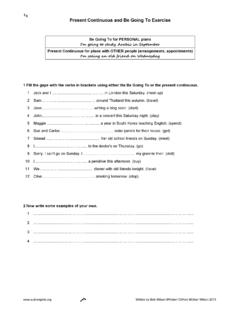
Transcription of Advanced Language Practice
1 AdvancedLanguage Practicewith keyMichael Vincewith Peter SunderlandEnglish Grammar andVocabularyMACMILLANM acmillan EducationBetween Towns Road, Oxford OX4 3 PPA division of Macmillan Publishers LimitedCompanies and representatives throughout the worldISBN 1 405 00762 1 with keyISBN 1 405 00761 3 without keyText Michael Vince 2003 Design and illustration Macmillan Publishers Limited 2003 First published 1994 This edition published 2003 All rights reserved; no part of this publication may bereproduced, stored in a retrieval system, transmitted in anyform, or by any means, electronic, mechanical, photocopying,recording, or otherwise, without the prior written permissionof the by Mike Brain Graphic Design LimitedLayout and composition by Newton Harris Design PartnershipCover design by Oliver DesignIllustrated by:Ed McLachlan pp 109; Julian Mosedale pp 12, 39, 110, 123, 153,176, 195, 217, 225, 257; David Parkins pp 3, 42, 73;Martin Shovel pp 10, 16, 56, 70, 117, 147, 235, 285;Bill Stott pp 122; Kingsley Wiggin pp 24, 27, 57, 191, by:Eyewire, Photodisc and Andrew author would like to thank the many schools and teacherswho have commented on these materials.
2 Also special thanks toPeter Sunderland and Sarah and bound in Italyby G. Canale and C. A Borgaro , Turin2007 2006 2005 2004 200310 987654321 ContentsIntroductionVlllGrammar 1 Grammar 2 Present timeBasic contrasts: present simple and present continuousState verbs and event (action or dynamic) verbsState verbs normally without a continuous formDifference of meaning in stative and active verbsOther uses of present continuousOther uses of present simpleFuture timeBasic contrasts: will, going to, present continuousFuture continuousFuture perfectOther ways of referring to the futureOther future referencesGrammar 3 Past timeBasic contrasts: past simple and past continuousPast perfect simple and continuousUsed to and wouldUnfulfilled past eventsPolite formsContrast with present perfectGrammar 4 Present perfectPresent perfect simplePresent perfect continuousContrast of present perfect simple and present perfect continuousTime expressions with present perfect14213340iiiGrammar 6 Passive 1 Basic usesUsing and not mentioning the agentGrammar 7 Passive 2 Have and get something done, need doir,Passive getReporting verbsVerbs with prepositionsCommon contexts for the passiveADVANCED Language PRACTICEG rammar 8 ConditionalsBasic usage: truths, real situations, hypothetical situations (presentand past)Variations: if only, unless, and other alternatives to if, past eventswith results in the present, should, were to, happen to, if it were not for,if it hadn't been forOther ways of making a conditional sentence.
3 Supposing, otherwise,but for, if so, if not, colloquial omission of if, if and adjectives,if meaning althoughGrammar 9 Unreal time and subjunctivesIt's time, it's high timeWishesI'd rather and I'd sooner, I'd preferAs if, as thoughSuppose and imagineFormal subjunctivesFormulaic subjunctive4654 Grammar 11 Modals: present and future 65 Don't have to and must not: absence of obligation, obligation notto do somethingShould: expectation, recommendation, criticism of an action,uncertainty with verbs of thinking, with be and adjectives describing chanceafter in case to emphasise unlikelihoodCould: possibility or uncertainty, with comparative adjectives toexpress possibility or impossibility, suggestions, unwillingnessCan: criticism, capabilityMust and can't: certainty, present time reference onlyMay and might: although clauses, may/might as well, possibility oruncertainty with tryShall: certainty, what the speaker wants to happenWill: assumption, intention, refuse and insistWould: annoying habits, certaintyNeed: need to not a modal, need partly a modalRelated non-modal expressions: had better, be bound toGrammar 12 Modals: past 72 Had to and must have: past obligation, past certaintyShould have and ought to have: expectation, criticism of an action,should have and verbs of thinking, with be and adjectivesdescribing chance, polite expressionsCould have: past possibility or uncertainty, with comparativeadjectives, unwillingnessCould: past permission or ability, compared with could haveMay have and can't have: certainty, with surelyWould not: unwillingnessWould have: events in the past which did not happen, assumptionsNeedn't have and didn't need to.
4 Unnecessary actions done and not doneAdverbs and modals: well, easily, obviously, really, justIVCONTENTSG rammar 13 InversionInversionInversion after negative adverbialsInversion after so/such with thatInverted conditional sentences without ifGrammar 14 EmphasisChanging word order to change focusAdding words for emphasisOther means7885 Grammar 16 Reported speech 97 Problems: reported speech with modals, with conditionals, don't thinkReporting verbsFunctions: verbs that describe a function, verbs that describe actionsChanges of viewpointGrammar 17 Articles 104 Definite article (the), indefinite article (a/an), zero articleTranslation problemsGrammar 18 Relative and non-finite clauses 111 Defining and non-defining clausesWhich and thatWho, whom, and whoseWhen and whereOmitting the relative pronounOmitting which/who + beClauses beginning with what and whateverNon-finite clauses containing an -ing formGrammar 19 Verbs + infinitive or -ing 118 Verbs followed by either -ing or infinitive with toVerbs with an object, followed by either -ing or infinitive with toVerbs normally followed by infinitive with toVerbs normally followed by -ingVerbs followed by infinitive without toVerbs followed by an object and to131138 Grammar 21 Verbs + prepositionsVerbs followed by: in, for, of, with, from, on, against, about, out, at, toGrammar 22 PrepositionsFollowing adjectives.
5 Of, about, with, at, on, to, by, for, in, fromFollowing nouns: on, to, over, with, forExpressions beginning: in, with, at, on, beyond, by, for, out of, under,without, within, afterADVANCED Language PRACTICEG rammar 23 Grammar 24 Grammar 25 Grammar 27 Grammar 28 Phrasal verbs 1 Add up to get up toPhrasal verbs 2 Give away to put up withPhrasal verbs 3 Rip off to work out144150156 Grammar 30 Further Practice182 Vocabulary ~TVocabulary 2 Vocabulary 3 Vocabulary 4 Vocabulary 5 Vocabulary 6 Vocabulary 7 Vocabulary 8 Vocabulary 9 Vocabulary 10 Vocabulary 11 Vocabulary 12 Vocabulary 13 Leisure activitiesTravel and movementNews eventsPlacesMedia and advertisingThe natural worldWorkBusiness and moneyPeople and relationshipsSocial problemsEntertainmentGovernment and societyHealth and the body188192196200204208211215219223227231 235 VILinking words and phrases 167 Text organisers.
6 Adding a point, developing a point, contrast,explaining reasons, making generalisations, giving new informationPunctuation and spelling 172 Common errorsProblem wordsWords with similar spelling but different meaningsPunctuation: commas, apostrophes, colons and semi-colonsCONTENTSV ocabulary 14 Vocabulary 15 Vocabulary 16 Vocabulary 17 Vocabulary 18 Vocabulary 19 Vocabulary 20 World issuesThinking and feelingTechnologyQuality and quantityEducationWord formationMultiple meaning2392432472502542582621 Expressions with come, expressions with in, idioms based on hand,wood and metal, prefix un-, verbs of movement2 Expressions with get, colour idioms, expressions withsee, suffix -ful, common expressions, expressions with out3 Expressions with on, expressions with one, expressions with break,sounds, words with more than one meaning, words connected withmemory4 Formality, expressions with no, expressions with head, wordsconnected with people, expressions with make, compound words5 Size, suffixes, headline Language , expressions with once, bodymovements, expressions with at6 Expressions with set, places.
7 Words with more than one meaning,speaking, expressions with within, adjective suffix -ing7 Expressions with by, idioms with parts of the body, adjective-nouncollocations, expressions with have, verbs of seeing, expressionswith do8 Collocations of nouns linked with of, size, expressions with bring,feelings, prefix well, expressions with from9 Adverbs, expressions with think, expressions with give, modifiers,words with more than one meaning, but10 Expressions with put, expressions with run, prefix under-, names,expressions with call, verbs with up265268271274277280283286289292 IndexGrammar answersVocabulary answersWords and phrases answers295297313322viiThe revised edition of this book is designed with a greater emphasis on text andcollocation, in keeping with recent trends in the world of English as a ForeignLanguage. It also incorporates the many changes to the revised proficiencyexamination from December 2002, such as word formation and multiple wordmeaning.
8 The book is also intended for use at the level of CAE, and includesnew exercises practising the formal/informal register transfer of the Practice sections in the Grammar and Vocabulary sections reflectsuch changes, and where texts are retained from the first edition, they havebeen given more of an exam , the core of this highly successful book remains the same. Thegrammar section now includes some additional revision and more subtleadvanced points. Units on phrasal verbs, prepositions and linking devices arealso included. The grammatical information provided can be used for referencewhen needed, or worked through vocabulary section includes topic-based vocabulary, collocations andidiomatic phrases. It also recycles work on prepositions, and phrasal book can be used as a self-study reference grammar and Practice book or assupplementary material in classes preparing for the CAE and Proficiency used for classwork, activities can be done individually or co-operatively inpairs or small are regular consolidation units which include forms of testing commonlyused in both exams and the material covers a range of difficulty appropriate toboth contrasts:present simpleand presentcontinuousState verbs andevent (action ordynamic) verbsPresent simple generally refers to:Facts that are always trueWater boils at 100 degrees people drink a lot of don't like gangster continuous (progressive) generally refers to actions which are inprogress at the moment.
9 These can be temporary:I'm staying in a hotel until I find a can be actually in progress:The dog is sleeping on our bed!Or they can be generally in progress but not actually happening at themoment:I'm learning to verbs describe a continuing state, so do not usually have a continuousform. Typical examples are:believe, belong, consist, contain, doubt, fit, have, know, like, love, matter, mean,need, own, prefer, seem, suppose, suspect, understand, want, wishSome verbs have a stative meaning and a different active meaning. Typicalexamples are:be, depend, feel, have, measure, see, taste, think, weighCompare these uses:EventJill's being 're having an interesting conversation!David's thinking about getting a new 'm just tasting the 'm feeling 're weighing the , I'm depending on you to win thiscontract for differences here apply to all verb forms, not just to present verb is has a think I like you!
10 This fish tastes awful!I feel that you are bag weighs a ton!It depends what you Language PRACTICEO ther uses ofpresentcontinuousOther uses ofpresent simpleTemporary situationsAre you enjoying your stay here?Repeated actionsMy car has broken down, so I am walking to work these about annoying habitsYou are always making snide remarks about my cooking!Other possible adverbs are: constantly, continually, foreverWith verbs describing change and developmentThe weather is getting worse!More and more people are giving up declarationsVerbs describing opinions and feelings tend to be state hope you'll come to my bet you don't know the answer!I hereby declare this hospital open!HeadlinesThese are written in a 'telegram' style, and references to the past are usuallysimplified to present sinks in midnight and itinerariesInstructions and recipes can be written in present simple instead of inimperative forms.

![John Steinbeck - The Pearl [EnglishOnlineClub.com]](/cache/preview/a/6/7/2/0/1/4/a/thumb-a672014a0e7c6d32ccce67a6d17482be.jpg)