Transcription of Advanced Risk Based Auditing - Business Risk
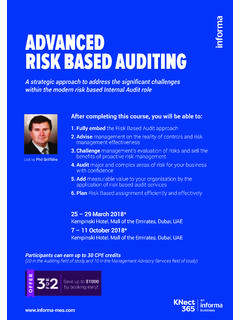
1 Advanced Risk Based Auditing Why you should attend Most Heads of Internal Audit would say that their functions have adopted a risk Based approach However, has this process been fully embedded? Have you for example:- Linked your audit programmes and testing directly with the risk registers? Made suggestions for reducing controls for over-managed risks ? Challenged management s evaluation of the residual risks ? If so, do you have a consistent basis for this challenge? Encouraged management to determine a target for each risk?
2 Completed risk Based audits of major projects? Carried out risk Based audits of complex Business activities such as marketing, environmental management and performance management? Audited your organisation s website, or social media activities? Determined a strategic audit plan which is flexible, but simple to explain to senior management? Have an audit plan which is fully coordinated with the other assurance providers in your Business This course is designed to cover these and other significant challenges of the modern risk Based audit role Who should attend?
3 Heads of Audit, Audit managers and senior auditors Auditors responsible for developing or implementing a risk Based approach Other assurance professionals such as those in Compliance and QA functions who are wanting to develop their Risk Based approach Managers and Directors of Business functions to aid their knowledge of a risk Based audit approach. Course Level Business RISK MANAGEMENT LTD This is an intermediary level course and delegates should have at least 12 months experience in Internal Audit (or other assurance roles) to attend Delegates should have a good educational standard (Bachelors degree or above)
4 And/or a professional qualification or be in the process of studying for such qualifications No advance preparation is required Delivery method Group-live (with exercises and case studies to provide practical application of the tools and techniques) A pre-course questionnaire will be sent out 2-3 weeks prior to the course date to obtain some information about the delegate s role and to provide an opportunity to indicate specific learning requirements After completing this course you will be able to Fully embed the RBA approach Advise management on the reality of controls and risk management effectiveness Challenge management s evaluation of risks and sell the benefits of proactive risk management Audit major and complex areas of risk
5 For your Business with confidence Add measurable value to your organisation by the application of risk- Based audit services Plan risk Based assignments efficiently and effectively CPE credits Participants can earn up to 30 CPE credits ( 20 in the Auditing field of study and 10 in the Management Advisory Services field of study) Day 1 Risk Based Auditing in the modern era The modern risk Based audit approach IIA guidance RBA 10 years on Worldwide trends in IA Trends (from GRC research and the BRM Internal audit best practice database) New RBA challenges (IIA standard 2120)
6 Organisational objectives support and align with the organisation's mission Appropriate risk responses are selected that align risks with the organisation's risk appetite Relevant risk information is captured and communicated in a timely manner across the organisation The need for auditors to provide wider assurance How risk Based audit has changed the face of Auditing Audit s primary roles, objectives and concerns IIA GRC report risk maturity evaluation Exercise 1 - Benefits of RBA Questions about the maturity of the audit process The need widen the coverage - to become more operationally Based The importance of dealing with the audit risks not just the Business risks The steps needed to enhance the risk Based approach The key challenges resulting RBA benefits and drawbacks new guidance Exercise 2 - IA strengths and opportunities RBA and ERM
7 (Enterprise risk management) The key elements of Enterprise risk (ERM) The key relationship between risk and objectives Why senior management may lack a full understanding of the risks Risk cultures and the implications for IA Surprises and risk and why IA should ask about surprises Measurement of risk and why many organisations scoring process may lead to misunderstanding of significance Categories of risk Exercise 3 - Analysing a disaster Auditing strategic risks Why strategic objectives are often poorly defined The questions IA should
8 Ask Evaluating the pulse of the organisation Risk appetite and the need for RBA focus The questions to ask about risk appetite The International Risk standard ISO 31000 (and the IA role) Evaluating the strategy setting process and identifying the gaps Evaluating the understanding of strategic objectives and risks across the Business Exercise 4 - Auditing strategic risks Day 2 Evaluating the ERM Process Risk Identification and Evaluation Methods of risk identification Measuring the impact and the likelihood of occurrence of each key risk Inherent.
9 Residual and target risk Challenging management if no target risk is set Evaluating the risk categories The effectiveness of the risk matrix The IA role in risk identification Facilitation of risk workshops A new paper on Auditing risk assessment will be provided IIA guidance on assessing risk maturity Root cause analysis an excellent tool for auditors Cause and effect analysis (Fishbone) Other evaluation techniques such as Monte Carlo Analysis Examining Committee and Board minutes for risk discussions Exercise 4 - Evaluating risks with multiple causes Assessment of Risk Mitigation How to assess risk mitigation New IIA guidance managers acknowledging risk The 3 types of controls Identification and evaluation of risk exposures Dealing with the exposures (The 4 Ts terminate, tolerate, treat or transfer)
10 Exploiting opportunities Evaluating the risk register Establishment of action plans Exercise 5 - Risk Exposures Auditing the ERM process Guidance on the links and differences between the audit and risk management roles (including the IIA position) Identifying, appraising and evaluation risk during the audit process Translating key risks from the Business risk process into the basis of the audit programme Auditing the process steps to take Risk ownership Reviewing the risk policy Assessing the roles and responsibilities Performance measures Assessing the Key risk indicators ( effectiveness and completeness) Frequency of risk evaluations (especially regarding major risks )