Transcription of Advisory Circular - FAA Aircraft certification - a step …
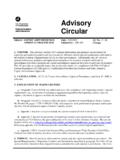
1 Departmentof TransportationFederal AviationAdministration Advisory Circular1 Subject:ELIGIBILITY, QUALITY, ANDDate:5/24/96AC No:20-62 DIDENTIFICATION OF AERONAUTICALI nitiated by:AFS-340 Change:REPLACEMENT PARTS1. Advisory Circular (AC) provides information and guidance for use in determiningthe quality, eligibility and traceability of aeronautical parts and materials intended for installation on products and to enable compliance with the applicable 20-62C, Eligibility, Quality, and Identification of Approved AeronauticalReplacement Parts, dated August 26, 1976, is RELATED REGULATORY SECTIONS.
2 (Title 14 of the Code of Federal Regulations (14 CFR)) 1, Definitions and 21, certification Procedures for Products and 39, Airworthiness 43, Maintenance, Preventative Maintenance, Rebuilding, and 45, Identification and Registration 91, General Operating and Flight 119, certification : Air Carriers and Commercial 121, certification and Operations: Domestic, Flag and Supplemental Air Carriers and CommercialOperators of Large 125, certification and Operation: Airplanes having a seating capacity of 20 or more passengersor a maximum payload capacity of 6,000 pounds or 135, Air Taxi Operators and Commercial 145, Repair following definitions apply to this AC:a.
3 Federal Aviation Administration (FAA)-Approved 14 CFR part 21, section ,parts which were produced under an FAA-approved production system and conform with FAA-approveddata, may be approved under the following:(1) A Parts Manufacturer Approval (PMA) issued under section (2) A Technical Standard Order Authorization (TSOA) issued by the Administrator.(3) In conjunction with type certification procedures for a 2AC 20-62D5/24/96(4) In any manner approved by the Administrator, such as part 21, subpart F, Parts Produced Undera Type Certificate (TC), and subpart G, Production Certificate (PC).
4 In addition, subpart N provides forthe acceptance of a new part produced in a country with which the United States has an agreement forthe acceptance of parts for export and import. The part is approved when the country of manufacture issuesa certificate of airworthiness for export for the Acceptable following parts may be found to be acceptable for installation on a type-certificated product:(1) Standard parts (such as nuts and bolts) conforming to an established industry or specification.
5 (2) Parts produced by an owner or operator for maintaining or altering their own product andwhich are shown to conform with FAA-approved data.(3) Parts for which inspections and tests have been accomplished by appropriately certificated per-sons authorized to determine conformity to FAA-approved design Class I complete Aircraft , Aircraft engine, or propeller that has been type-certificatedin accordance with the applicable regulations, and for which Federal Aviation Specifications or TC datasheets have been Class II major component of a Class I product ( , wings, fuselages, empennageassemblies.)
6 Landing gears, power transmissions, or control surfaces, etc.), the failure of which would jeopardizethe safety of a Class I product; or any part, material, or appliance, approved and manufactured under theTechnical Standard Order (TSO) system in the C Class III part or component that is not a Class I or Class II product, includingstandard parts. Class III products are considered to be Standard a part manufactured in complete compliance with an established Governmentor industry-accepted specification which includes design, manufacturing, and uniform identification require-ments.
7 The specification must include all information necessary to produce and conform the part. The specifica-tion must be published so that any party may manufacture the part. Examples include, but are not limitedto, National Aerospace Standards (NAS), Air Force-Navy Aeronautical Standard (AN), Society of AutomotiveEngineers (SAE), SAE Aerospace Standard (AS), Military Standard (MS), product, accessory, part, or material that has no operating time or : There could be time/cycles on a newly type-certificated product ( , use of amanufacturer s test cell or certification requirements).
8 H. a product, assembly, part, or material that has been released as surplus bythe military, manufacturers, owners/operators, repair facilities, or any other parts supplier. These productsshould show traceability to an FAA-approved manufacturing an airframe, Aircraft engine, propeller, appliance, or component part usingmethods, techniques, and practices acceptable to the Administrator, which has undergone the following:(1) Has been disassembled, cleaned, inspected, repaired when necessary, and reassembled to theextent possible.
9 (2) Has been tested in accordance with approved standards and technical data, or current standardsand technical data acceptable to the Administrator ( , manufacturer s data), which have been developedand documented by the holder of one of the following:(a) TC.(b) Supplemental Type Certificate (STC), or material, part, process, or appliance approval undersection 35/24/96AC 20-62D(c) an Aircraft , airframe, Aircraft engine, propeller, or appliance, using new or usedparts that conform to new part tolerances and limits or to approved oversized or undersized dimensionsthat has undergone the following:(1) Has been disassembled, cleaned, inspected, repaired as necessary, and reassembled to the extentpossible.
10 (2) Has been tested to the same tolerances and limits as a new Return to Service Inspection person approving or disapproving for return to servicea type-certificated product must ensure that the required maintenance record entries comply with 14 CFRpart 43, and therefore must include the following information:(1) Type of inspection and a brief description of the extent of the inspection.(2) Date.(3) Product hours, cycles, or life limits as applicable.(4) Signature, certificate number, and kind of certificate held by the person approving or disapprovingfor return to service.