Transcription of Afirmative Negative Interrogative Do s Does Do do
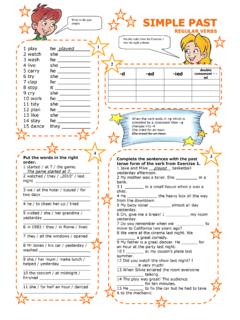
1 Third person singular We add s to the verb to form the third person singular (he, she, it). I drink he drinks I run he runs BUT We add es to verbs that end in ss, -sh, -ch, -x, -o. I watch he watches With verbs ending in consonant + y, we change the y to ies. I cry he cries But with verbs ending in vowel + y, we just add s as usual. I play he plays Afirmative I walk You walk He walks She walks It walks We walk You walk They walk Negative I don t walk You don t walk He doesn t walk She doesn t walk It doesn t walk We don t walk You don t walk They don t walk Interrogative Do I walk? Do you walk? Does he walk? Does she walk? Does it walk? Do we walk? Do you walk? Do they walk?
2 Short answers Affirmative Negative Yes, I / you / we / they do No, I / you / we / they don t Yes, he / she / it does No, he / she / it doesn t We use the present simple : for habits and actions that we do regularly: He visits his friends every Sunday. She goes to school by bus. for general truths: The sun rises in the East. for permanent situations: He lives in Athens. A. Write the third person singular of the following verbs. play _____ go _____ wash _____ teach _____ drive _____ carry _____ fly _____ start _____ help _____ kiss _____ watch _____ tidy _____ like _____ enjoy _____ cry _____ mix _____ B.
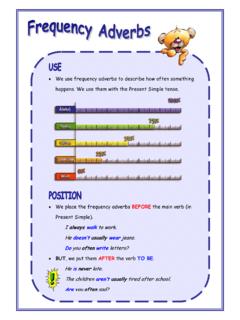
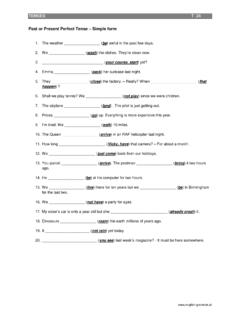
3 Complete the sentences with the present simple of the verbs in brackets. 1. Peter and his friends _____ to school by bus. (go) 2. Elephants _____ leaves and grass. (eat) 3. David's father _____ in a hospital. (work) 4. The bank opens at and _____ at (close) 5. Tom and Jim _____ football every day after school. (play) 6. Mr Jones is a teacher. He _____ History. (teach) 7. Our lessons _____ at and _____ at (start / finish) 8. My pen friend _____ in Japan. (live) 9. Mary and her brother _____ cartoons every Sunday morning. (watch) 10. John _____ his room every day. (tidy) Expressions used with the present simple Frequency adverbs: always, usually, often, sometimes, rarely, never (they are placed before the main verb) Time expressions: every day / week / on Mondays / at the in the morning / in winter / once a day / C.
4 Complete the blanks with the present simple of the verbs in the box. Mr Letty is a postman. He doesn't work in the post office. He always works outside in the streets. He _____ letters to all the people in the neighbourhood every day. He doesn't _____ but he _____ his motorbike. At the weekend, Mr Letty doesn't work. He _____. He _____ the countryside, so he always _____ to his country house with his wife. Mr and Mrs Letty _____ in the river and they _____ in the woods every weekend. D. Look at the pictures and write questions and answers, as in the example. 1. play / the guitar / in the afternoon Does he play the guitar in the aftenoon? No he doesn t play the guitar in the afternoon. He plays the accordion. 2. walk / after lunch _____ _____ _____ 3.
5 Ride / their / bicycles / to work / every day _____ _____ _____ go work ride deliver love jog rest fish walk 4. listen / to the radio / every Sunday _____ _____ _____ 5. clean / the house / on Mondays _____ _____ _____ 6. watch / TV / after school _____ _____ _____ E. Complete the blanks with the Negative or the Interrogative form of the present simple of the verbs in brackets. Mark: Hi, Tess! What are you doing? Tess: I'm watching the football team. Mark: Do you watch (watch) them every day? Tess: No, I don't. They _____ (not play) every day. They play four times a week. Mark: _____ you _____ (have) a favourite player? Tess: No, I _____ (not have) a favourite player.
6 Everyone on the team is good. Mark: _____ the attacker _____ (move) fast? Tess: No, he _____ (not move) fast, but he's very clever. _____ you _____ (like) football, Mark? Mark: No, I _____ (not like) it. I like basketball. It's a great sport.