Transcription of African tulip tree
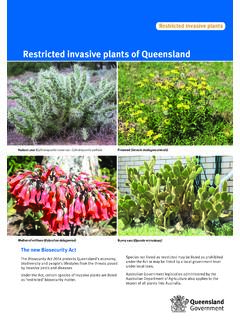
1 African tulipSpathodea campanulataThe rabbit and its controlOryctolagus cuniculusWild dog controlCanis familiarisDepartment of Agriculture, Fisheries and ForestryBiosecurity QueenslandRestricted invasive plant African tulip tree Spathodea campanulata The African tulip tree is native to tropical Africa. It is popular as an ornamental garden tree or street tree in tropical and subtropical parts of Queensland due to its showy, red tulip -shaped fowers. African tulip trees are a serious environmental weed in Coastal Queensland, where they are highly invasive and form dense stands in gullies and along streams, crowding out native vegetation. African tulip trees are extremely harmful to native stingless bees and a public safety hazard (when these trees are planted along footpaths, their dropped fowers can create a slippery walking surface).
2 The tree will reproduce via seeds and suckers and is very capable of spreading from a single planting. Areas most at risk include gullies, areas of vegetation around waterways and disturbed rainforest. Removal of African tulip trees is highly recommended, particularly when they are in close proximity to natural areas. Legal requirements African tulip tree is a category 3 restricted invasive plant under the biosecurity Act 2014. It must not be given away, sold, or released into the environment. The Act requires everyone to take all reasonable and practical steps to minimise the risks associated with invasive plants under their control. This is called a general biosecurity obligation (GBO). This fact sheet gives examples of how you can meet your GBO. At a local level, each local government must have a biosecurity plan that covers invasive plants in its area.
3 This plan may include actions to be taken on certain species. Some of these actions may be required under local laws. Contact your local government for more information. Description manual control African tulip tree is a fast growing evergreen tree that can grow up to 24 m in height. It has broadly oval-shaped leaves that are strongly veined, bronze when young and a deep, glossy green when mature. African tulip trees produce large fat clusters of velvety, bronze-green buds and large orange-red fowers with yellow frilly edges. Reddish-brown seed capsules are produced and can be up to 20 cm in length. Life cycle Flowering occurs mostly in Spring but can occur all year round. Will germinate from seed as well as sucker from damaged roots. Method of spread Mostly by people planting it as an ornamental tree .
4 It also spreads by birds eating the fruit, on water and wind. Habitat and distribution Native to tropical Africa, African tulip tree is a fast-growing evergreen tree . It is widespread in tropical and subtropical Queensland where it is a popular ornamental garden tree and street tree . Control Managing African tulip trees The GBO requires a person to take reasonable and practical steps to minimise the risks posed by African tulip trees. Table 1. Herbicides for the control of African tulip tree Young African tulip trees can be dug out or hand-pulled when the soil is moist. Stumps of felled trees need to be treated with herbicide due to their ability to sucker. Take care to ensure your own and others safety when trimming or lopping African tulip tree near power lines. For electrical safety information visit Herbicide control There are no herbicide products specifcally registered for the control of African tulip tree in Queensland.
5 However, a permit held by the Department of Agriculture and Fisheries allows people generally to use some herbicide products to control African tulip tree as an environmental weed in various situations. See Table 1 for the treatment options in situations allowed by the permit. Prior to using the herbicides listed under this permit (PER11463) you must read or have read to you and understand the conditions of the permit. To obtain a copy of this permit visit Further information Further information is available from your local government ofce, or by contacting biosecurity Queensland on 13 25 23 or visit Situation Herbicide Rate Registration status Comments Non-agricultural areas, domestic and public ser vice areas, commercial and industrial areas, bushland/native forests, roadsides, rights-of-way, vacant lots, wastelands, wetlands, dunal and coastal areas Triclopyr 200 g/L + Picloram 100 g/L + Aminopyralid 25 g/L (Tordon ReqrowthMaster) 1 L per 4 L water APVMA permit P ER11463 Permit expires 30/06/2023 Drill, frill, axe or stem inject Triclopyr 200 g/L + Picloram 100 g/L ( Slasher) 1 L per 4 L water Drill, frill, axe or stem inject Triclopyr 200 g/L + Picloram 100 g/L + Aminopyralid 25 g/L (Tordon ReqrowthMaster)
6 50 mL per 1 L water Cut stumps to less than 10 cm above the ground and immediately: paint stump after cutting spot spray cut stump Follow-up treatment needed on suckers Triclopyr 200 g/L + Picloram 100 g/L ( Slasher) 50 mL per 1 L water Cut stumps to less than 10 cm above the ground and immediately: paint stump after cutting spot spray cut stump Follow-up treatment needed on suckers Triclopyr 240 g/L + Picloram 120 g/L ( Access) 1 L per 60 L diesel Either paint stump immediately after cutting or paint or spray basal bark Glyphosate 360 g/L ( Roundup) Undiluted to 1 L per 2 L water at 1 mL per 2 cm of hole or cut Drill, frill, axe or stem inject Read the label carefully before use and always use the herbicide in accordance with the directions on the label. This fact sheet is developed with funding support from the Land Protection Fund.
7 Fact sheets are available from Depar tment of Agriculture and Fisheries (DAF ) ser vice centres and our Customer Ser vice Centre (telephone 13 25 23). Check our website at to ensure you have the latest version of this fact sheet. The control methods referred to in this fact sheet should be used in accordance with the restrictions (federal and state legislation, and local government laws) directly or indirectly related to each control method. These restrictions may prevent the use of one or more of the methods referred to, depending on individual circumstances. While ever y care is taken to ensure the accuracy of this information, DAF does not invite reliance upon it, nor accept responsibility for any loss or damage caused by actions based on it. The State of Queensland, Depar tment of Agriculture and Fisheries, 2021.
8 08/21