Transcription of Ages & Stages Questionnaires 20 Month …
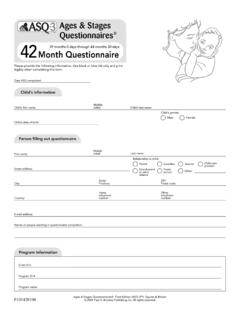
1 ages & Stages Questionnaires , Third Edition (ASQ-3 ),Squires & Bricker 2009 Paul H. Brookes Publishing Co. All rights filling out questionnaireChild s informationDate ASQ completed:Relationship to child:ParentStreet address:Names of people assisting in questionnaire completion:Grandparent or other relativeGuardianFoster parentTeacherChild care providerOther: ages & StagesQuestionnaires Month Questionnaire19 months 0 days through 20 months 30 daysPlease provide the following information. Use black or blue ink only and printlegibly when completing this s first name:Child s last name:Child s date of birth:First name:Last name:Middle initial:City:Home telephone number:State/Province:ZIP/Postal code:Other telephone number:E-mail address:If child was born 3 or more weeks prematurely, # ofweeks premature:Child s gender:MaleFemaleMiddle initial:Country:Program InformationAge at administration in months and days:Child ID #:Program ID #:Program name:If premature, adjusted age in months and days: ages & Stages Questionnaires , Third Edition (ASQ-3 ),Squires & Bricker 2009 Paul H.
2 Brookes Publishing Co. All rights 2 of 6E101200200 Month Questionnaire2019 months 0 days through 20 months 30 daysImportant Points to Remember: Try each activity with your baby before marking a response. Make completing this questionnaire a game that is fun foryou and your child. Make sure your child is rested and fed. Please return this questionnaire by :_____On the following pages are questions about activities babies may do. Your baby may have already done some of the activitiesdescribed here, and there may be some your baby has not begun doing yet. For each item, please fill in the circle that indi-cates whether your baby is doing the activity regularly, sometimes, or not this age, many toddlers may not be cooperative when asked to do things. You may need to try the following activities with yourchild more than one time. If possible, try the activities when your child is cooperative.
3 If your child can do the activity but refuses,mark yes for the Does your child imitate a two-word sentence? For example, when yousay a two-word phrase, such as Mama eat, Daddy play, Gohome, or What s this? does your child say both words back to you?(Mark yes even if her words are difficult to understand.)2. Does your child say eight or more words in addition to Mama and Dada ?3. Without your showing him, does your child pointto the correct picturewhen you say, Show me the kitty, or ask, Where is the dog? (Heneeds to identify only one picture correctly.)4. If you point to a picture of a ball (kitty, cup, hat, etc.) and ask your child, What is this? does your child correctly nameat least one picture?5. Without your giving him clues by pointing or using gestures, can yourchild carry out at least threeof these kinds of directions?a. Put the toy on the table. d. Find your coat. b. Close the door. e. Take my hand. c.
4 Bring me a towel. f. Get your book. 6. Does your child say two or three words that represent different ideastogether, such as See dog, Mommy come home, or Kitty gone ?(Don t count word combinations that express one idea, such as bye-bye, all gone, all right, and What s that? )Please give an ex-ample of your child s word combinations:YESSOMETIMESNOT YETCOMMUNICATION TOTALGROSS MOTOR1. Does your child climb on an object such as a chair to reach somethinghe wants (for example, to get a toy on a counter or to help you in thekitchen)?2. Does your child walk well and seldom fall?3. Does your child walk down stairs if you hold onto one of her hands?She may also hold onto the railing or wall. (You can look for this at astore, on a playground, or at home.)4. When you show your child how to kick a large ball, does he try to kick the ball by moving his leg forward or by walking into it? (If your child already kicks a ball, mark yes for this item.)
5 5. Does your child run fairly well, stopping herself without bumping into things or falling?6. Does your child walk either up or down at least two steps by himself? He may also hold onto the railing or MOTOR1. Does your child make a mark on the paper with the tipof a crayon (or pencil or pen) when trying to draw?2. Does your child stack three small blocks or toys on top of each other byherself? (You could also use spools of thread, small boxes, or toys thatare about 1 inch in size.)3. Does your child turn the pages of a book by himself? (He may turnmore than one page at a time.)4. Does your child get a spoon into her mouth right side up so that thefood usually doesn t spill?5. Does your child stack six small blocks or toys on top of each other byhimself? ages & Stages Questionnaires , Third Edition (ASQ-3 ),Squires & Bricker 2009 Paul H. Brookes Publishing Co. All rights Month Questionnairepage 3 of 6E101200300 YESSOMETIMESNOT YETGROSS MOTOR TOTALYESSOMETIMESNOT YETFINE MOTOR(continued)6.
6 Does your child use a turning motion with her hand while trying to turndoorknobs, wind up toys, twist tops, or screw lids on and off jars?PROBLEM SOLVING1. Without your showing him how, does your child scribble back and forthwhen you give him a crayon (or pencil or pen)?2. After watching you draw a line from the top of the paper to the bottom with a crayon (or pencil or pen), does your child copy you by drawing a single line on the paper in any direction? (Mark not yet if your child scribbles back and forth.)3. If you do any of the following gestures, does your child copy at leastone of them?a. Open and close your Pull on your Blink your Pat your If you give your child a bottle, spoon, or pencil upside down, does heturn it right side up so that she can use it properly?5. While your child watches, line up four objects like blocks or cars in a row. Does your child copy or imitate you and line up at least twoblocks side by side?
7 (You can also use spools of thread, small boxes, or other toys.)6. If your child wants something he cannot reach, does he find a chair orbox to stand on to reach it (for example, to get a toy on a counter or to help you in the kitchen)?PERSONAL-SOCIAL1. Does your child feed herself with a spoon, even though she may spillsome food?2. Does your child get your attention or try to show you something bypulling on your hand or clothes?3. Does your child drink from a cup or glass, putting it down again withlittle spilling?4. Does your child copy the activities you do, such as wipe up a spill,sweep, shave, or comb hair? ages & Stages Questionnaires , Third Edition (ASQ-3 ),Squires & Bricker 2009 Paul H. Brookes Publishing Co. All rights Month Questionnairepage 4 of 6E101200400 YESSOMETIMESNOT YETFINE MOTOR TOTALYESSOMETIMESNOT YETPROBLEM SOLVING TOTALYESSOMETIMESNOT YETC ount as yes Count as not yet PERSONAL-SOCIAL(continued)5. When playing with either a stuffed animal or a doll, does your child pre-tend to rock it, feed it, change its diapers, put it to bed, and so forth?
8 6. Does your child eat with a fork? ages & Stages Questionnaires , Third Edition (ASQ-3 ),Squires & Bricker 2009 Paul H. Brookes Publishing Co. All rights Month Questionnairepage 5 of 6E101200500 YESSOMETIMESNOT YETPERSONAL-SOCIAL TOTALOVERALLP arents and providers may use the space below for additional Do you think your child hears well? If no, explain:2. Do you think your child talks like other toddlers her age? If no, explain:3. Can you understand most of what your child says? If no, explain:4. Do you think your child walks, runs, and climbs like other toddlers his age? If no, explain:YESNOYESNOYESNOYESNOAges & Stages Questionnaires , Third Edition (ASQ-3 ),Squires & Bricker 2009 Paul H. Brookes Publishing Co. All rights Month Questionnairepage 6 of 6E101200600 OVERALL(continued)5. Does either parent have a family history of childhood deafness or hearingimpairment? If yes, explain:6. Do you have any concerns about your child s vision?
9 If yes, explain:7. Has your child had any medical problems in the last several months? If yes, explain:8. Do you have any concerns about your child s behavior? If yes, explain:9. Does anything about your child worry you? If yes, explain:YESNOYESNOYESNOYESNOYESNOAges & Stages Questionnaires , Third Edition (ASQ-3 ),Squires & Bricker 2009 Paul H. Brookes Publishing Co. All rights ASQ SCORE INTERPRETATION AND RECOMMENDATION FOR FOLLOW-UP: You must consider total area scores, overall responses, and other considerations, such as opportunities to practice skills, to determine appropriate follow-up. If the child s total score is in the area, it is above the cutoff, and the child s development appears to be on the child s total score is in the area, it is close to the cutoff. Provide learning activities and the child s total score is in the area, it is below the cutoff. Further assessment with a professional may be s name:_____Child s ID #:_____Administering program/provider:Date ASQ completed:_____Date of birth: _____Was age adjusted for prematurity when selecting questionnaire?
10 YesNoMonth ASQ-3 Information Summary2019 months 0 days through 20 months 30 daysCommunicationGross MotorFine MotorProblem SolvingPersonal-Social1234562. TRANSFER OVERALL RESPONSES: Bolded uppercase responses require follow-up. See ASQ-3 User s Guide,Chapter SCORE AND TRANSFER TOTALS TO CHART BELOW:See ASQ-3 User s Guidefor details, including how to adjust scores if itemresponses are missing. Score each item (YES = 10, SOMETIMES = 5, NOT YET = 0). Add item scores, and record each area the chart below, transfer the total scores, and fill in the circles corresponding with the total MotorFine MotorProblem SolvingPersonal-Social051015202530354045 505560 Total ACTION TAKEN: Check all that Provide activities and rescreen in _____ Share results with primary health care Refer for (circle all that apply) hearing, vision, and/or behavioral Refer to primary health care provider or other community agency (specify reason): Refer to early intervention/early childhood special No further action taken at this time_____ Other (specify): _____5.