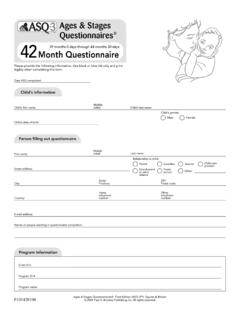
Transcription of Ages & Stages Questionnaires 36 Month …
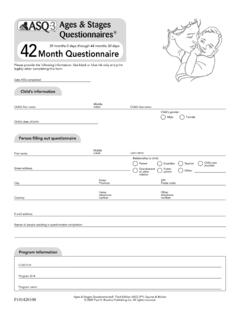
1 ages & Stages Questionnaires , Third Edition (ASQ-3 ),Squires & Bricker 2009 Paul H. Brookes Publishing Co. All rights filling out questionnaireChild s informationDate ASQ completed:Relationship to child:ParentStreet address:Names of people assisting in questionnaire completion:Grandparent or other relativeGuardianFoster parentTeacherChild care providerOther: ages & StagesQuestionnaires Month Questionnaire34 months 16 days through 38 months 30 daysPlease provide the following information. Use black or blue ink only and printlegibly when completing this s first name:Child s last name:Child s date of birth:First name:Last name:Middle initial:City:Home telephone number:State/Province:ZIP/Postal code:Other telephone number:E-mail address:Child s gender:MaleFemaleMiddle initial:Country:Program InformationChild ID #:Program ID #:Program name: ages & Stages Questionnaires , Third Edition (ASQ-3 ),Squires & Bricker 2009 Paul H. Brookes Publishing Co. All rights 2 of 7E101360200 Month Questionnaire3634 months 16 days through 38 months 30 daysImportant Points to Remember: Try each activity with your child before marking a response.
2 Make completing this questionnaire a game that is fun foryou and your child. Make sure your child is rested and fed. Please return this questionnaire by :_____On the following pages are questions about activities children may do. Your child may have already done some of the activitiesdescribed here, and there may be some your child has not begun doing yet. For each item, please fill in the circle that indicateswhether your child is doing the activity regularly, sometimes, or not When you ask your child to point to her nose, eyes, hair, feet, ears, andso forth, does she correctly point to at least sevenbody parts? (She canpoint to parts of herself, you, or a doll. Mark sometimes if she cor-rectly points to at least threedifferent body parts.)2. Does your child make sentences that are three or four words long?Please give an example:3. Without giving your child help by pointing or using gestures, ask him to put the book onthe table and put the shoe underthe chair.
3 Doesyour child carry out both of these directions correctly?4. When looking at a picture book, does your child tell you what is hap-pening or what action is taking place in the picture (for example, bark-ing, running, eating, or crying )? You may ask, What is the dog(or boy) doing? 5. Show your child how a zipper on a coat moves up and down, and say, See, this goes up and down. Put the zipper to the middle and askyour child to move the zipper the zipper to the middleand ask your child to move the zipper this several times, placingthe zipper in the middle before asking your child to move it up ordown. Does your child consistently move the zipper up when you say up and down when you say down ?6. When you ask, What is your name? does your child say both her firstand last names?YESSOMETIMESNOT YETCOMMUNICATION TOTALGROSS MOTOR1. Without holding onto anything for support, does your child kick a ball by swinging his leg forward?2. Does your child jump with both feet leaving the floor at the same time?
4 3. Does your child walk up stairs, using only one foot on each stair? (The left foot is on one step, and the right foot is on the next.)She may hold onto the railing or wall. (You can look for this at a store, on a playground, or at home.)4. Does your child stand on one foot for about 1 second without holding onto anything?5. While standing, does your child throw a ball overhandby raising his arm to shoulder height and throwing the ball forward? (Dropping the ball or throwing the ball underhand should be scored as not yet. )6. Does your child jump forward at least 6 inches with both feet leaving the ground at the same time?FINE MOTOR1. After your child watches you draw a line from the top of the paper to the bottom with a pencil, crayon, or pen, ask her to make a line like yours. Do not let your child trace your line. Does your child copy you by drawing a single line in a vertical direction? ages & Stages Questionnaires , Third Edition (ASQ-3 ),Squires & Bricker 2009 Paul H.
5 Brookes Publishing Co. All rights Month Questionnairepage 3 of 7E101360300 YESSOMETIMESNOT YETGROSS MOTOR TOTALYESSOMETIMESNOT YETC ount as yes Count as not yet FINE MOTOR(continued)2. Can your child string small items such as beads, macaroni, or pasta wagon wheels onto a string or shoelace?3. After your child watches you draw a single circle, ask him to make a circle like yours. Do not let him trace your circle. Does your child copy you by drawing a circle?4. After your child watches you draw a line from one side of the paper to the other side, ask her to make a line like yours. Do not let your child trace your line. Does your child copy you by drawing a single line in a horizontal direction?5. Does your child try to cut paper with child-safe scissors? He does not need to cut the paper but must get the blades to open and close while holding the paper with the other hand. (You may show your child how to use scissors. Carefully watch your child s use of scissors for safety reasons.)
6 6. When drawing, does your child hold a pencil, crayon, or pen betweenher fingers and thumb like an adult does?PROBLEM SOLVING1. While your child watches, line up four objects like blocks or cars in a row. Does your child copy or imitate you and line up fourobjects in a row?(You can also use spools of thread, small boxes, or other toys.)2. If your child wants something he cannot reach, does he find a chair orbox to stand on to reach it (for example, to get a toy on a counter or to help you in the kitchen)? ages & Stages Questionnaires , Third Edition (ASQ-3 ),Squires & Bricker 2009 Paul H. Brookes Publishing Co. All rights Month Questionnairepage 4 of 7E101360400 YESSOMETIMESNOT YETFINE MOTOR TOTALYESSOMETIMESNOT YETC ount as not yet Count as yes Count as yes Count as not yet PROBLEM SOLVING(continued)3. When you point to the figure and ask your child, What is this? does your child say a word that means a person or something similar? (Mark yes for responses like snowman, boy, man, girl, Daddy, spaceman, and monkey.)
7 Please write your child s response here:4. When you say, Say seven three, does your child repeat justthe twonumbers in the same order? Do not repeat the necessary,try another pair of numbers and say, Say eight two. (Your child mustrepeat just one series of two numbers for you to answer yes to thisquestion.)5. Show your child how to make a bridge with blocks, boxes, or cans, like the example. Does your child copy you by making one like it?6. When you say, Say five eight three, does your child repeat justthethree numbers in the same order? Do not repeat the neces-sary, try another series of numbers and say, Say six nine two. (Yourchild must repeat just one series of three numbers for you to answer yes to this question.)PERSONAL-SOCIAL1. Does your child use a spoon to feed herself with little spilling?2. Does your child push a little wagon, stroller, or toy on wheels, steeringit around objects and backing out of corners if he cannot turn?3. When your child is looking in a mirror and you ask, Who is in the mir-ror?
8 Does she say either me or her own name?4. Does your child put on a coat, jacket, or shirt by himself?5. Using these exact words, ask your child, Are you a girl or a boy? Does your child answer correctly?6. Does your child take turns by waiting while another child or adult takesa turn? ages & Stages Questionnaires , Third Edition (ASQ-3 ),Squires & Bricker 2009 Paul H. Brookes Publishing Co. All rights Month Questionnairepage 5 of 7E101360500 YESSOMETIMESNOT YETPROBLEM SOLVING TOTALYESSOMETIMESNOT YETPERSONAL-SOCIAL TOTALAges & Stages Questionnaires , Third Edition (ASQ-3 ),Squires & Bricker 2009 Paul H. Brookes Publishing Co. All rights Month Questionnairepage 6 of 7E101360600 OVERALLP arents and providers may use the space below for additional Do you think your child hears well? If no, explain:2. Do you think your child talks like other children her age? If no, explain:3. Can you understand most of what your child says? If no, explain:4. Can other people understand most of what your child says?
9 If no, explain:5. Do you think your child walks, runs, and climbs like other children his age? If no, explain:6. Does either parent have a family history of childhood deafness or hearingimpairment? If yes, explain:YESNOYESNOYESNOYESNOYESNOYESNOAg es & Stages Questionnaires , Third Edition (ASQ-3 ),Squires & Bricker 2009 Paul H. Brookes Publishing Co. All rights Month Questionnairepage 7 of 7E101360700 OVERALL(continued)7. Do you have any concerns about your child s vision? If yes, explain:8. Has your child had any medical problems in the last several months? If yes, explain:9. Do you have any concerns about your child s behavior? If yes, explain:10. Does anything about your child worry you? If yes, explain:YESNOYESNOYESNOYESNOAges & Stages Questionnaires , Third Edition (ASQ-3 ),Squires & Bricker 2009 Paul H. Brookes Publishing Co. All rights ASQ SCORE INTERPRETATION AND RECOMMENDATION FOR FOLLOW-UP: You must consider total area scores, overall responses, and other considerations, such as opportunities to practice skills, to determine appropriate follow-up.
10 If the child s total score is in the area, it is above the cutoff, and the child s development appears to be on the child s total score is in the area, it is close to the cutoff. Provide learning activities and the child s total score is in the area, it is below the cutoff. Further assessment with a professional may be s name:_____Child s ID #:_____Administering program/provider: Month ASQ-3 Information Summary3634 months 16 days through 38 months 30 daysCommunicationGross MotorFine MotorProblem SolvingPersonal-Social1234562. TRANSFER OVERALL RESPONSES: Bolded uppercase responses require follow-up. See ASQ-3 User s Guide,Chapter SCORE AND TRANSFER TOTALS TO CHART BELOW:See ASQ-3 User s Guidefor details, including how to adjust scores if itemresponses are missing. Score each item (YES = 10, SOMETIMES = 5, NOT YET = 0). Add item scores, and record each area the chart below, transfer the total scores, and fill in the circles corresponding with the total MotorFine MotorProblem SolvingPersonal-Social051015202530354045 505560 Total ACTION TAKEN: Check all that Provide activities and rescreen in _____ Share results with primary health care Refer for (circle all that apply) hearing, vision, and/or behavioral Refer to primary health care provider or other community agency (specify reason): Refer to early intervention/early childhood special No further action taken at this time_____ Other (specify): _____5.