Transcription of Alabama Parenting Questionnaire - CYFAR
1 Alabama Parenting Questionnaire Instrument: Alabama Parenting Questionnaire (APQ) Scale/Subscale Name: Alabama Parenting Questionnaire (APQ) Developers: Frick, P. J. Year: 1991 Target Audience(s): Parents of children 6-18 and children 6-18 Language other than English available: Chinese, Dutch, German, Spanish, Norwegian Type: Behavior Data collected: Quantitative Data collection format: Self report Pre/post Reading Level: Unavailable Existence of test/technical manuals, user guides, supplemental materials: Surveys and publications available at: Includes survey items and information on the psychometrics of the survey. Additional publications may be found at Level of training necessary for administration/scoring/interpretation: None necessary.
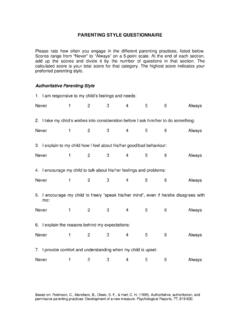
2 Paper and pencil scoring with the sum of ratings used as a total scale score. Widespread Use/Professional Endorsements: Scale has been used in multiple research articles looking at Parenting behaviors. The University of New Orleans provides the tests and measures at: Credit must be given to the developers. Cost of Use: No cost associated with the survey. Dr. Frick requests that copies of any publications using the APQ are sent to him at Description: The APQ measures five dimensions of Parenting that are relevant to the etiology and treatment of child externalizing problems: (1) positive involvement with children, (2) supervision and monitoring, (3) use of positive discipline techniques, (4) consistency in the use of such discipline and (5) use of corporal punishment.
3 There is both a parent form and a child form. 42 items Psychometrics: Information on reliability and validity are provided below. If information on a particular psychometric was not found, it is indicated as no information provided. It should be noted that this is not necessarily an indication of a lack of reliability or validity within a particular scale/instrument, but rather a lack of rigorous testing, for various reasons, by the developers or other researchers. Reliability: A correlation of at least .80 is suggested for at least one type of reliability as evidence; however, standards range from .5 to .9 depending on the intended use and context for the instrument. Internal Consistency: The average reliability across the APQ scales is .68. Inter-rater reliability: No information provided Test-Retest: No information provided Validity: The extent to which a measure captures what it is intended to measure.
4 Content/Face Validity: No information provided Criterion Validity: The APQ has good psychometric properties including criterion validity in differentiating clinical and nonclinical groups (Dadds, Maujean, & Fraser, 2003; Frick, Christian, &Wooton, 1999; Shelton et al., 1996). Frick et al. (1999) reported a mean r2 across its five scales of for predicting child symptoms of ODD and CD. Independent investigations have also shown the APQ to be an informative assessment tool. Construct Validity: No information provided Construct: Effective Parenting Scale Name: Alabama Parenting Questionnaire (APQ) Developers: Frick, P. J. Scoring for Parent Form: The items on the adult form are categorized into five subscales as follows: o Involvement: 1, 4, 7, 9, 11, 14, 15, 20, 23, 26 o Positive Parenting : 2, 5, 13, 16, 18, 27 o Poor Monitoring/Supervision: 6, 10, 17, 19, 21, 24, 28, 29, 30, 32 o Inconsistent Discipline: 3, 8, 12, 22, 25, 31 o Corporal Punishment: 33, 35, 39 No reverse coding necessesary.
5 Sum all items in the scale to obtain a total scale score (you may subtract this score by the number of items in the subscale so that the score range begins at zero). Other Discipline Practices is not a scale, but provides information on an item by item basis. Numbers for these items are: 34, 36, 37, 39, 40, 41, 42 Scoring for Child Form: The items on the child form are categorized into five subscales that are reflective of the parent subscales: o Involvement: 1, 4, 7, 9, 11, 14, 15, 20, 23, 26 (there are two parts to each of these questions one for mother involvement and one for father involvement) o Positive Parenting : 2, 5, 13, 16, 18, 27 o Poor Monitoring/Supervision: 6, 10, 17, 19, 21, 24, 28, 29, 30, 32 o Inconsistent Discipline: 3, 8, 12, 22, 25, 31 o Corporal Punishment: 33, 35, 39 No reverse coding necessesary.
6 Sum all items in the scale to obtain a total scale score (you may subtract this score by the number of items in the subscale so that the score range begins at zero). Other Discipline Practices is not a scale, but provides information on an item by item basis. Numbers for these items are: 34, 36, 37, 39, 40, 41, 42