Transcription of Alcohol Based Hand Sanitizer Safety Data Sheet
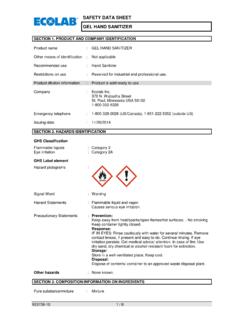
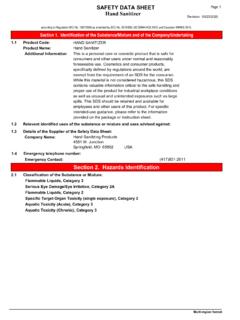
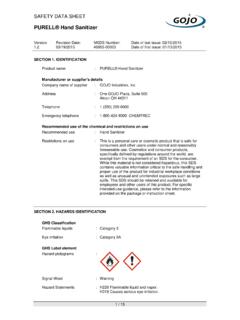
1 Alcohol Based Hand Sanitizer Safety Data Sheet Section 1: Identification of the substance or mixture and of the supplier Product Name: Alcohol Based Hand Sanitizer Synonyms/Other Means of Identification: Hand Sanitizer SKU #: AS04 Manufacturer: F-Matic Inc. 299 South Millpond Drive Lehi, Utah 84043 SDS Information: Phone: 800-824-9994 Section 2: Hazard(s) Identification Classification This chemical is considered hazardous by the 2012 OSHA Hazard Communication Standard (29 CFR ). This is a personal care or cosmetic product that is safe for consumers and other users under normal and reasonably foreseeable use.
2 Cosmetics and consumer products, specifically defined by regulations around the world, are exempt from the requirement of an SDS for the consumer. This SDS should be retained and available for employees and other users of this product. For specific intended-use guidance, please refer to the information provided on the package or instruction Sheet . Label Elements Signal Word Warning Hazard Statements Causes serious eye irritation Highly flammable liquid and vapor. Precautionary Statement(s): Keep away from heat/sparks/ open flames/ hot surfaces.
3 No Smoking. IF IN EYES: Rinse cautiously with water for several minutes. Remove contact lenses, if present and easy to do. Continue rinsing. If eye irritation persists: Get medical advice/attention. IF INHALED: Remove victim to fresh air and keep at rest in a position comfortable for breathing. Section 3: Composition / Information on Ingredients INGREDIENTS: The identity of the specific components of this mixture is proprietary information and regarded to be a trade secret, in accordance with the provisions of paragraph of Title 29 of the Code of Federal Regulations.
4 Please refer to section 2 for hazard identification. Chemical Name CAS No.# Content (w/w%) Ethanol 64-17-5 75% Activated Silver Ion Colloid - 5% Water 7732-18-5 12% Hydrogen Peroxide 7722-84-1 5% Xanthan Gum 11138-66-2 3% Alcohol Based Hand Sanitizer Page 2 of 7 Date of Revision: 10-July-2020 Status: Final Page 2 of 7 Status: Final Section 4: First Aid Measures Eye Contact: Flush eyes under eyelids with plenty of cool water for at least 15 minutes. If irritation persists, seek medical attention. For direct contact, remove contact lenses if present and easy to do so.
5 Immediately hold eyelids apart and flush the affects eye(s) with clean water for at least 15 minutes. Seek immediate medical attention. Skin Contact: If irritation persists, wash with water. Inhalation (Breathing): Get medical attention if symptoms occur. Ingestion (Swallowing): Contact a physician or Poison Control Center immediately. Do not induce vomiting, never give anything by mouth to an unconscious person. Most important symptoms and effects Acute: Eye irritation Delayed: None known Section 5: Fire-Fighting Measures NFPA 704 Hazard Class Health: 1 Flammability: 3 Instability: 0 (0-Minimal, 1-Slight, 2-Moderate, 3-Serious, 4-Severe) HMIS Health: 1 Flammability: 3 Physical Haz: 0 (0-Minimal, 1-Slight, 2-Moderate, 3-Serious, 4-Severe, *Chronic) Extinguishing Media: Use extinguishing media suitable for surrounding fire.
6 Specific Hazards Arising From the Chemical Unusual Fire & Explosion Hazards: No unusual fire or explosion hazards are expected. If container is not properly cooled, it can rupture in the heat of a fire. Hazardous Combustion Products: Carbon oxides. Special Protective Actions for Firefighters: For fires beyond the initial stage, emergency responders in the immediate hazard area should wear protective clothing. When the potential chemical hazard is unknown, in enclosed or confined spaces, a self- contained breathing apparatus should be worn.
7 In addition, wear other appropriate protective equipment as conditions warrant (see Section 8). Isolate immediate hazard area and keep unauthorized personnel out. Stop spill/release if it can be done safely. If this cannot be done, allow fire to burn. Move undamaged containers from immediate hazard area if it can be done safely. Water spray may be useful in minimizing or dispersing vapors and to protect personnel. Cool equipment exposed to fire with water, if it can be done safely. Section 6: Accidental Release Measures Personal Precautions: No special requirements.
8 Environmental Precautions: Avoid contact of large amounts f spilled material runoff with soil and surface waterways. Absorb with inert material. Use a water rinse for final cleanup. Methods and Materials for Containment and Clean-Up: Notify relevant authorities in accordance with all applicable regulations. Immediate cleanup of any spill is recommended. Absorb spill with inert material such as sand or vermiculite, and place in suitable container for disposal. If spilled on water remove with appropriate methods ( skimming, booms or absorbents).
9 In case of soil contamination, remove contaminated soil for remediation or disposal, in accordance with local regulations. Section 7: Handling and Storage Precautions for safe handling: Wash thoroughly after handling. Conditions for safe storage: Keep out of reach of children. Keep container tightly closed. Store between 32 to 122 degrees F. Alcohol Based Hand Sanitizer Page 3 of 7 Date of Revision: 10-July-2020 Status: Final Page 3 of 7 Status: Final Section 8: Exposure Controls / Personal Protection Note: State, local or other agencies or advisory groups may have established more stringent limits.
10 Consult an industrial hygienist or similar professional, or your local agencies, for further information. Chemical name ACGIH TLV OSHA PEL NIOSH Ethanol 64-17-5 STEL: 1000 ppm TWA: 1000 ppm TWA: 1900 mg/m3 (vacated) TWA: 1000 ppm (vacated) TWA: 1900 mg/m3 IDLH: 3300 ppm TWA: 1000 ppm TWA: 1900 mg/m3 Hydrogen peroxide 7722-84-1 TWA: 1 ppm TWA: 1 ppm TWA: mg/m3 (vacated) TWA: 1 ppm (vacated) TWA: mg/m3 IDLH: 75 ppm TWA: 1 ppm TWA: mg/m3 Engineering controls: Good general ventilation should be sufficient to control workers exposure to airborne contamination.