Transcription of Algebraic Expressions packet
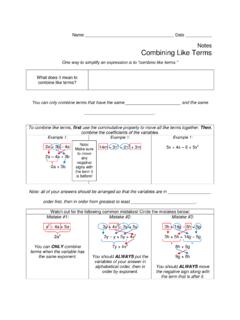
1 Algebraic Expressions Name _____ Period _____ 3(x 8) is 3x + (-24) or 3x - 24 -2x + 5x 9 + 10 is 3x + 1 4x + 12 is 4(x + 3) S Survey P Parentheses C Catch & Combine = ..in A Clear Add/Subtract D/M Clear Division/ multiplication 1 Simplifying Algebraic Expressions by Combining Like Terms Objective: Students will identify like terms. Students will simplify Algebraic Expressions by combining like terms. Term Definition Picture/Example Terms Quantities that you ADD to form an Algebraic expression are called terms.
2 There are 3 terms in 4n + 6b 8 The terms are: Like Terms You can COMBINE Like Terms **COMBINE means add, so use the addition rules (SSS, DSD) terms with the same variable raised to the same power You CAN add/subtract like terms. Unlike Terms terms whose variables are not the same, or who have the same variable, but it s raised to a different power You CANNOT add/subtract unlike terms. + C 2 3 For each Algebraic expression, identify the number of terms. Then list the coefficients and any constant terms.
3 Expression 6a + 3 6a 3 y + 8z n Number of Terms Coefficient(s) Constant(s) Identify the number of terms, the coefficients, and the constant term of the Expressions below. 1. 7p 6pc + 3c - 2 Number of terms: _____ Coefficients: _____ Constant terms: _____ 2. 8 + 4ab - 5b Number of terms: _____ Coefficients: _____ Constant terms: _____ 4 To simplify by combining like terms: 1. Search for like terms (same variable raised to the same power; and constants with other constants).
4 2. Catch the first term and any like terms. 3. Combine them using the addition rules. (SSS, DSD) 4. Continue with other like terms. *Remember that an invisible 1 lurks in front of variables that appear to have no coefficient attached to them. 1) 4x + 5x + 7 + x + 2 2) 2n + 3 5n + 6 _____ _____ 3) - 9b + 2n 4 + 2b 4) -7g + 3 8 3g + 7h _____ _____ 5) -8 + 2d 7 5d + 12 6) 5b + 7 3b 4 _____ _____ _____ _____ + C 5 Identify the number of terms, the coefficient(s), and the constant term(s) of the Expressions below.
5 1. 6p 7pc + 9c 4 2. 3 + 4ab - 5b + m Number of terms: _____ Number of terms: _____ Coefficients: _____ Coefficients: _____ Constant terms: _____ Constant terms: _____ 3. Sarah was asked to identify all coefficients and constants of the expression 4 + n + 7m. She said that 4 is a constant, and 7 is a coefficient. What is her error? a. She did not include the constant 1. b. She said 4 is a constant. It is actually a coefficient. c. She did not include the coefficient 1. d.
6 She said 7 is a coefficient. It is actually a constant. 4. Add. 2a + 8 + 4b + 5 5. Add. 8x 7 + 6x + 8 6. Find the sum. 8x + 2 -9x + 7 7. Find the sum. 3n + 4 8n -1 + C HOMEWORK 6 Variable A symbol used to represent an unknown amount. The symbol is usually a letter of the alphabet. Coefficient The number being multiplied by a variable. It is the number attached to the variable, and is usually in front. *Special note! A variable with no coefficient has an INVISIBLE 1 attached to it!
7 Constant A number that doesn t change. There is no variable attached to a constant. Algebraic Expression An expression that contains variables. 7 Expanding Algebraic Expressions (The distributive property ) day 1 Objective: Students will simplify Algebraic expression using the distributive property . Term Definition Example distributive property The distributive property combines multiplication with addition and subtraction You can multiply constants and Algebraic terms simply by multiplying the constant and the coefficient.
8 The variable remains the same. Remember, if the variable has no coefficient, it s an invisible 1. a. 2(3x) = _____ b. -2(3d) = _____ c. 5(n) = _____ d. -3y(4) = _____ You can also multiply variables by one another. e. a t = _____ f. b(y) = _____ g. 3c(b) = _____ h. 2n(4x) = _____ But what happens when you have more than one term inside the parentheses? Examples: 2(n + 4) 3(x 8) 8 x P (clear Parentheses) I times over the rainbow J The distributive property YOUR PARENTHESES GOODBYE!
9 Step 1: Catch the number touching the parentheses (on the outside) and any number inside that has a sign. Step 2: Multiply the number on the outside of the parentheses by the FIRST number inside the parentheses. Step 3: Multiply the number on the outside by the SECOND number that s inside. Examples: 1. 3(4x + 2) 2. -3(4x + 2) 3. -3(4x - 2) KISS 9 1. 5(x + 3) b. 2(x + 1) c. 4(x + 5) 2. -3(x + 4) b. -6(x + 5) c. -1(x + 4) 3. -4(x - 4) b.
10 -8(x - 3) c. -1(x - 7) 4. -3(2x - 5) b. -2(4x - 7) c. -2(6x - 8) 5. a(b - 4) b. n(d + 1) c. y(5 - z) 6. 2a(3p - 5) b. 4n(6d + k) c. 5y(6h - w) x P 10 a. 3(x + 2) b. 5(2y 7) c. -2(n + 9) d. -3(k 1) e. -4(1 + a) f. 3(d 4) g. -1(3x + 4) h. -3(b 9 + 2y) i. -5(2 m) j. 3(n 4 + 5y) k. -6(j 2 + 3k) l. -1(3 - h) HOMEWORK x P 11 Expanding Algebraic Expressions (The distributive property ) day 2 Let s review using the distributive property : 1.