Transcription of Algebraic Expressions packet
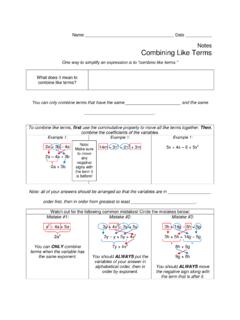
1 Algebraic Expressions Name _____ Period _____ 3(x 8) is 3x + (-24) or 3x - 24 -2x + 5x 9 + 10 is 3x + 1 4x + 12 is 4(x + 3) S Survey P Parentheses C Catch & Combine = ..in A Clear Add/Subtract D/M Clear Division/Multiplication 1 Simplifying Algebraic Expressions by Combining Like Terms Objective: Students will identify like terms. Students will simplify Algebraic Expressions by combining like terms. Term Definition Picture/Example Terms Quantities that you ADD to form an Algebraic expression are called terms. There are 3 terms in 4n + 6b 8 The terms are: Like Terms You can COMBINE Like Terms **COMBINE means add, so use the addition rules (SSS, DSD) terms with the same variable raised to the same power You CAN add/subtract like terms.
2 Unlike Terms terms whose variables are not the same, or who have the same variable, but it s raised to a different power You CANNOT add/subtract unlike terms. + C 2 3 For each Algebraic expression, identify the number of terms. Then list the coefficients and any constant terms. Expression 6a + 3 6a 3 y + 8z n Number of Terms Coefficient(s) Constant(s) Identify the number of terms, the coefficients, and the constant term of the Expressions below. 1. 7p 6pc + 3c - 2 Number of terms: _____ Coefficients: _____ Constant terms: _____ 2. 8 + 4ab - 5b Number of terms: _____ Coefficients: _____ Constant terms: _____ 4 To simplify by combining like terms: 1. Search for like terms (same variable raised to the same power; and constants with other constants).
3 2. Catch the first term and any like terms. 3. Combine them using the addition rules. (SSS, DSD) 4. Continue with other like terms. *Remember that an invisible 1 lurks in front of variables that appear to have no coefficient attached to them. 1) 4x + 5x + 7 + x + 2 2) 2n + 3 5n + 6 _____ _____ 3) - 9b + 2n 4 + 2b 4) -7g + 3 8 3g + 7h _____ _____ 5) -8 + 2d 7 5d + 12 6) 5b + 7 3b 4 _____ _____ _____ _____ + C 5 Identify the number of terms, the coefficient(s), and the constant term(s) of the Expressions below. 1. 6p 7pc + 9c 4 2. 3 + 4ab - 5b + m Number of terms: _____ Number of terms: _____ Coefficients: _____ Coefficients: _____ Constant terms: _____ Constant terms: _____ 3.
4 Sarah was asked to identify all coefficients and constants of the expression 4 + n + 7m. She said that 4 is a constant, and 7 is a coefficient. What is her error? a. She did not include the constant 1. b. She said 4 is a constant. It is actually a coefficient. c. She did not include the coefficient 1. d. She said 7 is a coefficient. It is actually a constant. 4. Add. 2a + 8 + 4b + 5 5. Add. 8x 7 + 6x + 8 6. Find the sum. 8x + 2 -9x + 7 7. Find the sum. 3n + 4 8n -1 + C HOMEWORK 6 Variable A symbol used to represent an unknown amount. The symbol is usually a letter of the alphabet. Coefficient The number being multiplied by a variable. It is the number attached to the variable, and is usually in front. *Special note! A variable with no coefficient has an INVISIBLE 1 attached to it!
5 Constant A number that doesn t change. There is no variable attached to a constant. Algebraic Expression An expression that contains variables. 7 Expanding Algebraic Expressions (The Distributive Property) day 1 Objective: Students will simplify Algebraic expression using the distributive property. Term Definition Example Distributive Property The distributive property combines multiplication with addition and subtraction You can multiply constants and Algebraic terms simply by multiplying the constant and the coefficient. The variable remains the same. Remember, if the variable has no coefficient, it s an invisible 1. a. 2(3x) = _____ b. -2(3d) = _____ c. 5(n) = _____ d. -3y(4) = _____ You can also multiply variables by one another.
6 E. a t = _____ f. b(y) = _____ g. 3c(b) = _____ h. 2n(4x) = _____ But what happens when you have more than one term inside the parentheses? Examples: 2(n + 4) 3(x 8) 8 x P (clear Parentheses) I times over the rainbow J The Distributive Property YOUR PARENTHESES GOODBYE! Step 1: Catch the number touching the parentheses (on the outside) and any number inside that has a sign. Step 2: Multiply the number on the outside of the parentheses by the FIRST number inside the parentheses. Step 3: Multiply the number on the outside by the SECOND number that s inside. Examples: 1. 3(4x + 2) 2. -3(4x + 2) 3. -3(4x - 2) KISS 9 1. 5(x + 3) b. 2(x + 1) c. 4(x + 5) 2. -3(x + 4) b. -6(x + 5) c.
7 -1(x + 4) 3. -4(x - 4) b. -8(x - 3) c. -1(x - 7) 4. -3(2x - 5) b. -2(4x - 7) c. -2(6x - 8) 5. a(b - 4) b. n(d + 1) c. y(5 - z) 6. 2a(3p - 5) b. 4n(6d + k) c. 5y(6h - w) x P 10 a. 3(x + 2) b. 5(2y 7) c. -2(n + 9) d. -3(k 1) e. -4(1 + a) f. 3(d 4) g. -1(3x + 4) h. -3(b 9 + 2y) i. -5(2 m) j. 3(n 4 + 5y) k. -6(j 2 + 3k) l. -1(3 - h) HOMEWORK x P 11 Expanding Algebraic Expressions (The Distributive Property) day 2 Let s review using the distributive property: 1. 3(x 4) 2. 4(n + 1) 3. -5(x 5) 4. 12(10) 5. 12(12) 6. 13(9) 7. 14(16) 8. 12(6x+10) 9. 12(8x 4) 10. 13(12x+9) 11. 13(15x 3) 12. 5(2x + 1 n) Objective: Students will simplify Algebraic expression using the distributive property.
8 Students will recognize that a problem can be written in different forms. Students will recognize that some problems that have parentheses, may NOT require the dist. property. Remember! The distributive property is multiplication over addition or subtraction. This means that in order to distribute, you must have a term (constant or variable) that is touching parentheses that contain more than one term. Those terms must be separated by addition or subtraction signs, NOT multiplication or division signs. x P 12 ERROR ALERT! Some addition and subtraction problems look very similar to distributive property problems. Ex. -3(x + 7) This expression requires the distributive property. (5 x)(-2) This expression requires the distributive property. (5 x) 8 and 2(n 4) These Expressions do not!
9 1. Circle the problems that require the distributive property. Put an X through those that do NOT require the distributive property. -a(3 + b) (-a)(3) + (b) (3 + b) - a (3 + b)(-a) 4(2 n) (3 g)(-5) (-4)(6) + n (8 + h) - 2 SHOULD I USE THE DISTRIBUTIVE PROPERTY?? YES NO -3(x + 1) -3 + (x + 1) (2x 4)(3) (2x 4) + 3 (3 + y)(-2) (3 y)( 2) 13 Use the Distributive Property to expand each expression. Ex. -4(2n + 5) a. 3(4x + 2) b. -5( y 7) c. -2(n + 9) d. 3(-1 5c) e. x(3 + 4y) f. -1(a 1) g. (4x 6) h. 14(8x + 12) i. 34(8x - 12) x P 14 Expand the Expressions that require the distributive property. Put an X through the Expressions that do not require the distributive property. REMEMBER you can only distribute (multiply) over addition or subtraction!
10 1. -6(a + 8) 2. 4(1 + 8x + a) 3. (-5n + 7)6 4. 2 + (4k 3) 5. (9m + 10) 2 6. -8(-b 4) 7. (3)(y)(-2) 8. 5(3 y) 9. -4(-6p + 7) 10. -4(n 5) 11. 13(9n + 15) 12. 126b 10() HOMEWORK 15 Simplifying Algebraic Expressions by Distributing and Combining Like Terms 16 Simplifying Algebraic Expressions by Distributing and Combining Like Terms Objective: Students will simplify Algebraic Expressions by combining like terms. Students will recognize when the distributive property is required to simplify an expression and when it is not. Before simplifying an expression that contains parentheses, you must determine whether or not you need to use the distributive property. If so, DO IT FIRST! A. simplify the Expressions below (Hint: ONE of them needs dist.)