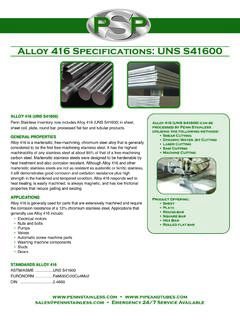
Transcription of Alloy 416 Specifications: UNS S41600
1 Alloy 416 (UNS S41600 )Penn Stainless inventory now includes Alloy 416 (UNS S41600 ) in sheet, sheet coil, plate, round bar, processed flat bar and tubular PROPERTIESA lloy 416 is a martensitic, free-machining, chromium steel Alloy that is generallyconsidered to be the first free-machining stainless steel. It has the highestmachinability of any stainless steel at about 85% of that of a free-machiningcarbon steel. Martensitic stainless steels were designed to be hardenable byheat treatment and also corrosion resistant. Although Alloy 416 and othermartensitic stainless steels are not as resistant as austenitic or ferritic stainless,it still demonstrates good corrosion and oxidation resistance plus highstrength in the hardened and tempered condition. Alloy 416 responds well toheat treating,is easily machined, is always magnetic, and has low frictionalproperties that reduce galling and 416 is generally used for parts that are extensively machined and requirethe corrosion resistance of a 13% chromium stainless steel.
2 Applications thatgenerally use Alloy 416 include: Electrical motors Nuts and bolts Pumps Valves Automatic screw machine parts Washing machine components Studs GearsSTANDARDS Alloy 416 ASTM/ASME .. UNS S41600 EURONORM .. FeMi35Cr20Cu4Mo2 DIN .. S S S P P P P P P Alloy 416 Specifications: UNS S41600 Alloy 416 (UNS S41600 ) can beprocessed by Penn Stainless utilizing the following methods: Shear Cutting Dynamic Water Jet Cutting Laser Cutting Saw Cutting Machine CuttingProduct Offering: Sheet Plate Round bar Square bar Hex Bar Rolled flat Emergency 24/7 Service AvailableCORROSION RESISTANCE Demonstrates corrosion resistance to natural food acids, waste products, basic and neutral salts, natural waters, andmost atmospheric conditions Less resistant that the austenitic grades of stainless steel and also the 17% chromium ferritic alloys High sulfur, free-machining grades like Alloy 416 are unsuitable for marine or other chloride exposure Maximum corrosion resistance is achieved in the hardened condition, with a smooth surface finishHEAT RESISTANCE Fair resistance to scaling in intermittent service up to 1400 F (760 C) and up to 1247 F (675 C)
3 In continuous service Not recommended for use in temperatures above the relevant tempering temperature if maintenance of mechanicalproperties is importantWELDING CHARACTERISTICS Poor weldability If welding is necessary use Alloy 410 low hydrogen electrodes Pre-heat to 392 to 572 F (200-300 C) Follow immediately with annealing or re-hardening, or a stress relief at 1202 to 1247 F (650 to 675 C)MACHINABILITY Has outstanding machinability Best machinability is in the sub-critical annealed PROPERTIES MECHANICAL PROPERTIES PHYSICAL PROPERTIEST empering Temperature ( C)Tensile Strength(MPa)Yield Strength Proof (MPa)Elongation (% in 50mm)Hardness Brinell (HB)Impact Charpy V (J)Annealed *51727630262 Condition T **75858618248-302 2041340105011388203161350106012388224271 405111011401#538100079513321#59384070519 248276507505752022338* Annealed properties are typical for Condition A of ASTM A582.
4 ** Hardened and tempered Condition T of ASTM A582 - Brinell Hardness is specified range, other properties are typical only.# Due to associated low impact resistance this steel should not be tempered in the range : : Emergency 24/7 Service AvailableAlloy 416 Density7750 Kg/ m3 Specific Heat at 32 - 212 F (0 - 100 C)460 Resitivity at 68 F (20 C)43 Microhm-cmElastic Modulus 200 GPaMean Coefficient of Thermal Expansionat 32 - 212 F (0 - 100 C) m/m/ Cat 32 - 599 F (0 - 315 C) m/m/ Cat 32 - 1000 F (0 - 538 C) m/m/ CThermal ConductivityW/mKat 212 F (100 C) 932 F (500 C) in PSP-108 7-13