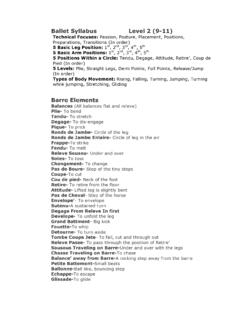
Transcription of AMERICAN BALLET INTENSIVES
1 AMERICAN BALLET INTENSIVES BALLET Terminology Adage [ a-DAHZH] In dancing it has two meanings: (1) A series of exercises following the centre practice, consisting of a succession of slow and graceful movements which may be simple or of the most complex character, performed with fluidity and apparent ease. These exercises develop a sustaining power, sense of line, balance and the beautiful poise, which enables the dancer to perform with majesty and grace. All gro [a-lay-GROH] Brisk, lively. A term applied to all bright and brisk movements. All steps of elevation such as the entrechat, cabriole, assembl , jet and so on come under this classification. The most important qualities to aim at in all gro are lightness, smoothness and ballon. la seconde [ah la suh-GAWND] To the second. A term to imply that the foot is to be placed in the second position, or that a movement is to be made to the second position en l'air.
2 As, for example, in grand battement la seconde. Arabesque [a-ra-BESK] One of the basic poses in BALLET , arabesque takes its name from a form of Moorish ornament. In BALLET it is a position of the body, in profile, supported on one leg, which can be straight or demi-pli , with the other leg extended behind and at right angles to it, and the arms held in various harmonious positions creating the longest possible line from the fingertips to the toes. The shoulders must be held square to the line of direction. The forms of arabesque are varied to infinity. The Cecchetti method uses five principal arabesques; the Russian School (Vaganova), four; and the French School, two. Arabesques are generally used to conclude a phrase of steps, both in the slow movements of adagio and the brisk, gay movements of all gro.
3 Assembl [a-sahn-BLAY] Assembled or joined together. A step in which the working foot slides well along the ground before being swept into the air. As the foot goes into the air the dancer pushes off the floor with the supporting leg, extending the toes. Both legs come to the ground simultaneously in the fifth position. Attitude [a-tee-TEWD] A particular pose in dancing derived by Carlo Blasis from the statue of Mercury by Giovanni da Bologna. It is a position on one leg with the other lifted in back, the knee bent at an angle of 90 degrees and well turned out so that the knee is higher than the foot. The supporting foot may be terre, sur la pointe or sur la demi-pointe. The arm on the side of the raised leg is held over the head in a curved position while the other arm is extended to the side.
4 There are a number of attitudes according to the position of the body in relation to the audience. terre [a tehr] On the ground. This term indicates: (1) that the entire base of the supporting foot or feet touches the ground; (2) that the foot usually raised in a pose is to remain on the ground with the toes extended. BALLET [ba-LAY] A theatrical work or entertainment in which a choreographer has expressed his ideas in group and solo dancing to a musical accompaniment with appropriate costumes, scenery and lighting. BALLET master, BALLET mistress The person in a BALLET company whose duty is to give the daily company class and to rehearse the ballets in the company repertoire. Ballott [ba-law-TAY] Tossed. This step consists of coup dessous and coup dessus performed in a series with a rocking, swinging movement.
5 The step may be performed with straight knees at 45 degrees or with d velopp s at 90. Balletomane A BALLET fan or enthusiast. The word was invented in Russia in the early nineteenth century. Barre [bar] The horizontal wooden bar fastened to the walls of the BALLET classroom or rehearsal hall which the dancer holds for support. Every BALLET class begins with exercices at the bar. See Exercices la barre. Battement tendu [bat-MAHN tahn-DEW] stretched. The working foot slides from the first or fifth position to the second or fourth position without lifting the toe from the ground. When the foot reaches the position pointe tendue, it then returns to the first or fifth position. Battement d gag [bat-MAHN day-ga-ZHAY] Disengaged battement. A term of the Cecchetti method. The battement d gag is similar to the battement tendu but is done at twice the speed and the working foot rises about four inches from the floor with a well-pointed toe, then slides back into the first or fifth position.
6 Battement frapp [bat-MAHN fra-PAY] Struck battement. An exercise in which the dancer forcefully extends the working leg from a cou-de-pied position to the front, side or back. This exercise strengthens the toes and insteps and develops the power of elevation. degrees. Bras [brah] Arms. Bras bas [brah bah] Arms low or down. This is the dancer's "attention." The arms form a circle with the palms facing each other and the back edge of the hands resting on the thighs. The arms should hang quite loosely but not allowing the elbows to touch the sides. Bris [bree-ZAY] Broken, breaking. A small beating step in which the movement is broken. Bris s are commenced on one or two feet and end on one or two feet. They are done dessus, dessous, en avant and en arri re. Fundamentally a bris is an assembl beaten and traveled.
7 The working leg brushes from the fifth position to the second position so that the point of the foot is a few inches off the ground, and beats in front of or behind the other leg, which has come to meet it; then both feet return to the ground simultaneously in demi-pli in the fifth position. Bris vol [bree-ZAY vaw-LAY] Flying bris . In this bris the dancer finishes on one foot after the beat, the other leg crossed either front or back. The foundation of this step is a fouett movement with a jet battu. In the Russian and French Schools the raised leg finishes sur le cou-de-pied devant or derri re and the bris vol is done like a jet battu. In the Cecchetti method, the working foot passes through the first position to the fourth position, the calves are beaten together and on alighting the free leg is extended forward or back with a straight knee.
8 Cinq [senk] Five. As, for example, in entrechat cinq. Cinq positions des pieds [sen paw-zee-SYAWN day pyay] Five positions of the feet. There are five basic positions of the feet in classical BALLET , and every step or movement is begun and ended in one or another of these positions, which were established by Pierre Beauchamp, ma tre de BALLET of the Acad mie Royale de Musique et de Danse from 1671 to 1687. Cinqui me [sen-KYEM] Fifth. As in cinqui me arabesque. Cabriole [ka-bree-AWL] Cabriole. An allegro step in which the extended legs are beaten in the air. Cabrioles are divided into two categories: petite, which are executed at 45 degrees, and grande, which are executed at 90 degrees. The working leg is thrust into the air, the underneath leg follows and beats against the first leg, sending it higher.
9 The landing is then made on the underneath leg. Cabriole may be done devant, derri re and la seconde in any given position of the body such as crois , effac , cart , etc Cavalier The male partner of the ballerina Cecchetti Method Enrico Cecchetti, one of the world's outstanding teachers of BALLET , established a system of passing on the tradition of BALLET to future generations of dancers. This system, the Cecchetti method, was codified and recorded by Cyril Beaumont, Stanislas Idzikowski, Margaret Craske and Derra de Moroda. The method has a definite program of strict routine and includes a table of principal set daily exercises for each day of the week. The Cecchetti Society was formed in London in 1922 to perpetuate his method of teaching. In 1924 the Society was incorporated into the Imperial Society of Teachers of Dancing.
10 Entrance to the Society is by examination and students must pass through a carefully graded system which has done much to raise the standard of dancing and teaching throughout the British Empire. Centre Practice Centre practice, or exercices au milieu, is the name given to a group of exercises similar to those la barre but performed in the centre of the room without the support of the bar. These exercises are usually performed with alternate feet and are invaluable for obtaining good balance and control. Cha n s [sheh-NAY] Chains, links. This is an abbreviation of the term "tours cha n s d boul s": a series of rapid turns on the points or demi-pointes done in a straight line or in a circle. Chass [sha-SAY] Chased. A step in which one foot literally chases the other foot out of its position; done in a series.