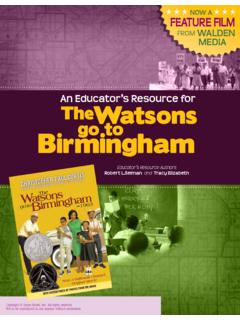
Transcription of An Educator’s Resource for
1 FROM WALDEN MEDIANOW AFEATURE FILMC opyright Zaner-Bloser, Inc. All rights reserved. Not to be reproduced in any manner without Educator s Resource forEducator s Resource Authors Robert and Tracy ElizabethVoices is a registered trademark of Zaner-Bloser, Inc., a subsidiary of Highlights for Children. Copyright Zaner-Bloser, Inc. All rights reserved. Not to be reproduced in any manner without more information, contact Zaner-Bloser at (8:00 am to 6:00 pm EST, Monday Friday) or visit the Zaner-Bloser website: L. SELMAN is the Roy E. Larsen Professor of Human Development and Education and Professor of Psychology in Psychiatry at Harvard University; 609 Larsen Hall, 14 Appian Way, Cambridge, MA 02478; email: He conducts research on social development and its integration with curriculum and instruction in elementary and secondary schools and with social media, including websites, social networking, and ELIZABETH is a doctoral student in the Human Development and Education program at Harvard University; 611 Larsen Hall, 14 Appian Way, Cambridge, MA 02478.
2 Email: Her research focuses on the promotion of children and adolescents academic, social, and moral development through education curricula and entertainment media. Starring Tony-winning and Grammy-nominated actress Anika Noni Rose and three-time Tony nominee David Alan Grier, the film is an adaptation of Christopher Paul Curtis Newbery Honor and Coretta Scott King Honor Award winning book The Watsons Go To Birmingham 1963. Skai Jackson, LaTanya Richardson, Wood Harris, Bryce Jenkins and Harrison Knight also is faithfully adapted by acclaimed children s book author and screenwriter Tonya Lewis Lee. The film is produced by Ms. Lee and Nikki Silver and is directed by Tony Award nominee Kenny this fall from Walden Family Theater, The Watsons Go to Birmingham is the tale of a summer journey that leaves a family and a nation forever by Walden Media, ARC Entertainment and Tonik Productions, LLC, in association with Walmart and P&G, The Watsons Go to Birmingham premieres September 20, 2013 on the Hallmark Channel.
3 Table of ContentsAbout VoicesAbout the BookAbout the Educator's Resource8 About Voices 8 Voices & Literacy Reading Comprehension Writing Vocabulary & Literary Analysis Oral Language, Listening, & Fluency Self and Social Awareness Development: Core Awareness, Skills, and Values10 The Voices Instructional Plan for The Watsons10 Instructional Formats11 Additional Resources in the Guide12 About the Book 12 Story Summary 13 About the Author 13 Historical Context 17 Awards and Honors 18 About the Educator s Resource18 Exploring the Central Theme19 Developing Literacy Skills 19 Promoting Self and Social Development20 Unit Planner for The Watsons Go to Birmingham 196322 Academic Language for The Watsons4 Table of ContentsUnit Plan for The Watsons24 Lesson #1: Family Relationships Chapter 1: Pages 1-1930 Lesson #2: Accepting Differences Chapter 2: Pages 20-3135 Lesson #3.
4 Friendship & Forgiving Chapter 3: Pages 32-4640 Lesson #4: Empathy & Conflict Resolution Chapter 4: Pages 47-6345 Lesson #5: Choices & Consequences Chapter 5: Pages 64-7450 Lesson #6: Empathy & Understanding Chapter 6: Pages 75-8555 Lesson #7: Choices & Consequences Chapter 7: Pages 86-9960 Lesson #8: Family Relationships Chapter 8: Pages 100-12065 Lesson #9: Culture & Conflict Chapter 9: Pages 121-13769 Lesson #10: Fears & Differences Chapter 10: Pages 138-14874 Lesson #11: Family Dynamics & Perspectives Chapter 11: Pages 149-16179 Lesson #12: Community & Culture Chapter 12: Pages 162-16883 Lesson #13: Risk & Identity Chapter 13: Pages 169-17988 Lesson #14: Acceptance & Adversity Chapter 14: Pages 180-19093 Lesson #15: Courage & Compromise Chapter 15: Pages 191-2065 Table of ContentsReader s Movie Theater for The Watsons Go to Birmingham199 Reader s Movie Theater for The Watsons Go to Birmingham100 The Three-E Framework for using Readers Theater in Media Educational Opportunities Entertainment Opportunities Ethical Opportunities101 A Note on a Developmental Difference in the Book and in the Film102 Text to Film Lesson 1: Scene 11104 Text to Film Lesson 2: Scenes 11-13108 Text to Film Lesson 3: Scene 56112 Text to Film Lesson 4.
5 Scenes 58 & 59115 Text to Film Lesson 5: Scene 66 Appendices2120 Appendix A: Reading Formats & Their Benefits121 Appendix B: Recommendations for Discussion Activities123 Appendix C: Strategies for Facilitating Healthy Discussions127 Appendix D: 4 Little Girls Video Connection Activity128 Appendix E: Historical Resources1 This section is original material, copyright Selman and Elizabeth2 This section is original material, copyright Elizabeth6 About VoicesAbout the BookAbout The Educator s Resource7 About VoicesReading ComprehensionAbout VoicesIn this guide, students learn, practice, and apply both simple and deep comprehension strategies that help deepen their understanding of the text. The instructional plan leads to the gradual transfer of responsibility from educator to student through these steps:The Educator s Resource suggests writing activities that encourage students to express their thoughts, opinions, and ideas across a range of writing genres and to demonstrate their understanding of the social development themes within the expand their vocabulary by relating vocabulary words to the mood, plot, characters, and setting of the story.
6 This guide also features vocabulary words that give students a common understanding of academic language crucial for understanding and discussing the thematic social development concepts they encounter in the Language & Literary AnalysisThe Voices approach to the promotion of literacy, self and social uses theory and evidence based research (Selman, 20033; Snow, 20094) to develop Resource guides for children s and young adult literature that encourages young people to develop their own voice. These innovative materials feature award-winning multicultural texts and comprehensive Educator Resources that integrate social and moral development, character education, violence prevention, social and emotional learning, literacy, reading comprehension, and & Literacy3 Selman, R.
7 L. (2003). The promotion of social awareness: Powerful lessons from the partnership of developmental theory and classroom practice. New York, NY: Russell Sage , C., Lawrence, J., & White, C. (2009). Generating knowledge of academic language among urban middle school students. Journal of Research on Educational Effectiveness, 2(4), 325 VoicesSelf and Social Development: Core Awareness, Skills, and ValuesSix thematic concepts are embedded in this Special Edition Resource to help students develop self-understanding, enhance their social-emotional skills, value their family, friends, and community, and strengthen their understanding and appreciation of & Cultural Identity Awareness Students explore who they are and how to integrate the various parts of their lives into a healthy self-concept within the culture in which they are growing Taking & Coordination Skills Students learn to express their own points of view and to take the perspectives of their peers and the characters from the literature they Conflict Resolution Skills Building on Perspective Taking, students learn ways to resolve conflicts with their peers and in society.
8 Family, Friends, & Community Values Students gain insight into the nature of their relationships with friends, family members, and & Civic Awareness Students develop their awareness of social and civic realities, cultural differences, and injustices that need to be : Freedom & Responsibility Values Students reflect and act upon their social responsibilities in a democratic Language, Listening, & FluencyOral language development, or oral literacy, involves fluency in speaking and listening, and both are related to improved text comprehension. Through activities such as partner sharing, paired reading, reader s theater, classroom discussion and debate, and others, students deepen their understanding of themselves, of others, and of the VoicesConnect This section suggests activities that introduce the students to the essential themes of the chapter, provides students with the social and historical context of the story, and gives students and the educator the opportunity to connect their own personal experiences to the issues raised in the This section of the lesson is critical to the students understanding of the story and how the story connects to their lives.
9 It is up to the educator to determine the most appropriate reading format for the students. Appendix A offers a list of possible reading formats and their respective literacy benefits. Discuss This section suggests open-ended critical thinking questions and discussion-based activities designed to deepen students comprehension of the content and broaden their perspectives about social issues addressed in the text. For more information, please see Appendices B & This section suggests writing prompts that deepen students reflections on critical issues in the story and how those issues may be resolved or contemplated using prosocial strategies like empathy, self-awareness, and perspective taking.
10 Reflect Through a variety of oral prompts, this section encourages students to develop their own reflective capacity by likening complicated events in the text to their own lives and greater community. The exercises encourage students to reflect upon the personal and social meaning of what they have read, heard, and discussed with their Voices Instructional Plan For The WatsonsThis Educator s Resource is organized around a Central Theme related to the primary themes of the book. Each of the following five Instructional Formats promote the Central Theme of the story, while also promoting literacy skills, social and emotional learning, and civic awareness. In the Resource , specific methods to implement these Instructional Formats are provided for each of the fifteen lessons that are aligned with each of the fifteen chapters of The Watsons Go to Birmingham Formats10