Transcription of An introduction to controlled groups - Kravitz, Inc.
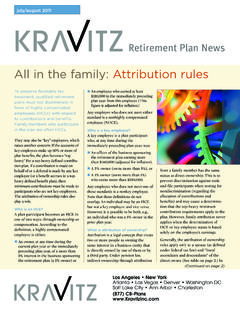
1 The controlled group rules wereadopted as part of the coverageand nondiscrimination regulationsto ensure that a plan (or plans)maintained by an employer doesnot discriminate in favor of highlycompensated employees (HCEs).A controlled group is considereda single employer for purposes ofa qualified plan. A controlled group of business entitiescan exist when one business owns acontrolling interest in another businessor when five or fewer individuals haveownership interests in two or more busi-nesses. In service industries, such asmedical practices and accounting,engineering, and consulting firms (amongothers), a controlled group can exist whenan element of control exists and two ormore entities are regularly associatedin providing services to third parties.
2 controlled group of corporations A controlled group of corporationsincludes a parent-subsidiary controlledgroup, a brother-sister controlled group ,or a combination of the two. PPaarreenntt--ssuubbssiiddiiaarryy ggrroouupp::A controlledgroup exists if one corporation owns an 80% or more interest in anothercorporation. The situation is a bit morecomplex where a holding companyexists and the ownership interest itholds in other companies varies. Control is determined by two criteria: At least 80% of each entity s interestmust be owned by the commonparent or by one or more of theother businesses, and The common parent must own atleast an 80% interest in one or moreof the other organizations.
3 The 80% ownership threshold isdetermined either by owning stockwith 80% of the voting power of allclasses entitled to vote or owning 80%of the total value of all shares of allclasses of stock. (See Example 1.)BBrrootthheerr--ssiisstteerr ggrroouupp:: Two or moreorganizations are within a brother-sister group if: The same five or fewer shareholders(individuals, estates, or trusts) own atleast an 80% controlling interest ineach company, and The same five or fewer shareholdershave an identical ownership amongall companies which, in the aggregate,is more than 50%.
4 In determining which five shareholders toconsider, certain family members may beaggregated and treated as one shareholder. If stockholder 1 owns 50% of Company A,20% of B, and 10% of C, his identicalownership in all three companies is the smallest percentage he owns in anyone, or 10%. Stockholder 2 owns 25% ofCompany A, 20% of B, and 15% of C,resulting in an identical ownership of15%. In the aggregate, stockholders 1 and2 have an identical ownership of 25%.march/april 2010(Continued on page 2)An introduction to controlled groups55%80%Bank Holding Company A100%Bank CBank DBank B100%40%MortgageGroup FTravelAgency EControlled group 1: Companies A, C, and DControlled group 2: Companies B and EExample 1: Parent-subsidiary groupOwnership in companyStockholder Co.
5 A Co. B Co. CIdenticalOwnership150% 20% 10%10%225% 20% 15%15%25%Example 2: Brother-sister groupLos Angeles Atlanta Las Vegas Denver Washington DC Salt Lake City Ann Arbor Minneapolis Charlestontel fax Plan NewsThere is no controlled group amongCompanies A, B, and C, since the identicalownership is less than 50%. However, whenlooking at just Companies B and C, there is adifferent is a controlled group among CompaniesB and C, since the three stockholders togetherown more than 80% of B and C and theiridentical ownership is greater than 50%.
6 CCoommbbiinneedd ggrroouupp:: Three or more corpora-tions are a controlled group if each is amember of a parent-subsidiary or brother-sister group of corporations and one is:A. A common parent corporation included in a parent-subsidiary group and B. Is also included in a brother-sister groupof individual stockholder owns 80% ofCorporation X and 85% of Corporation Y, thusforming a brother-sister controlled group . Y owns 100% of Corporation Z, thus forminga parent-subsidiary controlled group . Since Y is the parent in a parent-subsidiary groupand is also part of a brother-sister group , acombined controlled group exists between X, Y, and , proprietorships, etc.
7 The statute provides that rules similar tothose prescribed for a controlled group ofcorporations are applicable to a controlledgroup of unincorporated groups (Continued from page 1)An IRArollover a participant roll over a traditional IRA into a 401(k) accountto delay his or her required beginning date (the date requiredminimum distributions RMDs begin)? the following situation, yes. An IRA account holder, age 71, is working and participating in a401(k) plan that accepts rollovers from traditional IRAs.
8 Theparticipant is not a 5% owner of the entity sponsoring the plan. Theplan permits non-5% owners to defer the required beginning datefor taking required minimum distributions until the later of: (1) April 1 of the year following the year the participant reachesage 70 or (2) April 1 of the year following the year the participant terminatesemployment with the employer. IRS guidance (Revenue Ruling 2004-12) permits assets that are rolledover from a traditional IRA to receive the same treatment as the otherfunds in a 401(k).
9 The IRA owner in this scenario must take an RMDfrom the IRA for the current year beforethe rollover is made. Then,the rest of the IRA assets may be rolled over into the 401(k). Once therollover is completed, the required beginning date for taking RMDsfrom the funds rolled over from the traditional IRA is deferred untilApril 1 of the year following the year the participant terminatesemployment with the employer, just like the other 401(k) funds. TThhee RRootthh The participant also has the option of converting atraditional IRA to a Roth IRA.
10 * Roth IRAs are not subject to RMDs. Ofcourse, a Roth IRA conversion would require the participant to paytaxes on the amount converted. Ordinarily, taxes are due the year ofthe conversion. However, taxpayers that complete Roth IRA conver-sions in 2010 have the option of paying tax on half the convertedamount in 2011 and the other half in 2012. NNoottee::While it would seem to make sense to split the amount and paytax in later years, it is important to look at the individual s tax lower tax rates enacted in 2001 are set to expire at the end of2010.