Transcription of An Overview Higher Education
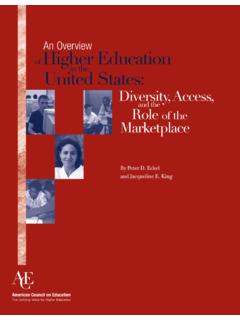
1 An Overview Diversity, Access,United States:of Higher Educationin the American Council on EducationThe Unifying Voice for Higher Educationand the Role of the MarketplaceBy Peter D. Eckel and Jacqueline E. King American Council on EducationACE and the American Council on Education are registered marks of the American Council on Council on EducationOne Dupont Circle NWWashington, DC 20036 This publication originally appeared as a chapter in J. Forest and P. Altbach (Eds.), The International Handbook of Higher Education (two volumes), published by Springer. Available at part of this book may be reproduced or transmitted in any form or by any means electronic or mechanical, including photocopying, recording, or by any information storage and retrieval system, without permission in writing from the .. iiiThe Distinctive Characteristics of Higher Education .
2 1 Size and Composition of Higher Education .. 1 Governance .. 3 Finance .. 5 Students.. 7 The Curriculum and Degrees .. 9 Faculty and Their Appointments .. 10 University Administration .. 11 Student Life and Athletics .. 12 Current Challenges Confronting Higher Education .. 15 The Marketplace (Not Government) as Key External Driver .. 15 Higher Education as an Engine of Mobility .. 16 Other Current Issues .. 17 Conclusion .. 19 References .. 20 Table of Contentshigher Education borrows its structure from both the British undergraduate college and German research university, but itscharacter is profoundly inf luenced by three major philosophicalbeliefs that shape American public by the Jeffersonian ideals of limitedgovernment and freedom of expression, states, religious communities, and individualsestablished and maintain a range of Higher Education institutions and continue to protectthese institutions from the levels of government control seen in most other second set of inf luences is capitalism and the belief in the rationality of colleges and universities vie for students, faculty, and funding under theassumption that diversity and high quality are best achieved through competition ratherthan centralized planning.
3 The final major philosophical inf luence on American highereducation is a widespread commitment to equal opportunity and social mobility. Highereducation was an elite activity for much of its history, excluding individuals based on gender, religion, race/ethnicity, and social class. However, during the 20th century, economic and social changes transformed Higher Education into a primary gateway to themiddle-class, and women and minorities made inroads against longstanding exclusionfrom mainstream Higher Education . Americans came to view broad access to Higher Education as a necessary component of the nation s ideal as a land of opportunity. Higher Education responded by broadening access. Indeed, the one uniquely Americantype of institution the community college was founded in the 20th century to ensureopen access to Higher Education for individuals of all ages, preparation levels, and by these beliefs, Higher Education ref lects essential elements of theAmerican character: independence, suspicion of government, ambition, inclusiveness,and competitiveness.
4 This publication describes the major characteristics of Americanhigher Education and important issues that challenge it, linking back as appropriate tothese essential philosophical Council on EducationiiiIntroduction1In the United States, several important terms differ in meaning from most of the rest of the world. The term collegerefers to an institution that typicallyawards only undergraduate degrees. The term facultycan refer either to an individual professor or to all instructors ( , The Harvard faculty approveda new degree program. ) Council on Education1ecause American Higher educa-tion is so diverse and complex,any description of standardpractice inevitably misstatesmuch about individual collegesand universities . Indeed, important exceptions to most of the characteristicsdescribed in this paper exist. Nonetheless,this section provides an Overview of howmost colleges and universities are governedand financed, their students and faculty,and the nature of the curriculum and student and Composition of Higher EducationIn addition to diversity, autonomy, com-petition, and accessibility, size is a distin-guishing feature of Higher Department of Education counts6,500 postsecondary institutions that participate in its student financial aid programs, including 4,200 colleges anduniversities that award degrees and 2,300institutions that award vocational certifi-cates.
5 These 6,500 institutions enrolledapproximately 16 million full- and part-time students, including 14 million under-graduates and 2 million graduate and professional students, in fall 2001. The4,200 colleges and universities awardedmore than million degrees in academicyear 2000 01. In addition, an untold number of other institutions offer post-secondary instruction of some typebut do not choose to participate in the The Distinctive Characteristics Higher EducationBfederal student aid programs and thereforeare not counted by the federal government( Department of Education , 2003).Degree-granting institutions are typically divided into four major groups,and a considerable amount of diversityexists within each group: America s 1,100 public two-year insti-tutions, or community colleges, enrollthe largest share of undergraduates (6 million students in 2001).
6 Theseinstitutions award associate degrees invocational fields, prepare students fortransfer to four-year institutions, andserve their communities by providing awide array of educational services range from specializedtraining for large employers, to Englishlanguage instruction for recent immi-grants, to recreational courses. Almost4 million students attended communitycolleges part-time in 2001. The does not track enrollmentfigures for noncredit adult Education orrecreational courses, but the AmericanAssociation of Community Collegesestimates that an additional 5 millionstudents enroll in these types of coursesat community colleges every year. There are only 630 public four-year colleges and universities in the UnitedStates. But these institutions whichinclude regional comprehensive universities that concentrate on under-graduate teaching and graduate preparation in professional fields such2AN Overview OF Higher Education IN THE UNITED STATESas teaching and business, as well asresearch universities that offer a comprehensive set of undergraduate,graduate, and professional degree programs enrolled million students in 2001.
7 This figure includes 5 million undergraduates and slightlymore than 1 million graduate Private not-for-profit institutions areextremely diverse, including researchuniversities, four-year liberal arts colleges that focus on undergraduateteaching, a small number of two-yearinstitutions, faith-based institutionsthat maintain strong links with religious denominations, women s colleges, historically black colleges and universities , and specialized institutions that focus on a single field,such as nursing or fine arts. Privatenot-for-profit institutions enrolled million students in 2001, million undergraduates and morethan 700,000 graduate students. For-profit institutions primarily offervocational programs that result in certificates rather than degrees. Of themore than 2,400 for-profit institutionscounted by the Department ofEducation, 500 offer two-year associatedegrees and 320 offer bachelor sand/or graduate degrees.
8 In total, for-profit institutions enrolled morethan 750,000 students in 2001, all but 50,000 of whom were at the undergraduate level. Table 1 provides an Overview of enroll-ment in each of these four sectors. Thislarge number and wide range of institu-tions offer both access and choice twohallmarks of American Higher educationthat respond to the previously describedvalue placed on opportunity and faith inthe 1. Postsecondary Institutions and Enrollments: Fall 2001 PublicPrivate Private TotalNot-for-ProfitFor-ProfitInstitution s2,0991,9412,4186,458 Four-Year6291,5673242,520 Two-Year1,1652697792,213 Less than Two-Year3051051,3151,725 Enrollment12,370,0793,198,354765,70116,3 34,134 Four-Year6,236,4863,120,472321,4689,678, 426 Two-Year6,047,44563,207241,6176,352,269 Less than Two-Year86,14814,675202,616303,4392 The number of graduate and undergraduate students does not add to the total number of students because some students may take courses outside aformal degree program and, in other cases, the degree level of students was not Council on Education3 GovernanceAnother of the philosophical underpin-nings of Higher Education is theJeffersonian notion of limited and, whenever possible, locally controlled government.
9 Based on this model, the Constitution reserves for the states all government functions not specificallydescribed as federal. Among those func-tions is Education . As a result, each of the50 states is responsible for governing public colleges and universities (whichenroll 75 percent of students), rather thanthe federal government. The degree ofcontrol by the states varies institutions, such as the Universityof California and the University ofMichigan, enjoy constitutional autonomyas separate branches of state the other extreme, locally electedboards of trustees govern some commu-nity colleges. In some states, a governingboard appointed by the governor and/orlegislature oversees all institutions, settingfunding levels, establishing accountabilitymeasures, setting policies, and approvingnew academic programs. In others, thestate board plays only an advisory functionand has little direct authority over institu-tions.
10 In many others, a state agency ispoised between the institutions and stategovernment, implementing statewide policy but also attempting to insulate institutions from ill-advised or overlyintrusive state public universities are part of statewide multi-campus systems inwhich an additional layer of oversightexists between the campus and state government. System administrators mayoversee campus budgets, set policies such as admissions standards, coordinatedegree programs, and facilitate credittransfer and articulation between thestate s public colleges and , and importantly, they advocate to the legislature on behalf ofpublic colleges and universities . In somestates, more than one multi-campus system exists, such as California s distinctsystems of community colleges, compre-hensive state colleges and universities ,and research the Constitution does notmention Education as a federal responsi-bility, the federal government plays a lim-ited role and the United States has neverhad an Education ministry, such as thosefound in most other countries.