Transcription of Analysis and Comparison of Project Management Standards ...
1 Analysis and Comparison of Project Management Standards and Guides Rui XUE1, a *, Claude Baron1, b , Philippe ESTEBAN1,c and Li ZHENG1,d 1 CNRS, LAAS, 7 av. du colonel. Roche, F-31400 Toulouse, France { , , , Keywords: Project Management ; Standards ; guides; references; pmbok ; ISO 21500; ISO/IEC 29110. Abstract. With the increasing scale of systems and products, many large companies ask different suppliers to manufacture the components of the final systems or products. Thus, managing projects dedicated to complex systems engineering is very tricky and ensuring the success of projects is a real issue. Many Project Management tools, techniques and even Standards or guides have been developed by different organizations in order to support the Management of such projects. For Project managers, selecting and relying on immediately operational methods, tools and references ( Standards and guides) for a Project manager to lead his Project represents a true difficulty.}
2 The purpose of this paper is to introduce, analyze and compare the most famous Project Management references ( pmbok , ISO 21500 and ISO/IEC 29110) to provide a global and a detailed views on Project Management methodological guidelines, in order to facilitate the choice of a Project Management reference to help the Project manager to manage the Project effectively, thus to improve the success rate of projects. Introduction Project Management (PM) plays a critical role in the implementation of projects in all the organizations or companies, wherever they are small or large. Using PM methods and tools cannot ensure the success of a Project , but it can improve its chances of success. PM has been practiced for thousands of years that can be dated back to the Great Pyramid of Giza [1,2]. Many methods and tools have been developed since and are now available and routinely used by projects managers.
3 Among them, the Gantt chart, the Critical Path Method (CPM), the Work Breakdown Structure (WBS) and the Earned Value Management (EVM) [3]. If some methods for developing systems are easier to manage than others and some more likely to succeed, particularly in large-scale projects, using Project Management references, Standards or compendiums of good practices, is also a way to support and guide Project Management [4,5]. The first PM reference was the pmbok guide , a guide to the Project Management Body of Knowledge; it was published by Project Management Institute (PMI) in 1987; the fifth version was edited in 2013 [6]. The ISO 21500 Standard for Project Management is a standard developed by ISO (International Organization for Standardization) from 2007, later released in the September 2012 [7]. The last international standard is the ISO/IEC 29110 elaborated by the sub-committee 7 of Joint Technical Committee 1 of the ISO and IEC (International Electrotechnical Commission) and dedicated to the very small entities [8].
4 It was first published in 2012. For Project managers, determining which standard or guide is more suitable for their projects means spending a lot of time to read, analyze and compare these three references. So the purpose of this paper is to make this Analysis and to compare the three Project Management Standards or guides to help the Project managers to facilitate their selection. The current situation in the domain of PM is stated in section 2. Section 3 briefly introduces and compares the three PM references. A conclusion on the Comparison of them is given in section manuscripts must be in English, also the table and figure texts, otherwise we cannot publish your paper. Current situation Recent Advances on Mechanics, Materials, Mechanical Engineering and Chemical EngineeringISBN: 978-1-61804-295-815 History and definition of Project Management .
5 The Great Pyramid of Giza, the Colosseum in Rome and the Great Wall of China are testimonies of successful construction projects. In the 2570 s BC, the ancient records show that there were managers for each of the four faces for the Great Pyramid when they were built. According to historical data, the labor force was organized into three groups: soldiers, common people and criminals when the Great Wall of China was built [9]. The origins of the theory of Project Management correspond with the development of Gantt chart, named by the creator Henry Gantt, in 1917. It is the forefather of Project Management . In the 1950s, the Navy employed the modern Project Management methodologies in their Polaris Project . During the 1960s and 1970s, many methods or tools were developed, for instance, the CPM, Program Evaluation Review Technique (PERT) and WBS.
6 At the same time, a lot of organizations were built to promote the methodology of Project Management , such as the American Association of Cost Engineers (AACE), the International Project Management Association (IPMA) and the PMI. Indeed, PM covers a wide field of applications where associations historically played and still play an important role [1,9]. Many organizations define what Project Management is. The PMI states that Project Management is the application of knowledge, skills, tools, and techniques to Project activities to meet the Project requirements [6]. The ISO 21500 defines the PM this way: Project Management is the application of methods, tools, techniques and competencies to a Project [7]. The definition of PMI emphasizes the purpose of PM is to meet the Project requirements. The application of Project Management can meet the requirements better; short the cost and time to finish the Project [6,7].
7 Evolution of Project Management references. Many Standards or guides were developed by the different organizations from the 1987 s. pmbok guide was first published as a white paper by PMI in 1987; it was an attempt to document and standardize Project Management practices [6]. The first edition appeared in 1996, the second edition in 2000, a third in 2004, a fourth in 2009 and the last version in 2013. In 2012, the International Organization for Standardization (ISO) recognized the importance of formalizing the practices of Project Management ; they published the standard ISO 21500 in 2012 [7]. Last but not least, another standard for Project Management , focusing on very little companies, ISO/IEC 29110, appeared in also appeared at the same date [8]. Next section introduces the three Project Management Standards or guide .
8 Analysis and Comparison of Project Management Standards and guides This section introduces the three Project Management references then analyzes, compares and aligns them. Introduction of the three references pmbok . With the development of Project Management , the pmbok has been released many times from 1996 to now. This guide aims at providing knowledge, processes, skills, tools and techniques that have a significant impact on the Project success [6]. The first part of this guide provides the subset of the Project Management body of knowledge that is generally recognized as good practices. It defines 47 processes in the first part of this guide into 10 Knowledge Areas (KA) about the professional field, Project Management field or area of specialization, such as the Project scope Management and Project cost Management .
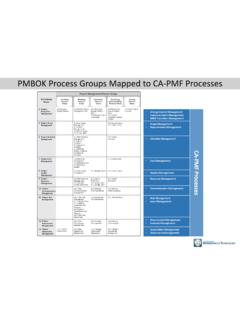
9 In the second part, this guide re-groups the processes to form a Project Management standard. It defines the five process groups based on the five stages of the Project implementation: initiating process group, planning process group, executing process group, monitoring and controlling process groups and closing process groups [6]. It details the input, tools and techniques, output and the data flow diagram of each process in the ten KA. At each stage of the systems engineering (SE), one can use all or part of the five process groups; any set of processes can also be reused for any stage of SE. Recent Advances on Mechanics, Materials, Mechanical Engineering and Chemical EngineeringISBN: 978-1-61804-295-816 It defines a table that provides the Project Management process group and knowledge area mapping for the readers in order to help them better under the processes.
10 The Fig. 1 shows the structure of pmbok . Fig. 1 structure of pmbok ISO 21500. Like the PMI, the ISO organization also recognized the importance of improving the performance of Project Management in order to enhance the competition of companies, and published the ISO 21500 Guidance in Project Management in 2012 [7]. It is an international standard on Project Management . The ISO started to edit this standard from 2007 and finished in 2012. This guide aims to provide guidance for Project Management and can be used by any type of organizations. It defines 39 processes that group into 5 process groups (like the 5 process groups of pmbok ) and 10 groups of subject (like the 10 KAs of pmbok ). The five process groups can be used at any stage or sub- Project or throughout the Project . Each process contains the purpose, input and output (deliverable, a result, a document.)