Transcription of Animal Physiology, Third Edition - sinauer.com
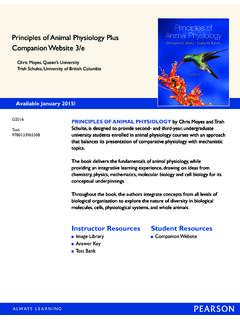
1 ANIMALPHYSIOLOGYTHIRD EDITIONR ichard W. HillMichigan State UniversityGordon A. WyseUniversity of Massachusetts, AmherstMargaret AndersonSmith CollegeSinauer Associates, Inc. Publishers Sunderland, iii3/13/12 2:26 PM3/13/12 2:26 PM Sinauer Associates, Inc. This material cannot be copied, reproduced, manufactured or disseminated in any form without express written permission from the IFundamentals of physiology 11 Animals and Environments: Function on the Ecological Stage 32 Molecules and Cells in Animal physiology 313 Genomics, Proteomics, and Related Approaches to physiology 674 Physiological Development and Epigenetics 85 5 Transport of Solutes and Water 99 PART IIFood, Energy, and Temperature 1256 Nutrition, Feeding, and Digestion 1277 Energy Metabolism 1618 Aerobic and Anaerobic Forms of Metabolism 1839 The Energetics of Aerobic Activity 20710 Thermal Relations 22511 Food, Energy, and Temperature at Work.
2 The Lives of Mammals in Frigid Places 277 PART IIII ntegrating Systems 29312 Neurons 29513 Synapses 327 14 Sensory Processes 359 15 Nervous System Organization and Biological Clocks 397 16 Endocrine and Neuroendocrine physiology 419 17 Reproduction 455 18 Integrating Systems at Work: Animal Navigation 485 PART IVMovement and Muscle 50119 Control of Movement: The Motor Bases of Animal Behavior 503 20 Muscle 523 21 Movement and Muscle at Work: Plasticity in Response to Use and Disuse 549 PART VOxygen, Carbon Dioxide, and Internal Transport 56722 Introduction to Oxygen and Carbon Dioxide physiology 56923 External Respiration: The physiology of Breathing 58324 Transport of Oxygen and Carbon Dioxide in Body Fluids (with an Introduction to Acid-Base physiology ) 61725 Circulation 64726 Oxygen, Carbon Dioxide, and Internal Transport at Work: Diving by Marine Mammals 679 PART VIWater, Salts, and Excretion 697 27 Water and Salt physiology .
3 Introduction and Mechanisms 699 28 Water and Salt physiology of Animals in Their Environments 717 29 Kidneys and Excretion (with Notes on Nitrogen Excretion) 753 30 Water, Salts, and Excretion at Work: Mammals of Deserts and Dry Savannas 787 Brief xiii3/9/12 2:11 PM3/9/12 2:11 PM Sinauer Associates, Inc. This material cannot be copied, reproduced, manufactured or disseminated in any form without express written permission from the 1 Animals and Environments: Function on the Ecological Stage 3 The Importance of physiology 4 Mechanism and Origin: physiology s Two Central Questions 5 The study of mechanism: How do modern-day animals carry out their functions?
4 5 The study of origin: Why do modern-day animals possess the mechanisms they do? 7 Natural selection is a key process of evolutionary origin 8 Mechanism and adaptive significance are distinct concepts that do not imply each other 8 This Book s Approach to physiology 10 Animals 11 The structural property of an Animal that persists through time is its organization 11 Most cells of an Animal are exposed to the internal environment, not the external environment 11 The internal environment may be permitted to vary when the external environment changes.
5 Or it may be kept constant 12 Homeostasis in the lives of animals: Internal constancy is often critical for proper function 12 BOX Negative Feedback 13 Time in the lives of animals: physiology changes in five time frames 14 BOX The Evolution of Phenotypic Plasticity 16 Size in the lives of animals: Body size is one of an Animal s most important traits 16 Environments 18 Earth s major physical and chemical environments 18 The environment an Animal occupies is often a microenvironment or microclimate 22 Animals often modify their own environments 23 Evolutionary Processes 24 Some processes of evolution are adaptive, others are not 24A trait is not an adaptation merely because it exists 25 Adaptation is studied as an empirical science 25 Evolutionary potential can be high or low.
6 Depending on available genetic variation 27 CHAPTER 2 Molecules and Cells in Animal physiology 31 Cell Membranes and Intracellular Membranes 32 The lipids of membranes are structured, diverse, fluid, and responsive to some environmental factors 33 Proteins endow membranes with numerous functional capacities 35 BOX Protein Structure and the Bonds That Maintain It 35 Carbohydrates play important roles in membranes 36 Epithelia 37 Elements of Metabolism 40 Enzyme Fundamentals 40 Enzyme-catalyzed reactions exhibit hyperbolic or sigmoid kinetics 42 ContentsPART I Fundamentals of xiv3/9/12 2:11 PM3/9/12 2:11 PM Sinauer Associates, Inc.
7 This material cannot be copied, reproduced, manufactured or disseminated in any form without express written permission from the xvMaximum reaction velocity is determined by the amount and catalytic effectiveness of an enzyme 43 Enzyme substrate affinity affects reaction velocity at the substrate concentrations that are usual in cells 43 Enzymes undergo changes in molecular conformation and have specific binding sites that interact 44 Enzymes catalyze reversible reactions in both directions 45 Multiple molecular forms of enzymes occur at all levels of Animal organization
8 46 Regulation of Cell Function by Enzymes 47 The types and amounts of enzymes present depend on gene expression and enzyme degradation 48 Modulation of existing enzyme molecules permits fast regulation of cell function 48 Evolution of Enzymes 52 Enzymes Are Instruments of Change in All Time Frames 54 The Life and Death of Proteins 54 Light and Color 55 BOX Squid and Bioluminescent Bacteria, a Study in Cross-Phylum Coordination: The Euprymna scolopes Vibrio fischeri Symbiosis Margaret McFall-Ngai 57 Reception and Use of Signals by Cells 58 Extracellular signals initiate their effects by binding to receptor proteins 58 Cell signal transduction often entails sequences of amplifying effects 61 Several second-messenger systems participate in cell signal transduction 63 CHAPTER 3 Genomics, Proteomics.
9 And Related Approaches to physiology 67 Genomics 72 Genomics is inextricably linked with advanced methods of information processing 72 One overarching goal of genomics is to elucidate the evolution of genes and genomes 73A second overarching goal of genomics is to elucidate the current functioning of genes and genomes 73 Genomes must ultimately be related empirically to phenotypes 74 Top-down versus Bottom-up Approaches to the Study of physiology 75 Screening or Profiling as a Research Strategy 76 The Study of Gene Transcription.
10 Transcriptomics 76 Transcription profiling often identifies large numbers of genes that exhibit altered transcription in response to environmental or other conditions 78 Transcription profiling reveals that many genes routinely undergo daily cycles of transcription 78 Manipulations of protein synthesis can be used to clarify gene function 79 Proteomics 80 Metabolomics 82 CHAPTER 4 Physiological Development and Epigenetics 85 The physiology of Immature Animals Always Differs from That of Adults 86 Phenotypic Plasticity during Development 90 Environmental effects during development may arise from programmed responses to the environment or may be forced by chemical or physical necessity 91 Insect polyphenic development underlies some of the most dramatic cases of phenotypic plasticity 91 Epigenetics 93 Two major mechanisms of epigenetic marking are DNA methylation and covalent modification of histones 93 Epigenetic marking during an Animal s early development affects the Animal s lifelong phenotype 94 Epigenetic marks on paternal and maternal copies of